U-Haul Holding Company (UHAL): Supplier relationships and what they mean for investors
Thesis — U-Haul (AMERCO) operates a vertically integrated DIY moving and storage business that monetizes primarily through truck and trailer rentals, self‑storage, and retail sales of moving supplies, with ancillary revenue from fleet remarketing and related‑party transactions. The company’s cash flow depends on maintaining a large rental fleet and steady supply lines for trucks and parts; therefore, supplier dynamics and related‑party arrangements are direct operational levers for margins and utilization. For a concise supplier risk snapshot, see more at https://nullexposure.com/.
How U‑Haul makes money and why suppliers matter
AMERCO is a large U.S. and Canadian operator of moving trucks and self‑storage, with trailing twelve‑month revenue of roughly $6.0 billion and EBITDA near $774 million (latest reported). The core monetization model is simple: customers rent trucks and storage, pay for supplies and services, and U‑Haul refreshes fleet assets through depreciation and remarketing. The company’s profit margin and operating margin are thin relative to revenue (profit margin ~2.14%, operating margin ~2.55%), which makes supplier cost and availability a material input to near‑term earnings. Insider ownership is unusually high, and related‑party activity is a meaningful line item, which investors should monitor in supplier disclosure and contracts. Visit https://nullexposure.com/ for consolidated supplier intelligence.
Public supplier relationship uncovered: Ford
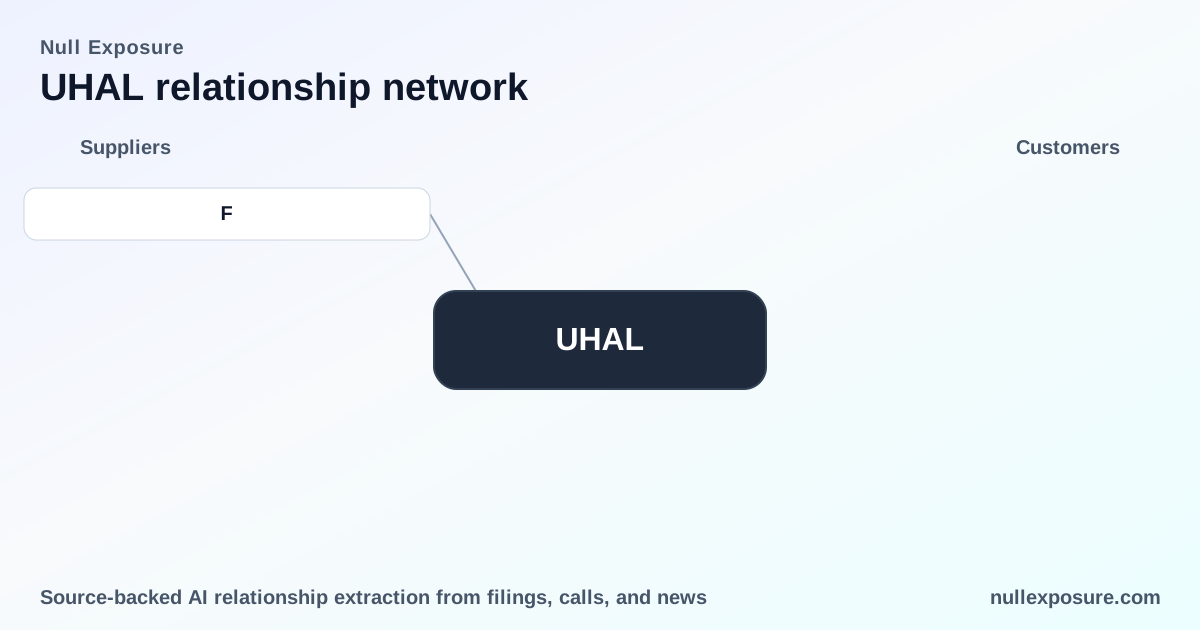
Ford has been identified in market reporting as a consequential equipment supplier. A March 2026 news report noted that Ford redirected capital allocation and eliminated the second shift at a truck plant U‑Haul relied on for over a decade, a change that directly affects a supplier channel U‑Haul has historically used (Zacks News, March 10, 2026). This is a single publicly surfaced relationship in the supplier results; the incident illustrates how OEM production decisions can transmit to rental availability and replacement timing for AMERCO’s fleet.
Constraints and what they reveal about the operating model
The company’s public disclosures and extracted constraints yield several company‑level signals about contracting posture, concentration, criticality, and maturity:
-
Large enterprise counterparties are standard. AMERCO discloses that it “enters into arrangements with counterparties that are significant financial institutions,” signaling a contracting posture that involves established, creditworthy counterparties and institutional counterparty terms (company filing language). This supports mature vendor negotiation dynamics but also ties U‑Haul to systemic financial counterparties.
-
Related‑party spend is nontrivial. Related‑party costs and expenses were $113.4 million in fiscal 2025, up from ~$90 million prior years, indicating substantive internal or affiliated economic flows that are material to expense lines and operational coordination. That level of related‑party activity signals complexity in commercial relationships and requires investor scrutiny of transfer pricing and governance (fiscal 2025 disclosure).
-
Manufacturing concentration exists. The company acknowledges it “obtains our rental trucks from a limited number of manufacturers,” which creates concentration risk in the supply base for core fleet assets; when an OEM changes production, U‑Haul’s fleet refresh cadence and replacement cost trajectory change.
-
Insurance/reinsurance exposure is minimal. Reinsurance recoverables were less than 1% of total assets as of March 31, 2025, described as immaterial based on historical loss experience and reinsurer credit quality. This is a company‑level signal that insurance counterparty risk is not a major vulnerability for capital recovery.
-
Scale of supplier spend is large. The firm’s related‑party cost band and manufacturing sourcing together place supplier spend well into the $100M+ range annually, meaning procurement policies and vendor stability are meaningful for cash flow and capex planning.
Collectively, these constraints describe a business that contracts with mature, large counterparties, relies on a narrow set of manufacturers for critical fleet assets, runs significant related‑party activity as part of operating flows, and carries limited reinsurance counterparty exposure.
What investors and operators should watch next
- Supply concentration and OEM production plans. The Ford example is a direct test case: OEM production shifts can reduce truck availability and drive up replacement or rental costs; monitor OEM capacity disclosures and plant shift announcements.
- Related‑party trends and governance. Track the trajectory of related‑party costs line‑by‑line in SEC filings and call transcripts to detect margin pressure or transfer pricing shifts. Company filings already show year‑over‑year growth in related‑party charges through fiscal 2025.
- Fleet remarketing and depreciation stress. Higher depreciation and losses on sales of retired rental equipment have impacted the bottom line in recent quarters, so supplier pricing and second‑hand market demand are immediate margin levers.
- Counterparty credit profile. Given the reliance on large financial counterparties for certain arrangements, investors should watch credit spread movements and bank counterparties’ health as an indirect supplier risk.
For an operational supplier map and continuous monitoring tools, go to https://nullexposure.com/ to see our consolidated view.
Quick, actionable checklist for investment diligence
- Confirm OEM concentration in the most recent annual report and note any single‑plant dependencies.
- Review the related‑party disclosure schedule and reconcile year‑over‑year shifts against gross margin movements.
- Model a shortfall scenario where a key manufacturer reduces output for 6–12 months and estimate utilization and replacement cost impacts on EBIT.
- Verify insurance recoverables and reinsurer ratings as part of downside capital recovery analysis (filings show reinsurance recoverable is immaterial vs. total assets).
Bottom line and recommended next steps
U‑Haul’s core revenue engine is simple but capital intensive, and supplier relationships—particularly OEM manufacturers—are strategic and operationally critical. The Ford supply disruption reported in March 2026 shows how quickly external capital allocation decisions at an OEM can propagate into rental availability and fleet economics. Investors and operators should prioritize monitoring manufacturer capacity, related‑party expense trends, and fleet remarketing results.
For deeper supplier intelligence and a consolidated supplier risk view for U‑Haul and peers, visit https://nullexposure.com/ — the quickest way to translate vendor signals into investment action.