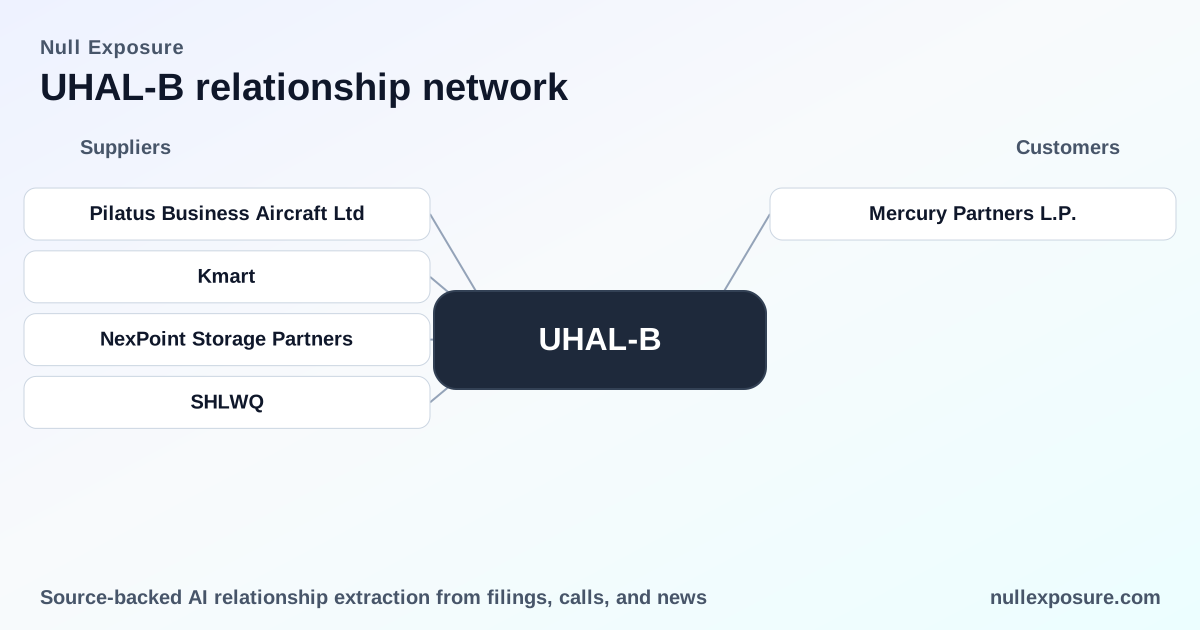
U-Haul Holding Company (UHAL-B): Supplier relationships that shape a capital-light storage and rental powerhouse
U-Haul monetizes a dual business model built on rental transportation and self-storage anchored by a large real-estate arm. The company generates free cash flow through truck and trailer rentals, interlinked self-storage revenues, and strategic property acquisitions and conversions executed by AMERICO Real Estate. Investors should read supplier relationships as extensions of that integrated model: vendor agreements and property purchases translate directly into network density, utilization leverage, and long‑term cash generation.
Explore supplier intelligence on Null Exposure
Operational and financial snapshot U-Haul is a sizeable, cash-generative operator: market capitalization roughly $8.15B, revenue about $6.0B TTM and EBITDA near $774M. The business shows low but positive margins (profit margin ~2.14%, operating margin ~2.55%) and a high trailing P/E (~90x), reflecting low earnings per share and a capital structure dominated by owner/insider holdings. These characteristics matter when assessing supplier exposure: the company relies on long-lived real estate and centralized operating leases to support its rental and storage footprint.
What the supplier relationships reveal about how U-Haul operates U-Haul’s supplier and counterparty interactions are consistent with an operator that pursues real estate as both an operating asset and a strategic acquisition target. Relationships in the public record show three themes:
- Real-estate acquisition and conversion: U-Haul’s AMERICO Real Estate actively acquires vacant retail properties and whole self-storage portfolios to densify its network.
- Selective, non-core asset purchases: The company opportunistically purchases assets from third parties (including alternative asset managers) to expand capacity.
- Occasional non-core capital deployments: U-Haul’s corporate family has transacted outside its core truck/storage business (for example, corporate aircraft acquisition for executive mobility), indicating flexibility in capital use.
These themes support a contracting posture that favors long-term leases and ownership, which preserves route density and stabilizes cash yields but increases exposure to real-estate cycle dynamics.
Constraints and what they imply about supplier risk The company-level signals in public disclosures identify three operating constraints that influence supplier relationships:
- Long-term contracting posture: U-Haul reports operating leases for storage locations with lease terms typically between 2 and 20 years, indicating suppliers and landlords are engaged under extended commitments that lock in network locations and reduce short-run site churn.
- Low materiality of reinsurance recoverables: Reinsurance recoverable was reported at less than 1% of total assets as of March 31, 2025, indicating reinsurance counterparty exposure is immaterial to the consolidated balance sheet.
- Service-provider role in insurance operations: The company’s insurance subsidiaries both assume and cede reinsurance, signaling U-Haul operates as a service provider in insurance flows rather than as a principal market-facing underwriter.
These constraints underline a mature, capital-intensive operating model: site control is prioritized through long leases or ownership, financial risk from reinsurance is de minimis, and insurance operations are handled within the corporate family’s service framework.
Detailed supplier and counterparty relationships you should know Below I summarize every relationship in the public results and link to the underlying reporting.
Pilatus Business Aircraft Ltd — corporate aircraft delivery U-Haul International took delivery of the first of two Pilatus PC‑24 Super Versatile Jets, reflecting a non‑core corporate aircraft acquisition for executive mobility and logistics. This transaction was reported during a delivery ceremony at Pilatus’s Colorado facility. Source: Corporate Jet Investor (FY2019) — https://www.corporatejetinvestor.com/news/u-haul-international-takes-delivery-of-the-first-of-two-pc-24s/
Kmart — opportunistic retail-property acquisitions AMERICO Real Estate, U-Haul’s real-estate arm, acquired thirteen vacant Kmart and Sears locations in a $62 million transaction, demonstrating the company’s strategy of repurposing distressed retail footprints for storage and service use. Source: WIFR report referencing Square Foot (FY2018) — https://www.wifr.com/content/news/U-Haul-takes-over-13-K-Mart-locations-including-Rockford-502096811.html
Sears — same transaction, same strategic play The Sears assets were part of the same thirteen-store portfolio acquired by AMERICO Real Estate, reinforcing the point that U-Haul sources large-box retail real estate to expand its storage and local rental network. Source: WIFR report referencing Square Foot (FY2018) — https://www.wifr.com/content/news/U-Haul-takes-over-13-K-Mart-locations-including-Rockford-502096811.html
NexPoint Storage Partners — portfolio purchase to scale storage capacity U-Haul acquired a four-property, 3,345-unit self-storage portfolio in the Midwest from NexPoint Storage Partners, illustrating the company’s roll-up approach to scale storage capacity through purchased portfolios rather than greenfield only. Source: REBusinessOnline (FY2024) — https://rebusinessonline.com/u-haul-acquires-3345-unit-self-storage-portfolio-in-midwest-plans-new-1150-unit-project-in-twin-cities/
How investors should weigh these relationships Each reported relationship reinforces a coherent operating playbook: acquire property, convert or operate storage, lock tenants/locations through long leases, and capture steady rental cash flow. From an investment perspective:
- Concentration and criticality: Real-estate sellers and storage portfolio vendors are strategically important for network growth but are not single points of failure; U-Haul uses many counterparties and owns a high share of its footprint. That diffuses supplier concentration risk.
- Maturity and contracting: The prevalence of multi‑year leases and portfolio acquisitions signals mature contracting — commitments are long-lived, which supports predictable revenues but raises sensitivity to local real-estate valuations.
- Operational leverage: Buying operating storage units from RE firms like NexPoint accelerates revenue scale and utilization, improving incremental operating margins over time if management executes on integration.
Key takeaways for portfolio and operations managers
- U-Haul is executing a real-estate-led growth strategy that converts retail vacancies and third-party portfolios into controlled storage and rental infrastructure. This is a direct lever for revenue growth and network defensibility.
- Long-term leases and ownership dampen short-term volatility but increase exposure to regional real estate cycles; monitor vacancies and regional rent trends where major acquisitions occurred.
- Counterparty risk is limited: reinsurance exposures are immaterial to the balance sheet, and property acquisitions come from standard market participants rather than concentrated single suppliers.
For deeper supplier mapping and to monitor new counterparties and constraints, Explore supplier intelligence on Null Exposure.
Conclusion: what this means for investors U-Haul’s supplier footprint reads as strategic and deliberate. The company uses property acquisitions and long-term leasing to secure density for its rental and storage economics, while keeping insurance counterparty exposure limited. Investors seeking exposure to stable, asset-backed rental cash flows should value U-Haul for its real-estate conversion capability and operational scale, while remaining attentive to the company’s capital allocation choices and local real-estate cycle risk.
To evaluate counterparties, contract terms, and how new acquisitions will affect cash flow dynamics, visit Null Exposure for ongoing supplier and constraint monitoring.