United Homes Group (UHG): Supplier relationships, capital posture, and what investors should watch
United Homes Group operates as a regional homebuilder that designs, builds and sells entry-level and first move-up homes in the Southeast, monetizing through the sale of completed homes and lot development activity. The company converts land and construction inputs into revenue—$406.7M in trailing twelve‑month revenue with $71.8M gross profit—while relying on third‑party trades, related‑party civil engineering and a small stable of advisors for financing and legal work. For investors and operators, the critical lens is how contracting posture, capital structure and supplier arrangements concentrate execution risk across short construction cycles and meaningful lot-deposit commitments. Learn more at https://nullexposure.com/.
Thesis: how supplier dynamics feed value and risk
United Homes’ business model is project-driven and cash-cycle sensitive: homes are built in under a year, sold to retail buyers, and the company replenishes inventory through lot purchases and pre‑acquisition work. Supplier relationships are operationally critical (trades and engineering) and strategically informative (external legal and financial advisors indicate corporate review activity). Capital commitments tied to lots—reported at roughly $48.2M of lot deposits plus $4.7M of capitalized pre‑acquisition costs—create concentrated counterparty exposure that suppliers and investors must treat as a central risk vector (company filings as of December 31, 2024).
Who UHG is working with now — advisors named in the press
-
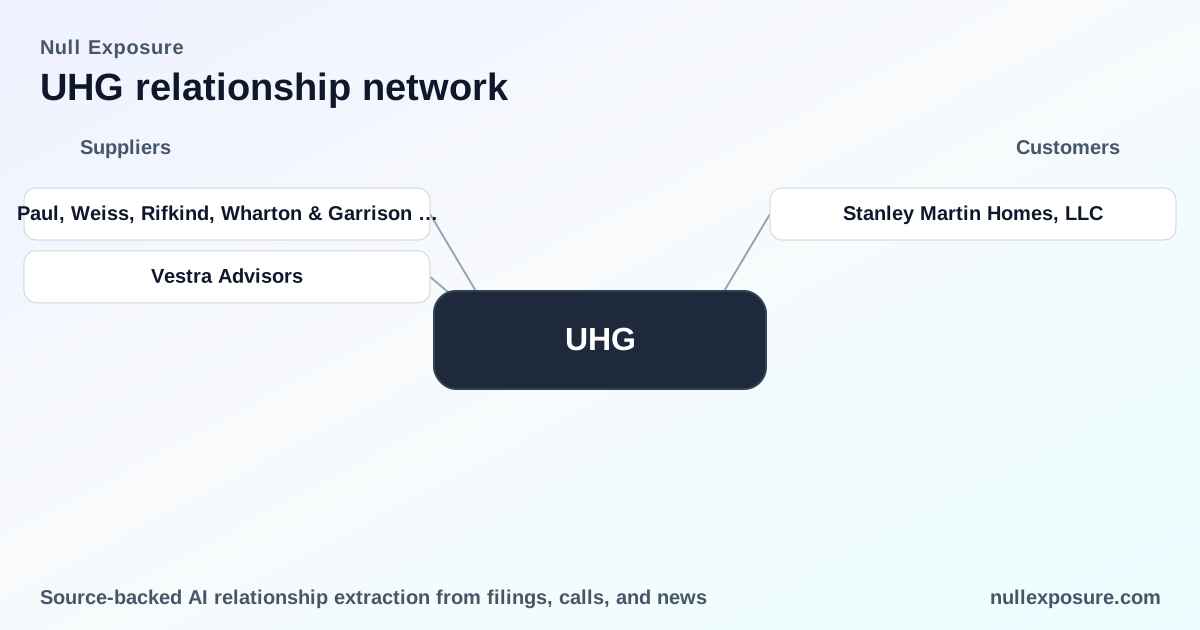
Paul, Weiss, Rifkind, Wharton & Garrison LLP is engaged as UHG’s legal advisor in connection with the company review; this engagement signals the company has retained top‑tier legal counsel for a material corporate process. Source: Yahoo Finance coverage of the company announcement (March 10, 2026) — https://finance.yahoo.com/news/united-homes-uhg-appoints-ceo-200049865.html.
-
Vestra Advisors is retained as the company’s financial advisor in connection with the review; that engagement indicates the board is using external investment banking expertise to evaluate strategic or capital alternatives. Source: Yahoo Finance (March 10, 2026) — https://finance.yahoo.com/news/united-homes-uhg-appoints-ceo-200049865.html.
What the filings say about contracting posture and supplier management
Company disclosures and financial statements paint a clear picture of how UHG organizes supplier risk and contractual relationships:
-
Short-term, project-based contracting dominates. The company treats its Syndicated Line as short‑term because average construction cycles are under one year, which creates a rolling requirement to finance new projects frequently (company filings, Dec 31, 2024).
-
Framework-style vendor onboarding is enforced. UHG requires vendors and subcontractors to sign a standard terms agreement during onboarding that includes work quality standards, indicating a policy-driven approach to vendor governance rather than ad‑hoc purchase orders.
-
Longer-dated financial commitments coexist. UHG has a Term Loan (originally $70M) with effective maturity provisions that place the practical maturity at August 2, 2027 based on agreement language—this is a material medium‑term liability that underpins capital availability for land purchases (company filings).
-
Regional concentration is explicit. Operations and leased offices are located in South Carolina with one office in North Carolina; the business is therefore geographically concentrated in the Southeast, which concentrates demand and execution risk regionally.
-
Service provider model for construction and software. UHG does not employ core trades directly; it uses third‑party plumbers, electricians and carpenters while staffing project managers and construction executives to oversee projects. The company also relies on various third‑party software providers and conducts ongoing compliance reviews for cybersecurity—a signal of operational reliance on external suppliers for execution and information systems.
-
Active leases and mid‑range spend exposure. Lease commitments recognized as of Dec 31, 2024 are active and non‑trivial; consolidated exposure from lot commitments places UHG in the $10M–$100M spend band, driven by lot deposits and capitalized pre‑acquisition costs.
If your diligence requires deeper supplier-level detail, we keep these relationships and contract signals indexed and searchable—visit https://nullexposure.com/ for direct access.
Concentration, criticality and maturity — what these constraints mean for investors
-
Concentration: Geographic and project concentration means supplier problems or local market softness translate quickly to operational stress. Investors should value UHG with awareness that its revenue base is regionally focused and tied to local land pipelines.
-
Criticality: Subcontractors and lot sellers are mission‑critical. Because UHG outsources skilled trades, supplier performance and availability directly determine build velocity and margin realization. The ledger line for related‑party civil engineering expenses (roughly $117k in 2024) highlights the company’s mix of related‑party and arm’s‑length engagements (company filings).
-
Maturity: Contracts are largely short‑term and project-driven but sit against medium‑term financing commitments (the Term Loan). This mismatch creates refinance and liquidity sensitivity across cycles—monitor the Term Loan maturity profile and any covenant language that could accelerate obligations.
Where supplier relationships create upside and where they create risk
-
Upside: Standardized vendor terms and active oversight of third‑party software point to scalable operational governance that supports margin improvement if volume stabilizes. The company’s affordable‑housing focus addresses enduring demand segments in the Southeast.
-
Risk: Large lot deposit exposure and reliance on subcontracted trades create concentrated counterparty and execution risk; a slowdown in retail housing demand or a supplier outage can produce immediate margin pressure. The engagement of Paul, Weiss and Vestra Advisors signals the board is exploring strategic options, which itself is a catalyst for re‑pricing risk and value.
Practical next steps for investors and operators
-
Review the company’s land exposure and lot deposit cadence: lot deposits drive the $10M–$100M spend band and are the largest near‑term counterparty exposure. Focus diligence on the enforceability and refundability of those deposits (company filings, FY2024).
-
Monitor financial-advisory and legal engagements as an indicator of corporate action: retention of Vestra Advisors and Paul, Weiss signals a strategic review with possible capital structure or M&A outcomes (Yahoo Finance, Mar 10, 2026).
-
Assess supplier strategy: verify the effectiveness of UHG’s standard vendor terms, subcontractor performance metrics, and third‑party software controls, since execution is outsourced and operational continuity depends on these providers.
-
Track the Term Loan maturity profile and liquidity buffers: the effective maturity mechanics place a material repayment or refinance decision in the medium term (effective maturity August 2, 2027).
If you want a structured view of these supplier exposures and a vendor‑level risk map, we publish detailed supplier profiles and constraint signals—see https://nullexposure.com/ for subscription options.
United Homes is a focused regional builder with clear operational dependencies: short-cycle construction, concentrated lot commitments, and heavy reliance on outsourced trades and advisors. For investors and operators, success hinges on underwriting those supplier relationships and the company’s ability to convert lot commitments into sales without excessive funding stress. If you need tailored diligence on UHG’s supplier roster or capital‑structure scenarios, visit https://nullexposure.com/ to connect with our research platform.