How Universal Health Realty Income Trust (UHT) Makes Money and Why its Suppliers Matter
Universal Health Realty Income Trust is a healthcare-focused REIT that owns and leases medical and human-services properties—from acute-care and rehabilitation hospitals to medical office buildings and child care centers. The company monetizes primarily through rental income and related fees, supplemented by advisory arrangements with operating partners, and returns cash to investors via a consistent dividend. For investors evaluating supplier and tenant relationships, the core thesis is simple: tenant concentration and related-party commercial ties drive both cash flow stability and governance risk. Explore deeper supplier mapping at https://nullexposure.com/ for actionable counterparty intelligence.
The business in plain language: assets, contracts, and cash flow drivers
Universal Health Realty invests in specialized real estate leased to healthcare providers and human service operators; rents and advisory fees make up the economic engine. Key financial cues reinforce the profile: market capitalization roughly $549M, trailing EBITDA ~$65M, and a dividend yield around 7.5% (Dividend per share $2.95), signaling a yield-driven REIT with modest growth metrics (Revenue TTM ~$101M). The firm trades at a premium multiple versus many REIT peers—trailing P/E ~30.7 and EV/EBITDA ~14.4—reflecting the perceived quality and defensive cash flows of healthcare real estate.
Operating model characteristics that matter to investors:
- Contracting posture: Predominantly long-term leases with healthcare operators that create stable, predictable rent rolls and reduce short-term vacancy risk.
- Concentration: Tenant concentration is meaningful—Universal Health Services (UHS) is the largest tenant and also acts as the REIT’s manager, which centralizes operational dependency.
- Criticality: Assets are mission-critical to operators (hospitals, emergency departments); downtime or tenant distress would have immediate cash-flow consequences.
- Maturity and governance: The company is an established REIT with multi-decade dividend history, but related-party arrangements (advisory/management) warrant ongoing governance scrutiny.
If you want a supplier and tenant heatmap for portfolio due diligence, start here: https://nullexposure.com/.
Supplier and tenant relationships you need on the radar
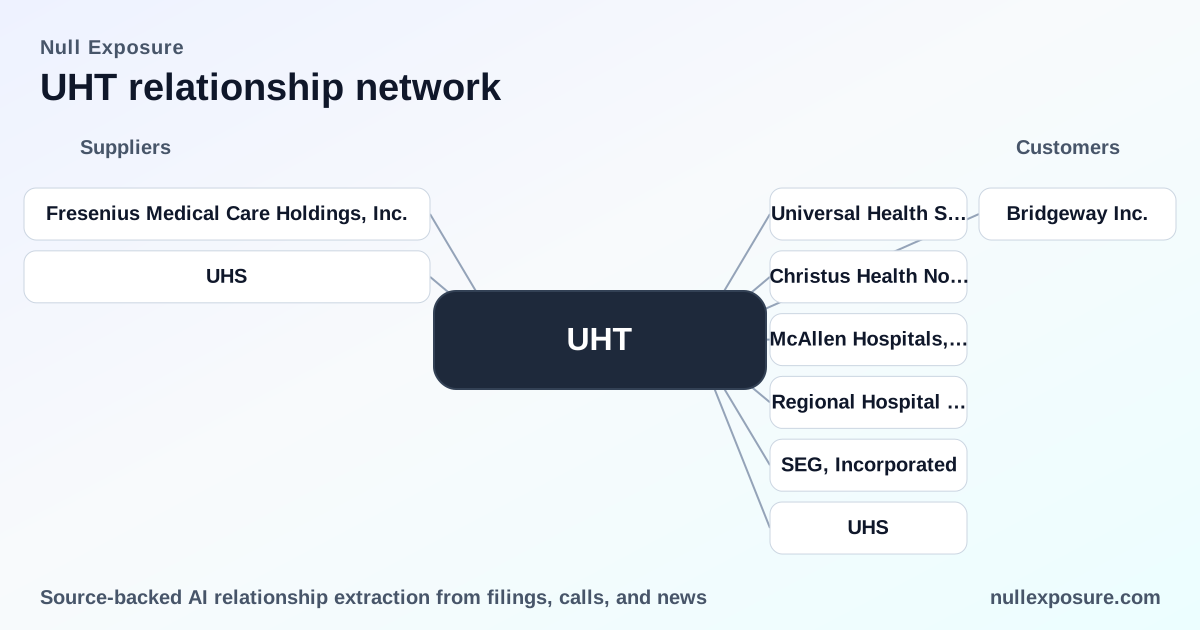
The data returned for UHT highlights four explicit relationship mentions across filings and media. Below I cover each entry exactly as documented and spell out the commercial implication.
Fresenius Medical Care Holdings, Inc. — specific property tenant (FY2024 filing)
Universal Health Realty’s 2024 Form 10‑K lists a medical office building in Escanaba, MI (Sand Point Medical Properties) as 100% leased to Fresenius Medical Care Holdings, Inc., indicating Fresenius operates dialysis-related services at that site and contributes to UHT’s localized rent stream. This is drawn from Universal Health Realty’s FY2024 10‑K disclosures.
Universal Health Services — largest tenant and manager (InsiderMonkey, FY2026)
An InsiderMonkey article in 2026 identifies Universal Health Services (UHS) as UHT’s largest tenant, which also serves as the REIT’s manager, underscoring a close commercial and managerial alignment between landlord and operator that materially shapes UHT’s revenue and governance profile.
Universal Health Services, Inc. — advisor relationship described (LeadersMag, FY2024 / Jan 2025)
A Leaders Magazine profile (January 2025) characterizes UHS as an advisor to Universal Health Realty, noting UHS’s scale and role advising the REIT; this confirms public descriptions that UHS performs both operating and advisory functions for UHT and highlights the related-party nature of part of UHT’s operating model.
Universal Health Services — advisory fee trends (The Globe and Mail press release, FY2026)
A Globe and Mail press release in 2026 reports that advisory fees paid to UHS rose 2.7% in the quarter and 2.1% for the full year, offering a quantitative read on the financial flows from UHT to its advisor and reinforcing that advisory fees are a measurable line item in UHT’s P&L.
What those relationships imply for risk and return
- Concentration risk is material. With UHS both the largest tenant and manager, cash flows are heavily tied to a single corporate relationship, which compresses diversification benefits and elevates counterparty risk.
- Related-party economics are visible and growing. Periodic increases in advisory fees to UHS are a direct channel of cash transfer and should be monitored for trajectory and governance safeguards.
- Tenant mix includes large specialized providers. The Fresenius tenancy illustrates UHT’s exposure to national healthcare chains beyond UHS, which provides some tenant diversification but not enough to neutralize the dominant UHS relationship.
- Operational criticality supports lease stability. Hospital and dialysis facilities generate essential services, which generally support predictable occupancy and rent collection even through economic cycles.
No supplier-specific regulatory or contractual constraints were flagged in the reviewed materials; that is a company-level signal that UHT’s publicly available supplier/tenant disclosures do not include formal restrictions or vendor sanctions in the examined sources.
How investors should act on this supplier analysis
- Perform focused counterparty due diligence on Universal Health Services: quantify contractual terms, breakpoints, escalation clauses, and any cross-default mechanics in lease and advisory agreements. The combination of tenant concentration and advisory fees is a governance and cash-flow issue, not a hypothetical risk.
- Monitor advisory fee trends and related-party disclosure frequency—rising advisory fees are an early operational signal and should be reconciled with market-rate benchmarks for REIT management services.
- Treat tenant-level exposures (for example the Fresenius lease) as incremental diversification but not a substitute for reducing core concentration with UHS through lease expirations or new tenants.
For a practical supplier map and follow-up counterparty reports, see https://nullexposure.com/—it’s the quickest way to convert this qualitative read into action.
Bottom line: concentrated cash flow, clear oversight needed
Universal Health Realty delivers stable, yield-focused returns through long-term leases to healthcare operators, but the company’s economics and governance are materially shaped by its relationship with Universal Health Services and by the presence of strategic tenants such as Fresenius Medical Care. Investors should price UHT not just as a healthcare real estate play but as a firm where related-party arrangements and tenant concentration are core valuation levers. For targeted supplier and counterparty intelligence to support investment or operational decisions, visit https://nullexposure.com/.