Unisys (UIS) supplier relationships: Microsoft, SolarWinds, and what investors should price in
Unisys operates as a global information technology services provider that monetizes through professional services, managed services, and software-enabled workplace solutions. The company generates roughly $1.95 billion in trailing revenue, with modest positive operating margins and constrained profitability (TTM EBITDA of $112.6 million, EPS deeply negative), which forces reliance on partner ecosystems and third‑party technology to deliver services at scale. For investors and operators evaluating UIS as a supplier or partner, focus on third‑party dependency, security posture, and strategic alliances as the key drivers of execution risk and growth potential. Learn more about supplier risk and coverage at https://nullexposure.com/.
Quick read: what these supplier links mean for investors
Unisys is both a buyer of hardware and software components and a seller of enterprise services, which creates a dual exposure: supply‑chain concentration risk on the procurement side and partner dependency on the revenue side. The constraints signal that Unisys relies on a limited number of suppliers for certain technology products and that those relationships are operationally critical to service delivery. At the same time, strategic technology partnerships—especially with hyperscale and platform vendors—drive product differentiation in AI and digital workplace offerings. These dynamics should be priced into valuation and counterparty selection decisions.
The relationships on record right now
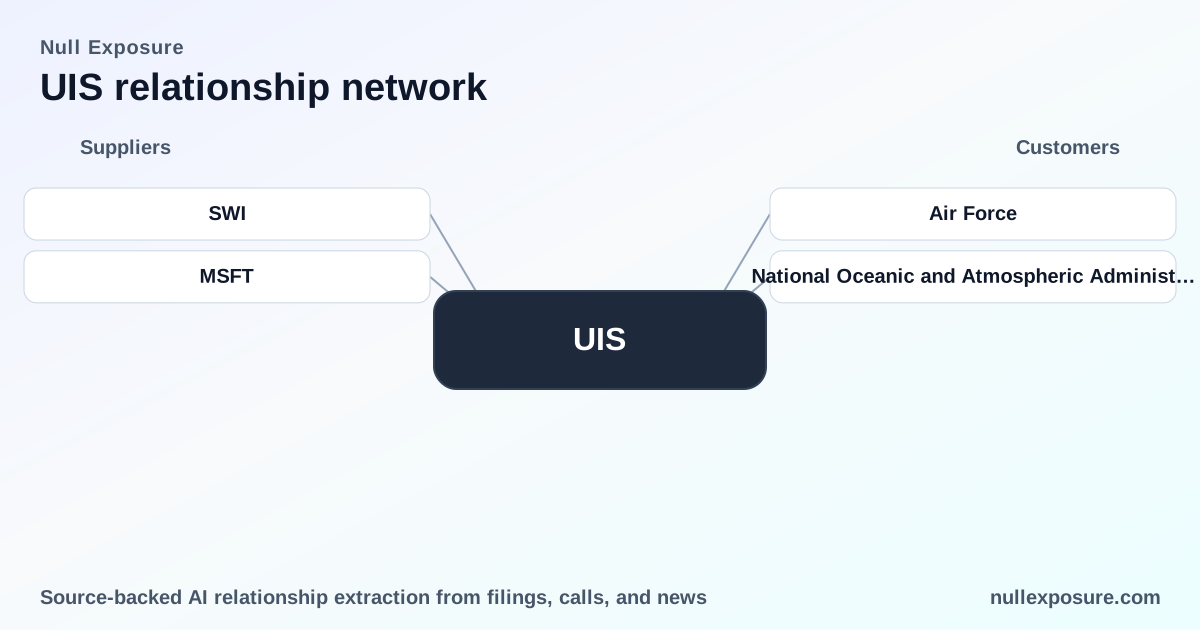
The public record returned two material supplier/partner relationships for Unisys. Below are plain‑English summaries and citations.
SolarWinds — third‑party cyber exposure recognized
Unisys was identified as one of the customers impacted by the SolarWinds Orion supply‑chain compromise, an incident in which nation‑state actors inserted malicious code into Orion updates that later allowed intrusions into multiple customer environments. This is a clear reminder that third‑party software compromises translate directly into operational and reputational risk for service providers. According to a Holland & Knight article that examined the SolarWinds aftermath (October 2024), Unisys was listed alongside other affected vendors and users, confirming exposure to that incident: https://www.hklaw.com/en/insights/publications/2024/10/undeterred-by-the-solarwinds-storm.
Microsoft — platform partnership powering workplace transformation
Unisys holds a strategic partnership with Microsoft that underpins its Microsoft Copilot guidance and workplace AI offerings; NelsonHall cited Unisys’ Microsoft‑centric strategies as a reason for industry recognition in digital workplace services. This relationship is commercially significant because it affects product roadmap, go‑to‑market positioning, and the company’s ability to capture AI‑led services revenue. A regional report relaying NelsonHall commentary and Unisys’ Copilot integration strategies was published in March 2026: https://www.mychesco.com/a/news/regional/unisys-earns-sixth-straight-nelsonhall-crown-for-digital-workplace/.
How these relationships interact with Unisys’ operating model
Unisys runs a service business that is capital‑light on balance sheet assets but capital‑intensive in terms of human capital and partner software. The combination of the SolarWinds exposure and the Microsoft partnership illustrates two distinct facets:
- Security and supplier concentration: The SolarWinds incident confirms that critical third‑party components can introduce systemic vulnerabilities into Unisys’ service delivery. The company has acknowledged reliance on a limited number of suppliers for certain technology products, which is a company‑level signal of concentration and criticality; failure to obtain or secure those inputs would materially affect operations.
- Ecosystem dependency for growth: The Microsoft link demonstrates how Unisys commercializes platform partnerships to deliver higher‑margin, AI‑enabled workplace solutions. This is structurally positive for revenue mix but increases exposure to partner product roadmaps and licensing economics.
Contracting posture and risk profile (company‑level signals)
Constraints documented for Unisys present the following company‑level signals that investors and counterparties must weigh when forming commercial relationships:
- Contracting posture: Unisys operates as both buyer and seller — it purchases specialized components while selling services built on partner technologies — which results in mixed bargaining power. Large enterprise customers and platform partners influence contract structure, SLAs, and pricing.
- Concentration and criticality: The company acknowledges reliance on a limited number of suppliers for certain technology products, creating single‑point dependencies that are operationally critical rather than merely convenience‑based.
- Maturity and remediation posture: The SolarWinds reference highlights legacy third‑party exposure and underscores the need for mature third‑party risk management and incident response capabilities within Unisys’ service model.
- Commercial leverage: Strategic alliances such as the Microsoft partnership provide go‑to‑market leverage and productization pathways for AI and digital workplace services, improving scalability but concentrating technology risk with platform owners.
If you’re evaluating supplier risk or partnership opportunities, consider the tradeoff between access to platform innovation and the attendant supply‑chain security obligations. For enterprise procurement teams, that balance dictates the type and rigor of contractual protections you should request.
Explore detailed supplier profiles and risk analytics at https://nullexposure.com/.
Investment implications and operational takeaways
- Security is a valuation lever. The SolarWinds inclusion is not merely reputational; it affects client trust and contract renewals in cybersecurity‑sensitive industries. Underwriting risk should incorporate potential remediation costs and client attrition after public incidents.
- Partnerships drive product differentiation. The Microsoft relationship materially improves Unisys’ ability to sell AI and Copilot‑enabled workplace transformation services, which is consistent with industry recognition from NelsonHall. Investors should value recurring service streams tied to platform adoption, while monitoring license and margin pressure.
- Supplier concentration is a delivery risk. The company’s own disclosures flag single‑ or limited‑source dependence for specific components; this is an operational constraint that complements the cyber exposure and should be reflected in scenario analyses for revenue continuity.
Bottom line and next steps for investors and operators
Unisys trades with comparatively low market capitalisation relative to revenue (market cap roughly $165 million vs. $1.95 billion revenue TTM), negative reported EPS, and modest EBITDA — a profile that elevates the importance of partner economics and supplier reliability to near‑term performance. Investors should price in both the upside from Microsoft‑enabled services and the downside from supplier concentration and third‑party security exposure.
If you need deeper counterparty diligence or want to see how Unisys’ supplier signals compare across other vendors, visit https://nullexposure.com/ for comprehensive supplier risk profiles and analytic tools.
For commercial teams negotiating with Unisys, insist on clear contractual SLAs, vendor security attestations, and redundancy clauses for critical components. For investors, focus on partnership KPIs (Copilot adoption, managed services retention) and any remediation investments related to third‑party security incidents.
Make supplier risk a live part of your investment and sourcing playbook — start your deeper review at https://nullexposure.com/.