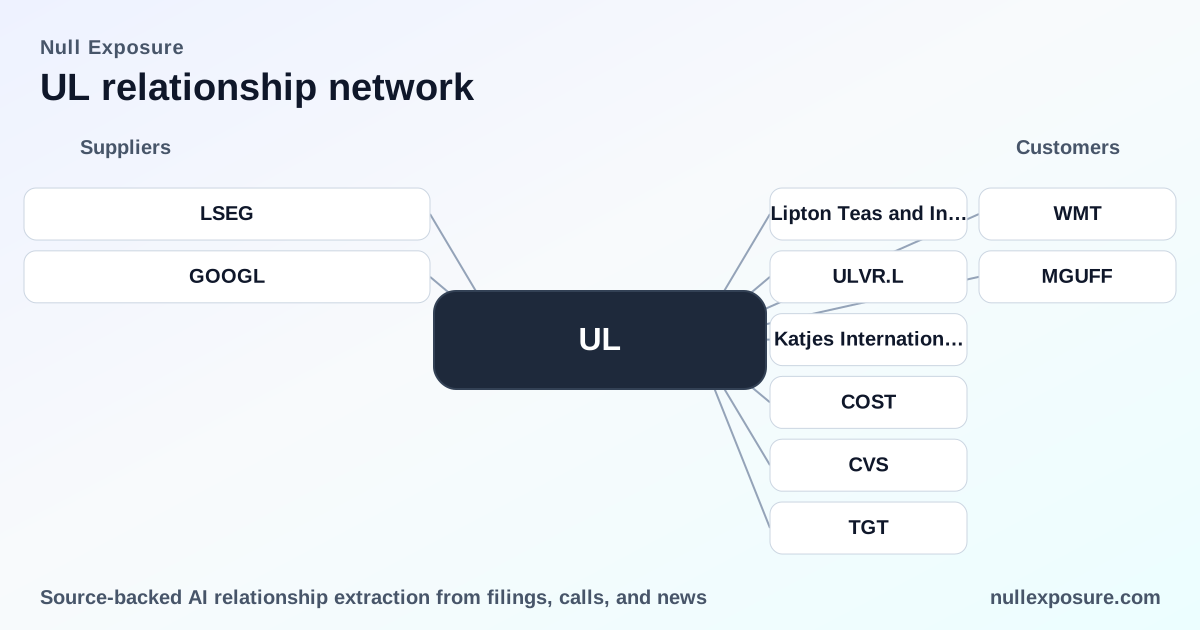
Unilever (UL) supplier relationships: strategic partners and market signals
Unilever is a global fast-moving consumer goods company that monetizes a broad portfolio of household and personal-care brands through retail and direct channels, generating roughly $50.5 billion in annual revenue and sustained cash flow that supports dividends and brand investment. The company extracts value from scale, distribution density, and margin management across diverse geographies; increasingly, it also leverages outside technology providers to accelerate digital commerce and operational efficiency while using modest equity issuance to satisfy employee compensation. For investors and operators evaluating UL as a supplier counterparty, the mix of capital discipline, brand franchise, and strategic technology partnerships defines the commercial posture and execution risks. Learn more at https://nullexposure.com/.
Why these supplier relationships matter for investors
Unilever’s supplier and partner choices reveal how management balances two imperatives: protecting low-margin, high-volume consumer flows and investing in digital transformation. Technology partners that enable personalization and commerce are value accelerants, while capital actions tied to employee incentives are minor dilution events that affect the equity base and governance optics.
The full partner list and what each relationship means
Below I cover every relationship flagged in the available results and provide concise, plain-English takeaways with source references.
London Stock Exchange — equity admission for employee awards
Unilever issued and allotted 4,200,000 new ordinary shares to satisfy vesting under its Unilever Share Plan 2017 and related schemes, and these new shares were admitted to trading on the LSE under an existing block admission dated 14 March 2024. This is a standard capital-market housekeeping action tied to compensation rather than an operational supplier dependency. According to a London Stock Exchange notification reported in FY2026, the issuance was completed to satisfy employee share scheme vesting (research-tree, March 2026).
Google — strategic AI and retail partnership
Public reporting notes that Unilever has engaged Google to apply AI across shopping and consumer brand experiences, positioning Google’s capabilities to reinvent how consumers discover and buy everyday brands. This relationship signals Unilever’s intent to rely on large cloud and AI partners to accelerate digital revenue channels and personalization (finviz news reporting coverage in FY2025).
Google Cloud — agentic AI deployment partner
Separate coverage emphasizes a deal specifically with Google Cloud focused on agentic AI—tools that can automate tasks and decisioning for commerce and operations. This partnership elevates Google Cloud from vendor to a strategic transformational supplier for Unilever’s digital roadmap and cost-efficiency programs (finviz and related reports, FY2025–FY2026).
Operating-model constraints and company-level signals
There are no explicit supplier constraints listed in the relationship payload, which itself is a signal: Unilever did not publish contractual limitations or special supplier restrictions in the items retrieved. Treat that absence as a company-level indicator rather than a partner-level attribution.
Company-level operating and business-model characteristics to weigh:
- Contracting posture — centralized but flexible. Unilever operates with global procurement scale and brand control; it contracts large platform suppliers for technology while retaining strategic control over manufacturing and channel agreements.
- Concentration — low supplier concentration for goods, higher for cloud/AI. Physical raw materials and packaging sourcing are distributed; however, digital transformation introduces concentration risk when a small number of cloud providers (e.g., Google Cloud) supply mission‑critical capabilities.
- Criticality — high for brand custodianship, elevated for digital partners. Technology partners that enable e‑commerce and AI-based personalization are now critical to growth experiments and margin improvement initiatives.
- Maturity — core FMCG is mature, digital stack is acceleration-stage. The legacy business is stable and cash-generative; investments with Google/Google Cloud reflect an early-to-mid stage modernization push that requires execution monitoring.
Investment implications: risks and levers to watch
- Execution on AI partnerships is a growth lever. Successful integration with Google and Google Cloud will materially improve digital ROI and accelerate direct-to-consumer channels; failure or delays will weigh on the marginal growth profile.
- Minor equity dilution from employee share issuance is routine. The 4.2M shares admitted in FY2026 are immaterial to Unilever’s ~2.18B shares outstanding but are worth monitoring for cadence and governance signaling (LSE notification, FY2026).
- Vendor concentration risk in cloud services is real but manageable. Relying on a major cloud provider reduces time-to-market and capability gaps but creates dependency that requires contractual protections and multi‑cloud contingency planning.
- Stable financial footing supports strategic partnerships. With ~ $50.5B revenue, an operating margin around 20% and a market capitalization near $143B, Unilever has the balance sheet and cash flow to invest in technology while sustaining distribution and manufacturing networks.
For a deeper view of partner exposure across suppliers and to model counterparty risk implications, visit https://nullexposure.com/ for comprehensive supplier intelligence.
Practical monitoring checklist for investors and operators
- Track progress metrics on AI-enabled revenue attribution and conversion lift from Google/Google Cloud integrations; these will determine whether partnership economics justify continued investment.
- Watch disclosure cadence for future admissions or share-based compensation that could incrementally change the share count or governance dynamics (London Stock Exchange filings).
- Ensure contractual language around uptime, data portability, and escalation paths with cloud partners is visible to management and investors; these are the clauses that protect operations if a supplier failure occurs.
Bottom line: actionable takeaways
Unilever combines a stable, cash-generative consumer goods core with targeted bets on AI and cloud partners to modernize commerce. The LSE share issuance is a routine compensation event that does not alter the capital structure materially, while partnerships with Google and Google Cloud are strategic and execution-critical for digital growth. Investors should underwrite the stock on both the resilience of the legacy business and the pace at which these technology relationships convert into measurable top-line and margin gains.
For ongoing supplier monitoring and to evaluate how third-party relationships influence company valuations, explore practical intelligence and deal tracking at https://nullexposure.com/.