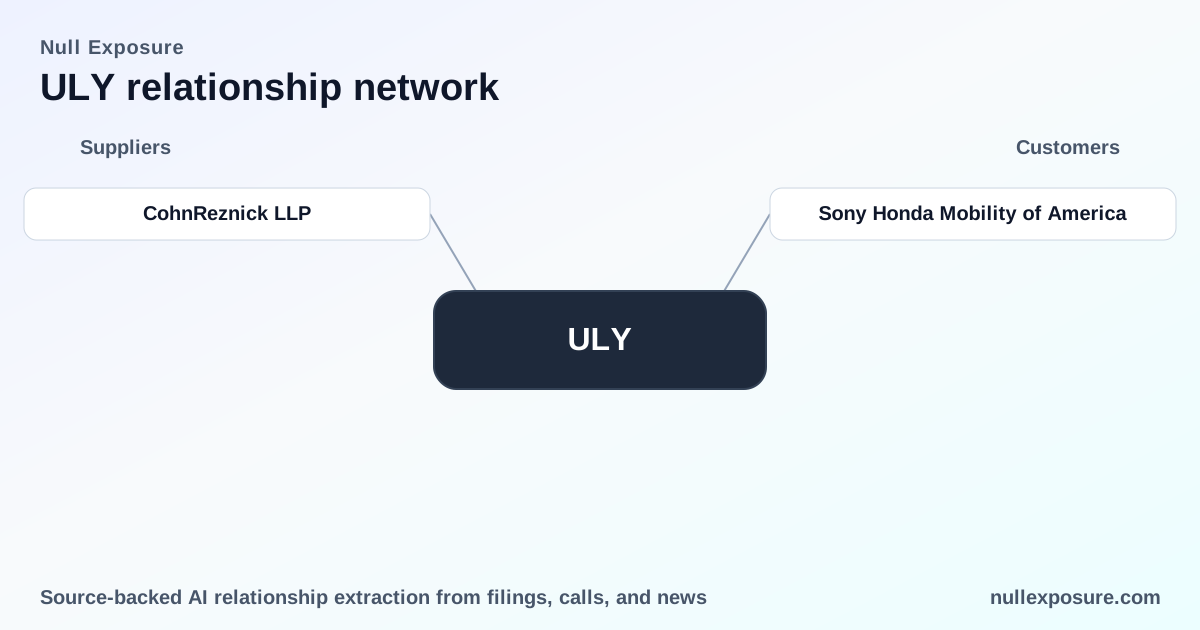
Urgent.ly (ULY) supplier relationships: what investors should price in
Urgent.ly operates a two-sided mobility platform that connects consumers and enterprise partners to a distributed network of roadside Service Providers and monetizes by taking fees on transactions and charging Customer Partners for platform access and managed services. The company pays Service Providers on a usage-based, per-job basis while scaling revenue through enterprise agreements and broader partner integrations; this structure creates a variable-cost operating model that drives revenue per engagement but compresses margin unless utilization and pricing power improve. For a structured view of supplier risk and third‑party relationships, visit https://nullexposure.com/.
How the supplier model underpins the business
Urgent.ly’s economics are driven by matching supply to demand across North America. Revenue (TTM $129.2M) and Gross Profit ($32.8M) reflect material transaction volume, but operating losses and negative EPS illustrate that the company is still investing to scale. The platform’s cost base is heavily concentrated in payments to Service Providers—listed as cost of revenue—and that line is directly variable with jobs performed, which limits fixed-cost leverage but also reduces downside when volumes drop.
Key operational facts investors should carry into any valuation:
- Usage-based payments: the company pays suppliers on a per-job schedule (typically within three weeks), which makes supplier payouts tightly coupled to volume and cash flow timing.
- SMB supplier base: Urgent.ly contracts primarily with small and medium businesses operating in limited geographic areas, which influences counterparty credit and operational consistency.
- North American footprint: the service provider network is established across North America, supporting the company’s enterprise partner base and consumer coverage.
For supplier risk scoring and to monitor changes in third-party relationships, see https://nullexposure.com/.
What the disclosed relationship list contains
Urgent.ly’s public supplier relationship disclosures in the reviewed file are compact; the item captured reflects an auditor appointment that is material to governance but external to the fleet of roadside providers. Below I cover the single disclosed relationship in the source results.
CohnReznick LLP — independent registered public accounting firm
Urgent.ly stockholders ratified the appointment of CohnReznick LLP as the company’s independent registered public accounting firm for the fiscal year ending December 31, 2025, a vote reported in March 2026 and indicative of continuity in external financial oversight. This is a governance and assurance relationship rather than an operational supplier of roadside services. (TipRanks company announcement, March 10, 2026: https://www.tipranks.com/news/company-announcements/urgent-ly-stockholders-approve-directors-and-auditor-at-meeting)
What the constraints tell investors about supplier dynamics
The documented constraints and excerpts should be read as company-level signals about how Urgent.ly sources and compensates suppliers—none of these constraints are specific to the auditor relationship above.
- Contracting posture: usage-based, per-job payments signal a highly variable cost structure with short payment cycles (typically within three weeks). This reduces fixed commitments but creates working-capital demands tied to volume.
- Counterparty type and concentration: the supplier population consists largely of SMBs operating locally; Urgent.ly reported about 13,700 active Service Providers at year-end 2024 and a broader participating driver count of over 75,400. This scale dilutes single-counterparty concentration but elevates operational variability and quality control needs.
- Geography and market focus: the supplier network is North America–centric, which concentrates regulatory, economic, and competitive exposure regionally while enabling focused scale benefits for enterprise partners in that geography.
- Relationship role and criticality: Service Providers are the core operational muscle—Urgent.ly’s product is worthless without reliable providers able to accept jobs. Providers are non‑exclusive independent contractors who often work with multiple aggregators, which makes retention, pricing, and interface UX critical levers for supply availability.
- Relationship maturity: the network is active and growing, with year‑over‑year increases in contracted service providers and notable enterprise Customer Partners (49 reported), indicating operational scale but ongoing execution risk in standardizing performance across many SMBs.
These constraints together describe a business that is asset-light but operationally intensive, where the platform controls demand flows and quality through software and partner management rather than through ownership of fleet assets.
Risk and opportunity implications for investors
- Margin pressure from non-exclusive SMB suppliers: because providers are free to take jobs from competitors, Urgent.ly must maintain competitive rates, a superior UX, or value-added services for providers to secure capacity—this weighs on margin unless offset by scale economics or higher enterprise pricing.
- Cash flow timing and working capital: usage-based payouts with short settlement windows require disciplined cash management; growth in job volume increases gross outflows before receivables settle from enterprise customers.
- Operational complexity at scale: 13.7k contracted providers and tens of thousands of participating drivers deliver geographic coverage but require robust onboarding, fraud controls, and quality assurance to preserve customer experience.
- Governance continuity: ratification of CohnReznick as auditor supports financial reporting continuity—important for investors focused on transparency as the company scales (TipRanks announcement, March 2026).
Practical next steps for investors and operators
- For quant investors: model volume-driven margins with explicit working-capital assumptions tied to per-job payouts and enterprise payment terms; stress-test provider availability under pricing pressure.
- For strategic operators: prioritize provider retention levers—faster payouts, better dispatch integration, and differentiated support—to reduce churn to competing aggregators.
- For credit or partnership diligence: evaluate regional supplier performance variance and the company’s ability to enforce SLAs with non-exclusive SMBs at scale.
For ongoing monitoring of Urgent.ly’s supplier relationships and governance events, check the platform at https://nullexposure.com/. For tailored supplier risk reports and alerts, visit https://nullexposure.com/ to subscribe.
Conclusion: how to think about ULY’s supplier exposure
Urgent.ly’s supplier model is scale-oriented, variable-cost, and North America‑focused, which is attractive for growth but requires disciplined execution on supplier economics and platform reliability to convert revenue scale into sustainable profits. The auditor ratification with CohnReznick is a governance positive, while the underlying SMB supplier base is the operational heart of the business and the primary source of execution risk. Investors should weight upside from top-line growth against margin vulnerability from a largely non‑exclusive, usage-paid supplier network. For a consolidated view of third-party exposures and ongoing alerts, go to https://nullexposure.com/.