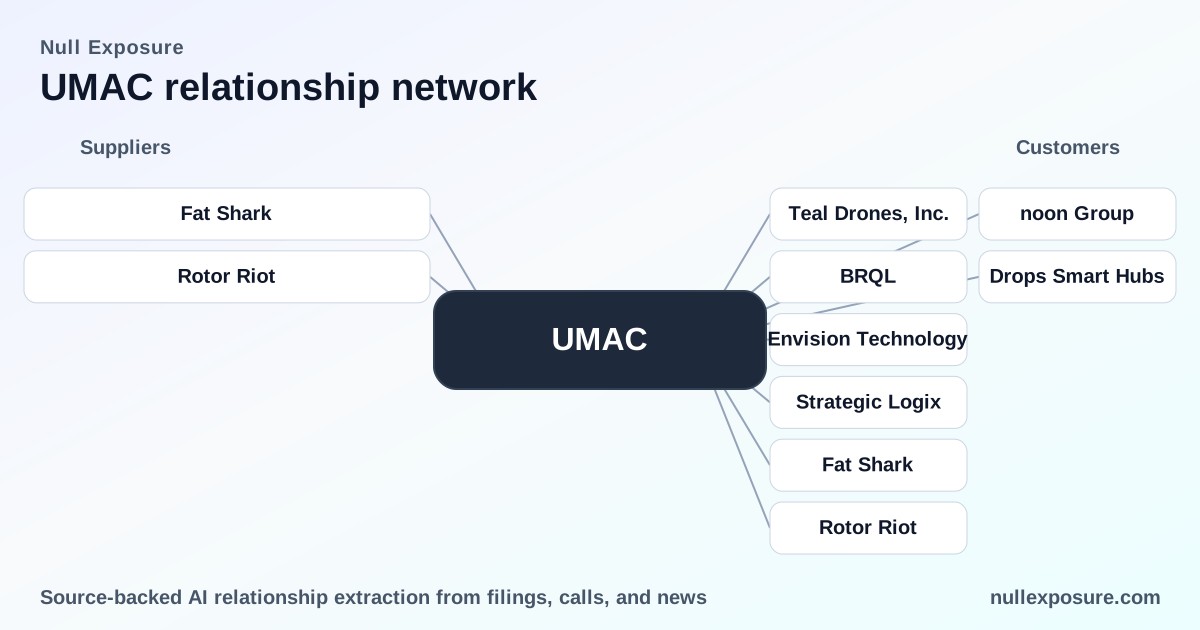
Unusual Machines (UMAC): Supplier Footprint and What It Signals for Investors
Unusual Machines monetizes advanced robotics and automation by selling integrated hardware and software solutions to industrial and defense customers, generating revenue through unit sales, recurring services, and strategic partnerships. The company scales by combining proprietary systems with third-party components and maintains a leased operations base to support assembly and fulfillment. For investors, the core question is how supplier relationships and contractual posture support growth while exposing the company to component, tariff and timeline risk. Learn more about supplier intelligence and how it informs underwriting at https://nullexposure.com/.
Quick read: what the company is buying and why it matters
Unusual Machines reported roughly $11.2 million revenue TTM with negative operating margins and a still-developing commercial footprint. Revenue is concentrated on product sales that incorporate third-party components, and management has signaled a multi-year commitment to physical operations—evidence of scale intent but also fixed-cost leverage. Valuation metrics show the market is pricing growth into the equity: EV/Revenue ~50.8 and Price/Sales ~64.6, while profitability lags. These economic facts make supplier stability a material factor in the investment case: input availability, tariff exposure and vendor timelines translate directly into revenue delivery and margin expansion potential.
What the public record shows about suppliers (every mention accounted for)
Below are the supplier mentions captured in public reporting and mapped to the company’s supplier profile.
-
Fat Shark — A Streetwise Reports article dated January 20, 2026 lists Fat Shark Aura analog cameras, Aura video transmitters (VTX), HDO+ headsets and motors as included in a government-oriented order that integrates components into customer drone platforms. This mention is recorded as part of UMAC’s supplier relationships in FY2026. (Streetwise Reports, Jan 20, 2026: https://www.streetwisereports.com/article/2026/01/20/component-supplier-finds-excellent-growth-opportunity-in-pentagons-us-9-4b-program.html)
-
Rotor Riot — The same January 20, 2026 Streetwise Reports article specifies that Rotor Riot’s Brave flight controllers and Brave ESCs are included in the order for drone platforms operating under government timelines; this entry is logged as a supplier relationship in FY2026. (Streetwise Reports, Jan 20, 2026: https://www.streetwisereports.com/article/2026/01/20/component-supplier-finds-excellent-growth-opportunity-in-pentagons-us-9-4b-program.html)
-
Fat Shark (second mention) — A separate Streetwise Reports article dated January 21, 2026 repeats that the order comprises Fat Shark Aura cameras, VTXs, HDO+ headsets and motors destined for integration into customer drone platforms subject to tight government deadlines; this repeat mention reinforces Fat Shark’s role in FY2026 supplier activity. (Streetwise Reports, Jan 21, 2026: https://www.streetwisereports.com/article/2026/01/21/drone-manufacturer-secures-us-2-1m-defense-order-breakthrough-in-us-market.html)
-
Rotor Riot (second mention) — The January 21, 2026 Streetwise Reports follow-up likewise repeats inclusion of Rotor Riot Brave flight controllers and ESCs in the same defense-oriented order, creating a duplicate but confirmatory record for Rotor Riot in FY2026. (Streetwise Reports, Jan 21, 2026: https://www.streetwisereports.com/article/2026/01/21/drone-manufacturer-secures-us-2-1m-defense-order-breakthrough-in-us-market.html)
Each of these articles highlights component suppliers commonly used in tactical drone platforms and has been captured as part of UMAC’s supplier mapping for FY2026.
What the constraints and filings reveal about operating posture
Unusual Machines’ public disclosures and the supplier-excerpt corpus provide a coherent view of how the business operates and what that implies for supplier risk.
-
Long-term fixed commitments: The company assumed a five-year operating lease for roughly 6,900 square feet of warehouse and office space in Orlando, Florida. This is a multi-year fixed-cost commitment that supports assembly, testing and logistics but increases cash-flow sensitivity to revenue volatility.
-
Manufacturer relationships: The firm purchases certain Blue UAS products from a privately held U.S. manufacturer under purchase orders. This is a single-source product relationship for specific items, which creates a product-level dependency even while the overall supplier count is broad.
-
Supplier breadth and tariff exposure: Unusual Machines purchases inventory from approximately 50 suppliers. A diversified supplier count reduces counterparty concentration risk, but the company explicitly flags potential exposure to varying tariffs—this is a structural input-cost risk that directly compresses gross margins if not hedged or passed on.
These constraints together describe a company that is operationally committed (lease), partially dependent on specific manufacturers for product lines, and simultaneously diversified across many smaller suppliers with tariff sensitivity.
Investment implications: risk-reward framed
-
Revenue delivery tied to supplier timelines. Public reporting connecting component suppliers like Fat Shark and Rotor Riot to defense orders implies sensitivity to government schedule risk. Government customers impose fixed delivery windows; missing those windows damages both revenue and reputation.
-
Margin compression from tariffs and single-source products. The combination of many low-concentration suppliers and at least one single-source manufacturer for Blue UAS products implies that input cost volatility is likely to flow to margins unless managed through contracts or pricing power.
-
Fixed-cost leverage and scaling necessity. The five-year lease indicates management expects production scale; that works in favor of margin expansion only if revenue growth outpaces fixed-cost absorption. Current negative operating margins demand operational scaling or better component economics.
-
Valuation assumes growth; execution matters. With elevated EV/Revenue and Price/Sales multiples, the market prices strong growth. Supplier disruptions or tariff-driven cost shocks would materially undermine that valuation thesis.
If you want a deeper supplier-risk scorecard or counterparty map to pair with this operating model view, start here: https://nullexposure.com/.
How operators should think about vendor diligence
For operators evaluating UMAC as a supplier or investment:
- Validate long-term supply visibility for critical components such as flight controllers and camera systems; confirm second-source options where single manufacturers provide unique items.
- Audit tariff exposure across the ~50-supplier footprint and confirm whether contracts include pass-through pricing or hedging.
- Stress-test the business plan against missed government delivery windows; timelines in defense contracts have outsized P&L impact.
Bottom line and next step
Unusual Machines is scaling a hardware-centric automation business that relies on a mix of specialized single-source products and a broad supplier base. The company’s leased operating footprint and public supplier mentions tied to defense orders make supplier continuity and tariff management two of the most material operational risks for the investment case. For investors and partners who need structured supplier intelligence and contract-level insight, explore supplier scoring and exposure tools at https://nullexposure.com/.
Key takeaway: Growth potential is real, but proof-of-execution depends on stable components, tariff control, and on-time delivery against government-driven schedules.