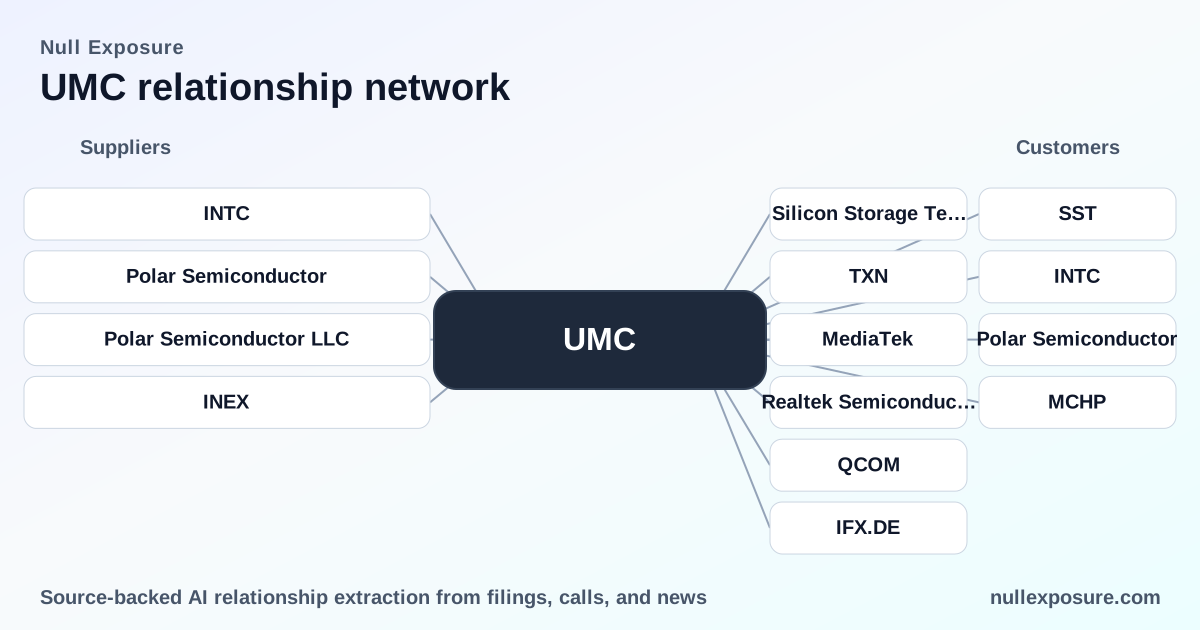
United Microelectronics (UMC): Foundry relationships that reshape capacity and risk
United Microelectronics Corporation operates as a global semiconductor wafer foundry, monetizing by manufacturing chips for fabless and integrated device manufacturers across multiple geometries and geographies. The company sells wafer fabrication capacity and process technology services, capturing revenue from contract manufacturing, process development partnerships, and capacity expansion agreements. UMC’s economics are driven by wafer throughput, node migration (notably 12nm in recent developments), and strategic manufacturing placement—especially U.S. fab activity tied to reshoring and customer-driven demand.
If you monitor supplier exposure in semiconductors, this profile of UMC’s partner ecosystem is actionable—explore more supplier intelligence at https://nullexposure.com/.
Why supplier relationships matter for UMC’s earnings profile
UMC is a capacity-centric business: revenue scales with utilization and successful technology rollouts, while margin stability depends on node mix and customer concentration. The company’s financials show it is a sizable industry player with RevenueTTM of roughly $237.6B and gross profit of about $68.9B, supporting a market capitalization near $24.0B (company filings and market data through FY2025). These figures underline why strategic partnerships—process co-development and U.S. production MOUs—translate directly into demand visibility and capital allocation decisions.
The partner relationships that matter now
Below are the relationships captured in public reporting and investor communications; each line gives a plain-English summary and a concise source note.
Intel — collaborative development and U.S. capacity acceleration
UMC is working with Intel to jointly develop 12-nanometer process technology and has received customer requests to accelerate capacity buildouts tied to Intel, with volume production planned at an Intel U.S. facility for 2027. According to Taipei Times coverage in 2025, UMC prioritized 12nm development with Intel and arranged for production to ramp at an Intel plant in 2027, citing customer interest and reshoring dynamics (Taipei Times, April–May–December 2025 reporting).
Polar Semiconductor / Polar Semiconductor LLC — U.S. eight-inch manufacturing MOU
UMC signed a memorandum of understanding with Polar Semiconductor to collaborate on producing 8-inch wafers in the United States and to identify devices Polar would manufacture at its expanded Minnesota facility. The partnership was reported in trade press and local coverage detailing the MOU and manufacturing scope (Gasworld, December 2025; Taipei Times reporting December 2025).
INEX — process design kit (PDK) delivery partnership
UMC disclosed that its collaboration with INEX will enable delivery of an industry-standard PDK to customers in 2027, a critical enabler for customer tape-outs and volume production readiness. This cooperation was described during UMC’s Q4 2025 earnings call transcript coverage and related investor summaries (earnings call transcript, FY2026 commentary via InsiderMonkey).
What these relationships reveal about UMC’s operating posture
These partnerships collectively reveal several company-level characteristics that investors and operators must treat as strategic constraints and drivers.
- Contracting posture: customer-driven capital allocation. UMC expands capacity and aligns process roadmaps in response to direct customer requests, rather than unilateral capacity bets; Intel’s demand-driven acceleration of 12nm underscores this posture.
- Concentration and criticality: diversified customers, but key tech partnerships are highly material. While UMC serves many customers globally, co-development with major players like Intel and tie-ups for U.S. wafer production create high-impact nodes where partner decisions materially influence utilization and forward revenue.
- Geographic and political sensitivity: reshoring increases U.S. footprint importance. UMC’s collaboration on U.S. 8-inch production and Intel’s U.S. fab ramp position UMC as a supplier inside geopolitically-sensitive manufacturing moves, raising both strategic opportunity and regulatory/operational complexity.
- Maturity of technology and commercialization timelines. The 12nm line and PDK delivery schedule (targeted volume and toolchain readiness in 2027) signal a multi-year commercialization cadence that requires capital discipline and customer coordination.
These points are company-level signals extracted from public reporting and earnings communications; they frame how UMC allocates capital, prioritizes partners, and sequences process rollouts.
Investment and operational implications for suppliers and buyers
UMC’s current partnerships create concrete implications for investors and counterparties:
- Revenue visibility increases when co-development timelines align. Intel-driven 12nm acceleration and the PDK availability from INEX narrow execution risk for volume ramp, boosting utilization prospects in 2027.
- Execution risk is concentrated at the node and location level. Successful ramp of U.S.-based 8-inch and 12nm production is binary for near-term volume—operators should underwrite contingency plans for tool delivery, yield ramp, and cross-border supply chain friction.
- Strategic optionality via MOU and co-development frameworks. The Polar MOU and Intel collaboration create optional channels into U.S. manufacturing demand, which is particularly valuable under current reshoring trends.
- Capital intensity remains high; watch capex cadence vs. contracted demand. Given UMC’s capital-dependent revenue model, investors should monitor utilization metrics and customer-backed commitments that convert MOUs and development agreements into funded capacity.
For deeper supplier exposure and scenario analysis tools, visit https://nullexposure.com/ for methodologies and tracking.
Practical next steps for investors and operators
- Validate counterparty commitments: require milestone-linked agreements or customer-funded capex to convert MOUs into economic capacity.
- Monitor PDK and tape-out schedules from INEX and similar partners as a leading indicator of 2027 volume readiness.
- Stress-test regional risk: model production continuity scenarios for U.S. fabs vs. Taiwan/Asia capacity in supply-disruption cases.
If you want a tailored review of UMC’s supplier relationships and how they map to your portfolio or operations, start a provider assessment at https://nullexposure.com/.
Conclusion — concentrated levers, actionable timeline
UMC’s partner set shows strategic, high-impact collaborations that materially affect its capacity roadmap and revenue profile through 2027. Intel’s role in accelerating 12nm, Polar’s U.S. 8-inch MOU, and INEX’s PDK delivery form a coherent picture: UMC is executing a customer-driven expansion that increases its exposure to geopolitical reshoring while providing clear volumetric levers if execution meets timeline commitments. Investors and operators should prioritize milestone-based evidence of ramp success and incorporate node/location execution risk into valuation and supply agreements.