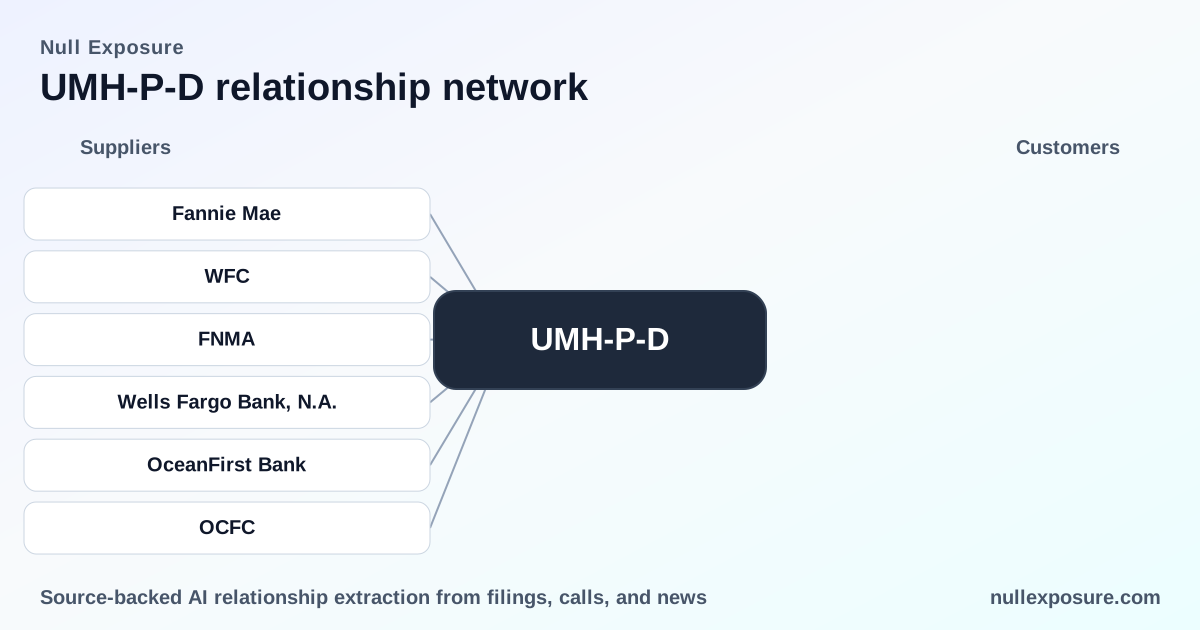
UMH-P-D: Preferred holders get income backed by an REIT that finances growth with agency and bank credit
UMH Properties operates and monetizes by owning and operating manufactured housing communities and conventional multifamily assets, generating rental cash flow and using structured secured financing to acquire and stabilize new communities; the 6.375% Series D cumulative redeemable preferred shares carry a $25 liquidation preference and deliver fixed income ahead of common equity in the capital stack. UMH funds expansion and replaces higher-cost debt through agency-backed credit facilities and bank lines, creating predictable financing lanes that support the preferred dividend profile. Explore deeper supplier intelligence at https://nullexposure.com/.
Why financing counterparties matter to preferred investors
UMH’s business model is highly dependent on access to low-cost, long-tenor secured financing to convert acquisitions into stable cash flows that support fixed preferred dividends. Over the last 12–18 months the company moved aggressively to fold new communities into a Fannie Mae credit facility and to manage its revolving bank lines — actions that materially affect liquidity, interest expense, and the company’s ability to prioritize preferred distributions. The practical outcome for holders of UMH-P-D is clear: secured, fixed-rate credit increases cash flow predictability and reduces refinancing risk on a portion of the portfolio.
Explore our analysis and relationship mapping at https://nullexposure.com/ for more transaction-level context.
Operating model constraints and company-level signals
There are no explicit constraint disclosures attached to the supplier scope here; however, company-level signals are evident from public activity and transaction structure:
- Contracting posture: UMH transacts through structured, agency-backed credit facilities and bilateral bank arrangements rather than pure unsecured markets, indicating a conservative contracting posture that prioritizes secured, long-term capital.
- Counterparty concentration: The financing profile shows concentration toward agency (Fannie Mae) and a handful of banks (Wells Fargo, OceanFirst), signaling counterparty risk that is elevated relative to a more diversified lender base.
- Criticality: Lender relationships are critical to the operating model because agency facilities are used to fund acquisitions and to retire higher-cost liabilities; disruption would have immediate liquidity and cost-of-capital consequences.
- Maturity profile: Public statements reference multi-year fixed-rate arrangements and short-term revolver maturities; the coexistence of long-term fixed-rate loans and shorter revolving facilities is a maturity-alignment feature that supports acquisition finance while requiring active liquidity management.
Counterparty breakdown: every relationship in the record
Fannie Mae — agency credit facility partner
UMH placed multiple manufactured-home communities into its Fannie Mae credit facility to access fixed-rate, interest-only loans that free up liquidity for acquisitions and debt replacement. According to SimplyWallSt and company coverage in November 2025 and March 2026, UMH added seven communities (1,765 sites) to its Fannie Mae facility for approximately $91.8 million and has used Fannie Mae capacity to support portfolio growth (SimplyWallSt reporting, Nov 2025 / Mar 2026; see company press summaries).
Source: SimplyWallSt coverage and related summaries referencing the November 25, 2025 transaction (news coverage compiled March 2026).
Wells Fargo Bank, N.A. — arranging bank counterparty
Wells Fargo acted as the arranging bank to place communities into the Fannie Mae facility and originated fixed-rate loans on UMH’s behalf, including a May 2025 expansion where UMH added ten communities to the facility for roughly $101.4 million. The structure uses Wells Fargo as the conduit to agency credit, enabling interest-only, fixed-rate financing that supports acquisitions and temporary repayment of higher-cost debt (GlobeNewswire press release, February 25, 2026; Sahm Capital summary, Feb 26, 2026).
Source: GlobeNewswire press release reporting results for the year ended Dec 31, 2025 (Feb 25, 2026) and related Sahm Capital coverage.
OceanFirst Bank — revolving credit provider
UMH amended a $35 million revolving line of credit with OceanFirst Bank to extend the maturity to June 1, 2027, preserving short-term liquidity headroom while the company executes its longer-term placement strategy into the Fannie facility. The amendment is disclosed in the company’s year-end reporting and corroborated by mid‑2026 press summaries (GlobeNewswire, Feb 25, 2026; Sahm Capital coverage).
Source: GlobeNewswire press release on FY2025/FY2026 results (Feb 25, 2026) and subsequent syndication summaries.
What these relationships mean for UMH-P-D holders
UMH’s transactional use of Fannie Mae‑sponsored financing and bank-arranged placement through Wells Fargo is credit-positive for preferred holders because it translates a portion of the portfolio to long-term, fixed-rate debt at known coupons (public coverage cites a 5.46% nine-year interest-only loan for a tranche). The OceanFirst revolver amendment shows active liquidity management to bridge near-term needs while longer-term asset-level financing is executed.
Key investor takeaways:
- Lower interest-rate exposure on agency-backed tranches improves cash-flow stability that supports fixed preferred dividends.
- Counterparty concentration is elevated: Fannie Mae and Wells Fargo are central to the executed strategy; operational or eligibility changes at the agency level would directly affect UMH’s financing runway.
- Near-term liquidity is managed but finite: extending the OceanFirst revolver to mid‑2027 preserves flexibility, but continued access to agency capacity and bank markets is necessary to execute acquisitions and refinance short-term balances.
Risks and practical monitoring points
- Watch agency eligibility and underwriting shifts at Fannie Mae that could tighten or expand UMH’s access to fixed-rate credit.
- Monitor Wells Fargo’s role as arranger and the health of the bank conduit market; changes in appetite for manufactured housing collateral could change execution economics.
- Track the revolver maturity cadence and covenant package tied to OceanFirst to assess near-term funding risk.
Conclusion: the financing backbone for a steady preferred coupon
UMH’s 6.375% Series D is underpinned by a clear financing strategy that layers agency-backed fixed-rate loans and bank liquidity lines to fund growth and lower overall cost of capital. For income-focused investors, the key positive is predictable cash flow from secured financing; the primary watch items are counterparty concentration and revolver maturity dynamics. For an ongoing relationship and supplier-risk view, see the full supplier mapping at https://nullexposure.com/. If you evaluate preferred exposure or counterparty risk, return to https://nullexposure.com/ for transaction-level updates and issuer relationship intelligence.