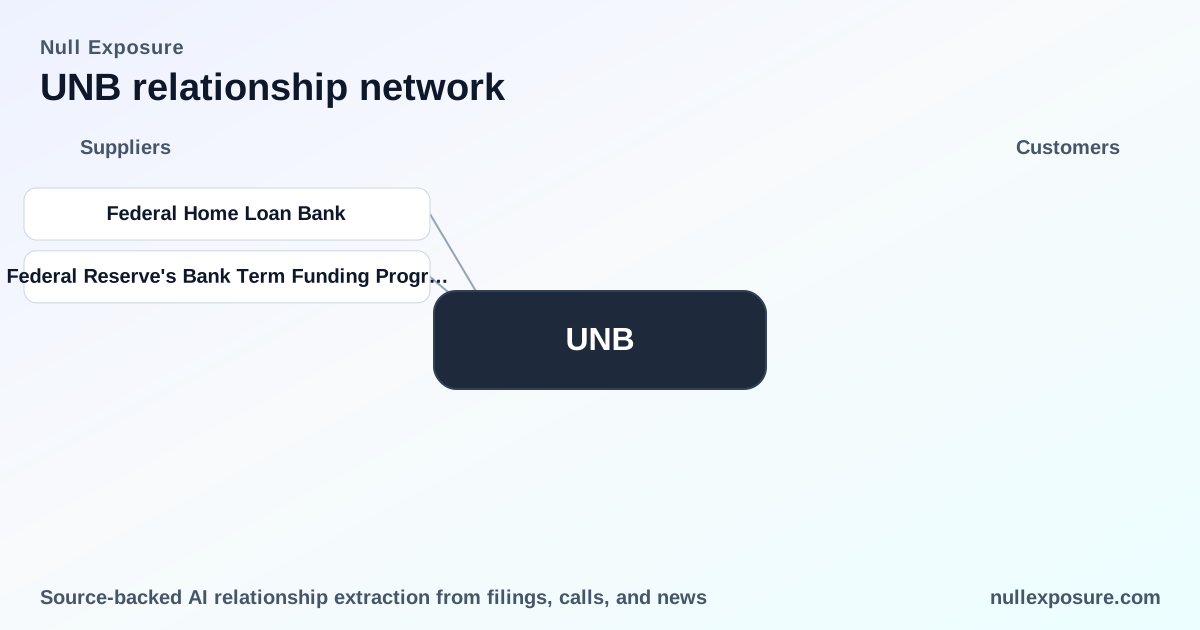
Union Bankshares (UNB) — supplier relationships that shape liquidity and operations
Union Bankshares, Inc. is a regional bank holding company that monetizes through traditional net interest income and fee-based banking services across Northern Vermont and New Hampshire, while using wholesale funding facilities and third‑party infrastructure to support balance sheet liquidity and customer delivery. For investors and counterparties, the critical questions are how Union finances its loan book and how dependent core operations are on outside vendors — both factors that influence capital flexibility and operational resilience. Explore supplier exposure and strategic implications with NullExposure for deeper diligence: https://nullexposure.com/
Quick read: what this supplier map means for a shareholder
Union’s supplier footprint in the record reviewed is narrowly concentrated around funding partners and outsourced infrastructure. Two material funding relationships show that the bank uses Federal Home Loan Bank (FHLB) advances and, historically, an advance from the Federal Reserve’s Bank Term Funding Program (BTFP) as part of its liquidity toolkit. Separately, company disclosures flag that third‑party vendors provide key infrastructure (internet, network, core processing), which is a structural operational dependency for a small regional bank.
If you want a concise supplier risk score and contract-level drilldown, NullExposure maintains an investor-facing portal with supplier maps and source traceability: https://nullexposure.com/
How Union structures funding and operations (operating-model implications)
Union operates like a classic regional bank that supplements deposit funding with secured advances and externally hosted technology. This operating posture has four practical implications:
- Contracting posture: Union uses committed and non‑deposit wholesale facilities rather than fully self-funded balance sheet strategies, which increases reliance on counterparties for short- to medium-term liquidity.
- Concentration and counterparty criticality: With a small number of identified funding relationships, counterparty concentration is meaningful for liquidity risk management; counterparties such as FHLB are credit and funding anchors for regional banks.
- Operational criticality: Disclosure that third‑party vendors supply "internet connections, network access and core application processing" signals that service‑provider continuity is essential to customer service and regulatory reporting.
- Maturity and flexibility: Use of programmatic advances (e.g., BTFP in the pandemic/transition period) shows willingness to tap temporary central bank facilities, indicating a pragmatic liquidity playbook rather than a singularly conservative deposit-only model.
These are company-level signals drawn from Union’s public disclosures rather than assertions tied to a single supplier contract. The firm explicitly states that dividends paid by Union are the primary source of funds available to the holding company for stockholder distributions, underscoring the importance of predictable cash generation and access to external liquidity.
Federal Home Loan Bank — the primary wholesale anchor
Union reported Federal Home Loan Bank advances of $270.8 million as of September 30, 2025, up from $230.7 million a year earlier, indicating active use of FHLB borrowings to supplement funding. According to Union Bankshares’ FY2025 earnings release (GlobeNewswire, reported by ManilaTimes, Oct 16, 2025), these advances are a material component of the bank’s borrowed funds.
- Implication: FHLB access provides secured, scalable liquidity but also creates interest expense and collateral management obligations; for a bank of Union’s size, the FHLB is a routine and critical counterparty. (Source: Union Bankshares FY2025 earnings release, Oct 2025.)
Federal Reserve’s Bank Term Funding Program — tactical, limited usage
Union disclosed that $10.0 million in advances from the Federal Reserve’s Bank Term Funding Program were outstanding as of September 30, 2024, reflecting participation in temporary central bank facilities during stress or balance-sheet adjustment periods. The same FY2025 release documents this legacy exposure.
- Implication: The small absolute size ($10 million) signals a tactical, not structural, reliance on emergency-style central bank liquidity; it is a liquidity backstop rather than a core funding strategy. (Source: Union Bankshares FY2025 earnings release, Oct 2025.)
The invisible but consequential supplier set: vendors that run the bank
Union’s public disclosures emphasize that third‑party vendors provide key components of business infrastructure — internet, network access, and core application processing — which is typical for community banks that outsource specialty systems. This is a company-level disclosure drawn from regulatory and investor materials.
- Implication for investors: Operational risk is concentrated in a small set of suppliers; contract terms, service-level commitments, and business‑continuity arrangements therefore have direct value at the shareholder level. A bank’s ability to process payments, maintain online services, and meet regulatory reporting timelines depends on these vendor relationships and their maturity.
Risks mapped to business and capital strategy
- Liquidity risk: Heavy reliance on FHLB advances increases sensitivity to collateral valuation and borrowing capacity limits; in constrained markets, access pricing can widen and compress net interest margins.
- Operational concentration: Outsourced core systems and network dependencies create single‑point failure risk that could affect customer deposits, fee income, and regulatory compliance if service disruptions occur.
- Dividend sustainability: Union states that dividends paid by the bank are the primary source of funds for holding company dividends; this makes consistent bank-level earnings and access to wholesale funding critical for shareholder distributions.
What investors should watch next
- Monitor FHLB advance balances and the loan‑to‑collateral profile each quarter to assess how liquidity sourcing trends over time.
- Scrutinize vendor contracting language in 10‑Q/10‑K disclosures or proxy statements for service-level guarantees and business continuity provisions.
- Track core deposit trends and interest‑rate sensitivity to project whether wholesale borrowing will be a temporary bridge or a longer-term fixture.
For a deeper supplier-by-supplier breakdown and traceable source links, see NullExposure’s supplier workstreams: https://nullexposure.com/
Bottom line: concentrated funding, outsourced operations, manageable tactical central bank usage
Union Bankshares runs a concentrated but conventional supplier profile for a regional bank: substantial FHLB reliance, a historical and small BTFP draw, and outsourced infrastructure that is operationally critical. For investors, the combination indicates liquidity flexibility with attendant counterparty and operational concentration risks that deserve active monitoring relative to deposit behavior and collateral dynamics.
If you evaluate bank counterparties or run an investor diligence program, NullExposure can provide the supplier mappings and primary-source links that matter: https://nullexposure.com/
Bold takeaway: Union’s funding model leverages secured wholesale advances for liquidity while delegating operational execution to third‑party vendors — a structure that supports growth but concentrates counterparty and operational risk.