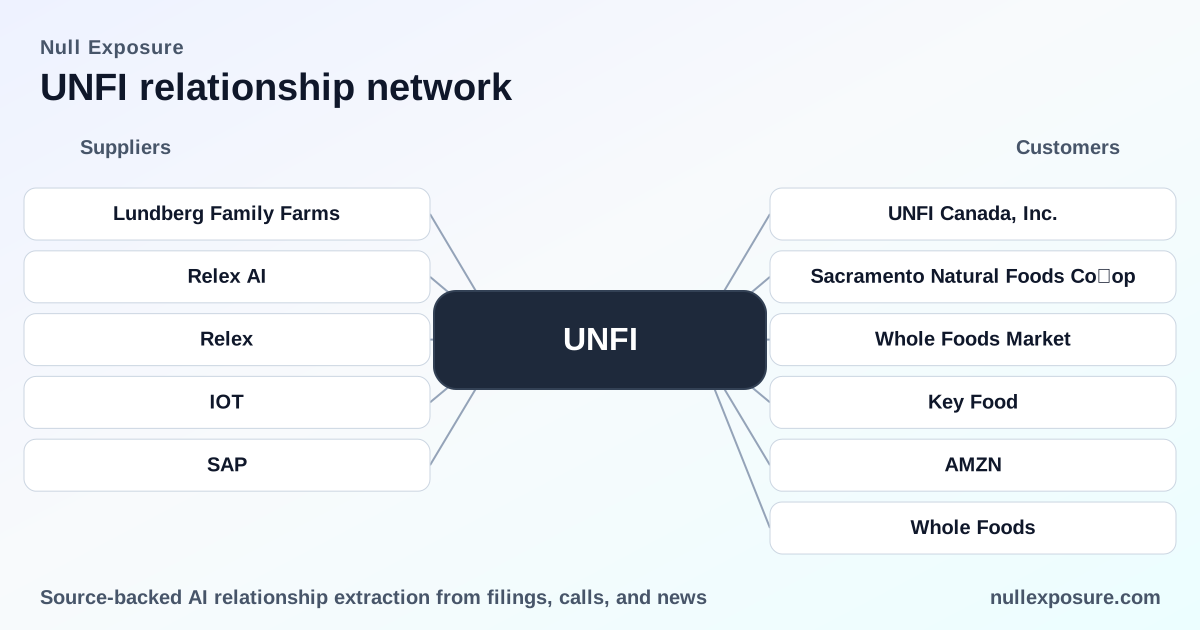
United Natural Foods (UNFI): Supplier Relationships, Tech Partners, and Operational Constraints
United Natural Foods, Inc. (UNFI) distributes natural, organic, specialty and conventional grocery products across the United States and Canada, monetizing through wholesale distribution margins, logistics services and value-add retail support to independent grocers and chains. With roughly $31.5 billion in trailing revenue and a broad national footprint, UNFI’s P&L depends on scale in procurement, distribution efficiency, and improving fill rates through technology—the latter being an explicit strategic priority as the company modernizes its supply chain and operations. For a focused view of UNFI’s supplier and vendor network and what it implies for investors and operators, read on. For service providers and counterparties looking to assess exposure or partnership opportunities, learn more at https://nullexposure.com/.
How UNFI actually operates and what that implies for partners
UNFI purchases products from nearly 10,000 suppliers and sells to a broad set of retail customers; the business is fundamentally a logistics and distribution operation that captures margin on product flows and charges for service. Key operating characteristics revealed in company disclosures and reporting are:
- Contracting posture is predominantly short-term. UNFI states it does not maintain long-term purchase commitments with most suppliers, which produces a flexible sourcing posture and lower supplier lock-in but also places a premium on operational execution and supplier relations to secure reliable supply (company filing commentary, fiscal 2025).
- Concentration is low. No single supplier accounted for more than 5% of purchases in fiscal 2025, signaling diversified procurement and limited vendor concentration risk.
- Geographic focus is North America with some global sourcing. The supplier base is primarily US and Canada, supporting a distribution footprint concentrated in North America.
- Relationship maturity and criticality vary. While the supplier base is large and mostly transactional, UNFI has exclusive distribution arrangements with some suppliers and is investing in long-term infrastructure (for example, a Sarasota distribution center recognized as a $118 million right-of-use asset in fiscal 2025), indicating selective longer-term commitments to support service levels.
These signals shape counterparty dynamics: suppliers face a transactional buyer that prizes scale and reliability; technology and logistics vendors that materially improve margins and fill rates are strategically critical. If you evaluate UNFI exposure, prioritize partners that deliver measurable operational improvements.
Supplier and vendor relationships you need to know
Lundberg Family Farms
Lundberg Family Farms is a long-standing supplier—partnering with UNFI since 1976—and was publicly recognized by UNFI for its leadership in organic rice and regenerative practices. According to an UNFI investor relations press release in March 2026, the company celebrated 50 years of partnership with Lundberg Family Farms (UNFI press release, March 2026).
Relex AI
UNFI completed a rollout of an AI-driven demand-forecasting platform identified as Relex AI across its distribution centers, delivering a 15% reduction in food waste and improved retailer fill rates, indicating material upside to gross margin and inventory turns from better forecasting. PredictStreet coverage on FinancialContent highlighted these operational gains in January 2026 (PredictStreet / FinancialContent, Jan 2026).
Relex (implementation across network)
UNFI reported implementing Relex across roughly half of its distribution network as of fiscal 2025, using automation and AI to raise fill rates and reduce inventory days—an explicit element of the company’s growth and margin plan through 2028. Supermarket News documented this rollout and the company’s financial targets in its FY2025 reporting (Supermarket News, FY2025).
Samsara
UNFI is deploying Samsara’s Connected Operations platform to improve driver safety and track delivery performance, reflecting a push to digitize fleet operations and lower logistics cost and risk. Supermarket News referenced the Samsara deployment in the company’s FY2025 growth-plan coverage (Supermarket News, FY2025).
SAP
UNFI’s board refresh and tech strategy include moving toward a unified SAP technology stack alongside Relex, signaling enterprise-level consolidation of ERP and supply-chain systems to support scale and visibility. PredictStreet coverage (FinancialContent) noted this strategic shift and the board changes in January 2026 (PredictStreet / FinancialContent, Jan 2026).
What the constraints tell investors about UNFI’s operating model
UNFI’s disclosed constraints present a cohesive company-level picture rather than relationship-specific limitations:
- Contract structure: The company signals a short-term supplier contracting posture for most relationships (confidence 0.80), which supports flexibility in procurement but makes operational execution and supplier service-level agreements more important for stability.
- Selective long-term commitments: UNFI also records multi-year lease commitments for distribution infrastructure (confidence 0.60), which anchors parts of the cost base and logistics capacity even while product procurement remains largely short-term.
- Geographic profile: The supplier base is concentrated in North America (confidence 0.80), consistent with a distribution-first North American business model that sources globally when necessary.
- Materiality and concentration: Suppliers are materially immaterial individually—no supplier exceeded 5% of purchases in fiscal 2025 (confidence 0.90)—reducing single-counterparty procurement risk but increasing reliance on internal logistics and forecasting to extract margin.
- Role diversity: UNFI operates as buyer, seller and service provider across its network (confidence 0.80), executing procurement from many suppliers while selling to many retail customers and providing distribution services through its DC network.
- Relationship stage: Most supplier and vendor relationships are active and operational, supported by investments in DCs and technology (confidence 0.80).
Collectively, these constraints describe a high-volume, low-concentration distribution business that invests selectively in fixed logistics capacity and prioritizes technology to convert volume into sustainable margin.
If you want to benchmark supplier risk or understand UNFI’s counterparty posture for contracting or credit decisions, get deeper signals and consolidated relationship data at https://nullexposure.com/.
Investment implications and risk-reward framing
UNFI’s transition to AI-driven forecasting and connected fleet operations addresses two of the largest profit levers in food distribution: waste reduction and delivery productivity. The several-point improvements in fill rates and a 15% reduction in food waste reported with Relex AI translate directly to margin expansion potential and working capital efficiency—critical when baseline operating margin is thin (operating margin TTM ~1.07%). UNFI’s broad supplier base and low concentration lower supplier-credit risk but elevate the importance of internal controls, forecasting accuracy, and DC performance.
Key investor takeaways:
- Upside catalyst: Technology and analytics (Relex AI, SAP integration) that materially reduce waste and inventory days are primary near-term value drivers.
- Operational risk: A mostly short-term supplier contracting posture creates exposure to supply shocks and price volatility; UNFI’s hedging against this is network scale and technology-enabled forecasting.
- Capital structure and fixed commitments: The company has committed to distribution center leases and capex that lock in capacity and cost; successful productivity improvements are necessary to cover these fixed costs.
If you are an operator or vendor evaluating partnership economics or credit exposure, model scenarios that assume incremental margin capture from improved forecasting and reduced logistics cost, and use UNFI’s published targets as baselines. Learn how to translate these relationship signals into commercial opportunity maps at https://nullexposure.com/.
Bottom line
UNFI runs a high-volume, low-concentration distribution platform that is in the midst of a technology-driven operational upgrade—one that transforms fill rates, reduces waste, and makes fixed distribution assets more productive. For investors and counterparties, the critical questions are execution of Relex and SAP integrations, realization of DC productivity gains, and UNFI’s ability to convert operational improvement into durable margin expansion. For further analysis and tailored exposure assessments, visit https://nullexposure.com/.