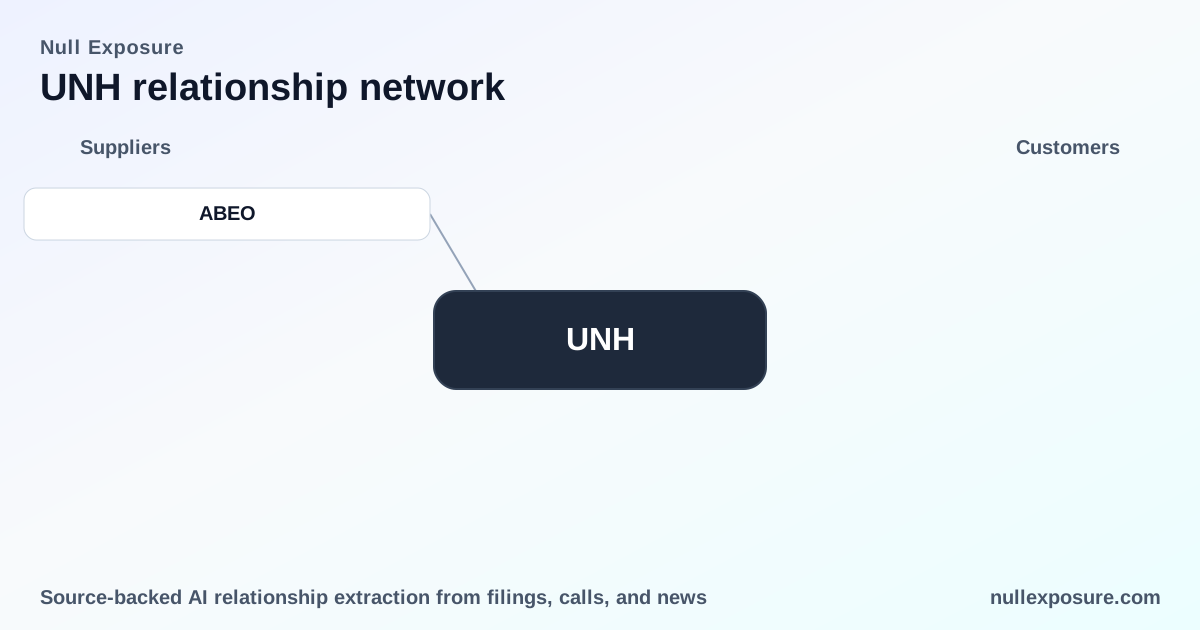
UnitedHealth Group (UNH): payer leverage, supplier exposure, and what Abeona coverage tells investors
UnitedHealth Group operates and monetizes as a dominant managed healthcare and insurance platform: it underwrites risk, negotiates provider and product contracts, and administers benefits through UnitedHealthcare (roughly 80% of group revenue), while Optum supplies analytics and care-delivery services that drive margin expansion. The business converts scale into negotiating leverage with suppliers and pharmaceutical manufacturers, extracting narrow margins on premium flows but benefiting from large, recurring cash conversion and diversified product sets. For investors, the most relevant lens is how coverage decisions and supplier arrangements translate into predictable claims expense, concentration risk, and optionality on new therapeutic spending.
Explore detailed supplier intelligence at https://nullexposure.com/.
Why supplier relationships matter to the UNH earnings model
UnitedHealth’s economics depend on controlling medical cost trends and steering utilization through coverage policy, prior authorization, and network design. When UnitedHealthcare adds coverage for a novel, high-cost therapy it directly affects short-to-medium-term claims liabilities and long-term negotiating posture with innovators and specialty manufacturers. That dynamic is both a risk (upfront increase in claims) and a bargaining lever (access to larger patient bases for suppliers). Company-level data reinforces the stakes: UnitedHealth reported roughly $448 billion in trailing revenue, giving the company scale to absorb some cost shifts but also exposing it to outsized spending on breakthrough therapies. According to company data as of the latest quarter (2025-12-31), UnitedHealthcare comprises the lion’s share of group revenue and is the primary conduit for these supplier relationships.
The supplier relationships in this file: one concise list
Below I cover every supplier relationship present in the provided results. Each is summarized in plain English with its source.
Abeona Therapeutics Inc. — ZEVASKYN coverage by UnitedHealthcare
Abeona’s FDA-approved autologous gene therapy ZEVASKYN received published coverage policies from major commercial payers including UnitedHealthcare, which signals that UnitedHealthcare will reimburse the therapy under commercial plans and thus act as a paying customer for Abeona’s product; that alignment accelerates patient access and revenue recognition for the supplier while increasing UnitedHealth’s exposure to a high-cost, specialized therapy. This was reported in a GlobeNewswire release distributed March 9, 2026 and covered by The Manila Times. (March 2026 coverage report.)
What the Abeona relationship reveals about UNH’s supplier posture
The Abeona coverage item is small in count but large in implication. UnitedHealthcare’s published policy inclusion means UNH functions as an enabler of commercial market access for specialty suppliers, but it also highlights several structural features of UNH’s operating model:
- Contracting posture: UnitedHealth operates as a buyer with substantial negotiating leverage; published coverage is the precursor to contract terms for pricing, step edits, and utilization management. That leverage constrains supplier pricing upside over time.
- Concentration: Because UnitedHealthcare represents the majority of group revenue, coverage decisions disproportionately influence supplier revenues and UNH’s claims trajectory, creating a feedback loop between supplier success and payer cost management.
- Criticality: For suppliers of one-off or high-cost therapies, access through UnitedHealthcare is critical to commercial viability; for UnitedHealth, these therapies are critical drivers of short-term claims volatility but not fundamental revenue drivers given scale.
- Maturity: UnitedHealth’s policy apparatus and historical use of utilization controls reflect a mature payer operating model that standardizes access while retaining tools to manage cost.
No supplier-level constraints were flagged in the provided constraint set; at the company level, that absence is itself a signal: no immediate supplier engagement red flags were captured in this pass, but the single relationship above warrants monitoring because specialty therapy coverage decisions are discrete events with outsized financial impact.
Explore UNH supplier coverage trends and alerts at https://nullexposure.com/.
Operational and investor implications
Investors and operators need to parse three concrete impacts from coverage moves like the Abeona decision:
- Near-term spend volatility: Coverage for high-cost gene therapies increases claims spend unpredictably. UnitedHealth’s scale cushions the blow, but earnings sensitivity to specialty launches is non-trivial.
- Negotiation windows: Coverage creates a commercial channel; the payer retains leverage to negotiate price, outcomes-based arrangements, and patient-identification criteria, which compresses supplier margins over time and stabilizes payer unit costs.
- Portfolio and supplier concentration risk: A single supplier relationship can grow quickly if patient uptake is faster than actuarial expectations; investors should watch uptake curves and utilization management rules that dictate real-world spend.
UnitedHealth’s financial profile — including a trailing revenue near $448B, EBITDA and margin metrics in company reporting, and a substantial institutional ownership base — positions it to absorb some shocks while preserving its bargaining power. The core risk for investors is not unilateral coverage, but coverage that accelerates durable, high-cost utilization without effective mitigants.
Practical next steps for investors and operators
- For investors: monitor policy language, utilization management criteria, and early uptake signals for newly covered therapies; these are leading indicators of claims trajectory and potential guidance impacts.
- For operators (procurement and contracting teams): prioritize outcomes-based terms and prospective authorization protocols when dealing with gene therapies to maintain cost predictability.
- For risk teams: stress-test actuarial models for scenarios where multiple specialty therapies are covered in the same plan year.
If you want a continuous feed of supplier coverage activity and contract-change alerts, sign up at https://nullexposure.com/.
Final takeaways
UnitedHealth’s decision to publish coverage for Abeona’s ZEVASKYN is a textbook example of how the company’s payer role accelerates commercial access for suppliers while transferring the negotiation and cost management burden onto the payer. With UnitedHealthcare accounting for roughly 80% of group revenue and generating scale-based negotiating power, investors should treat such coverage moves as high-impact but manageable catalysts—important to monitor for short-term earnings volatility and long-term supplier contract evolution. For ongoing tracking of UNH supplier relationships and policy shifts, visit https://nullexposure.com/ for alerts and analysis.