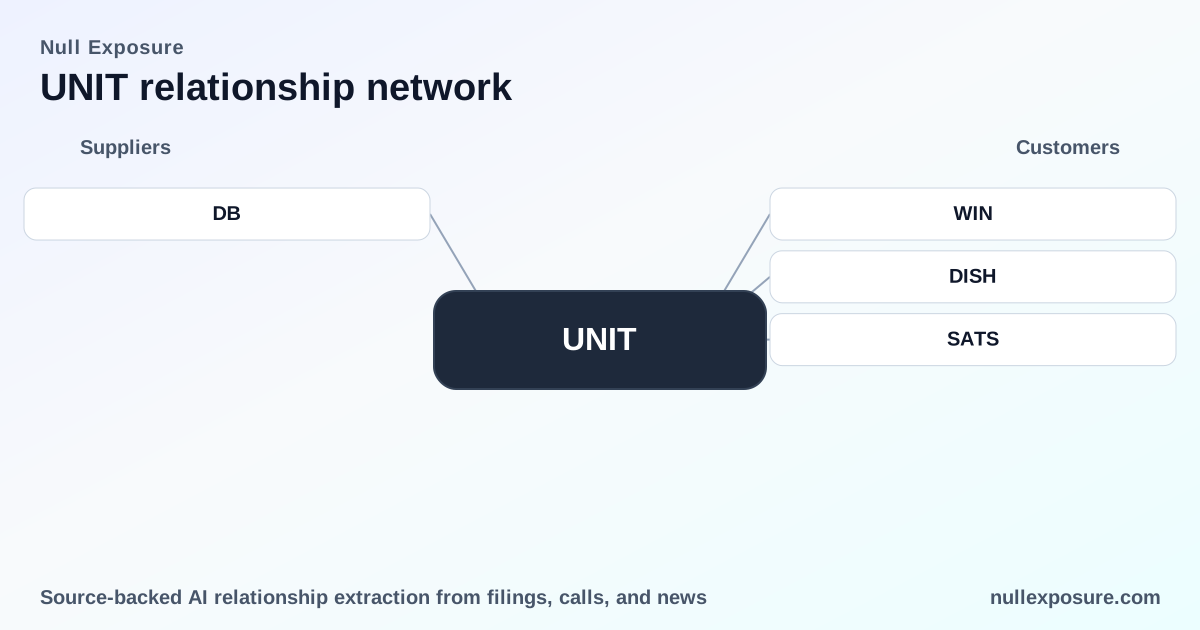
Uniti Group (UNIT) — Supplier relationships and what the Deutsche Bank note indenture reveals
Uniti Group operates as an internally managed real estate investment trust that acquires, builds and leases mission‑critical communications infrastructure to wireless operators and communications service providers. The business monetizes through long‑term lease revenue on fiber and wireless infrastructure while funding growth and liquidity predominantly through capital markets transactions and secured debt, creating recurring cash flow that supports distributions and asset reinvestment. For a focused supplier‑relationship view and cross‑reference material, visit https://nullexposure.com/.
Capital markets are a functional supplier for Uniti's growth engine
Uniti’s operating model is capital‑intensive and relies on external finance partners as de facto suppliers: banks, trustees and noteholders supply the capital that converts asset pipelines into leased infrastructure. The company’s most recent supplier‑scope disclosure shows a material capital transaction: a private offering of $1.0 billion of 8.625% Senior Notes due 2032, for which Deutsche Bank Trust Company Americas serves as trustee. According to TradingView’s report dated March 10, 2026, Uniti completed the offering and entered into an Indenture with Deutsche Bank Trust Company Americas as trustee (FY2026). This financing increases fixed interest obligations but also extends liquidity to support network acquisitions and development.
The Deutsche Bank trustee relationship, in plain English
Deutsche Bank Trust Company Americas acted as the indenture trustee on Uniti’s $1.0 billion 8.625% Senior Notes due 2032, a standard role that places the bank in an administrative and fiduciary position for the bondholders under the indenture. According to a TradingView report (March 10, 2026), the trust relationship accompanies Uniti’s private placement and is procedural to how the new debt is governed and administered (FY2026).
Why this financing relationship matters to operators and investors
- It is a direct signal of financing posture. Uniti uses liability markets actively: a high‑coupon private note indicates access to capital but at a premium cost of funds, which in turn pressures operational cash flow unless offset by high‑quality lease contracts and margin.
- Trusteeship is operationally important but not strategically controlling. Deutsche Bank, as trustee, administers covenants and bondholder communications rather than providing operational services; the agreement increases investor oversight via covenants embedded in the indenture.
- For more supplier relationship intelligence across financing and non‑financing suppliers, see https://nullexposure.com/.
What the supplier reporting (and absence of constraints) signals about Uniti’s operating model
The supplier‑scope data contains no explicit constraint entries. That absence is a company‑level signal worth noting in evaluating UNIT’s supplier posture:
- Contracting posture — internally managed and capital‑centric. Uniti’s self‑management model concentrates operational decision‑making internally while outsourcing capital and administrative functions (trustees, lenders, service contractors) to the market. This reduces dependence on external asset managers but increases reliance on capital providers.
- Concentration — institutional ownership and capital dependence. With institutional ownership at roughly 93.9%, Uniti faces concentrated market scrutiny and dependency on institutional sentiment for equity liquidity and governance. Capital suppliers therefore function as critical counterparties.
- Criticality — suppliers are mission‑critical for funding and compliance. Financing partners enable growth and refinance risk management; trustee relationships ensure bondholder protections and covenant enforcement.
- Maturity and lifecycle — predictable lease cash flows paired with episodic financing events. The business generates recurring revenues from long‑term leases (Revenue TTM: $2.2345 billion, EBITDA: $1.118 billion) but executes discrete capital market transactions to fund acquisitions and buildouts.
Because no supplier constraints were flagged in the reported supplier scope, investors should treat the absence as an explicit data point: Uniti’s supplier disclosures contained no flagged contractual constraints in the supplier view at the time of the data pull, which implies clean supplier reporting rather than an absence of risk.
Key financial context that shapes supplier risk
Uniti’s financial profile informs the lens through which supplier relationships are evaluated:
- Scale and profitability: Revenue TTM is $2.2345bn with an EBITDA of $1.118bn and a reported profit margin of 58.4%, indicating strong operating leverage on existing assets and the ability to service fixed costs from recurring cash flow.
- Leverage and cost of capital: The issuance of 8.625% senior notes demonstrates willingness to pay elevated yields to access liquidity; investors should treat such financings as a sign of active liability management and possible refinancing risk at the instrument’s maturity in 2032.
- Market perception: Institutional ownership concentration and mixed analyst sentiment (Buy/Hold/Sell spread present) mean that financing events and trustee relationships will attract attention from institutional gatekeepers.
Practical checklist for evaluating supplier exposures at Uniti
- Confirm the terms and covenants of the indenture that Deutsche Bank administers, because covenant tightness drives refinancing flexibility and potential stress triggers.
- Assess lease revenue quality and counterparty concentration on the asset side to determine the company’s ability to absorb higher financing costs.
- Review the timeline for the new notes (2032 maturity) against Uniti’s asset maturity and planned capital raises to evaluate refinancing windows and liquidity needs.
Closing view and recommended next steps
Uniti’s supplier footprint in the financing domain is material: capital providers serve as operational enablers, and the Deutsche Bank trustee role on the $1.0 billion 8.625% notes is a clear example of how financing relationships function as supplier relationships for this REIT. Investors and operators should prioritize covenant analysis and the interplay between high‑quality lease cash flow and episodic reliance on market debt.
For an expanded supplier map and ongoing monitoring of Uniti’s counterparty relationships, visit https://nullexposure.com/. If you’re building a diligence file for UNIT or comparable communications‑infrastructure REITs, the interplay between trustee/lender roles and asset cash flows is the single most actionable area for near‑term risk management — explore further at https://nullexposure.com/.