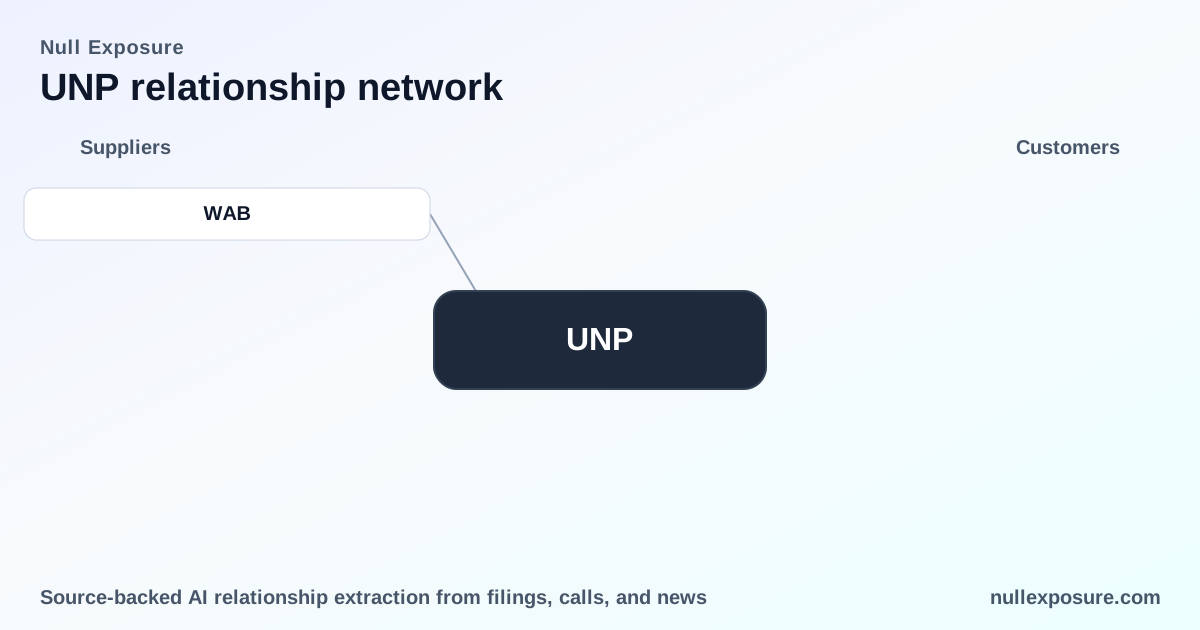
Union Pacific’s supplier posture: why the Wabtec modernization deal matters to investors and operators
Union Pacific Corporation runs one of North America’s largest freight rail networks and monetizes primarily through freight haulage, asset utilization, and disciplined pricing on a largely contracted customer base. The company’s operating leverage is driven by rolling stock availability, fuel efficiency and the reliability of locomotives—factors that make suppliers of locomotives and parts strategically consequential for both near-term operations and multi-year return-on-capital. Investors should view supplier relationships not as peripheral procurement items but as core drivers of cost, capacity and service reliability. For detailed supplier intelligence and monitoring, visit https://nullexposure.com/.
The commercial headline: a US$1.2 billion Wabtec modernization program
Union Pacific has announced a major locomotive modernization agreement with Westinghouse Air Brake Technologies (Wabtec). The program is priced at roughly US$1.2 billion and targets upgrades across a large portion of the fleet, a move that signals a focus on fuel efficiency and reliability that directly affects operating margins and capital planning.
Relationship inventory — every mention in the record
-
A Simply Wall St report (March 10, 2026) highlights the settlement context and references Wabtec’s US$1.2 billion Union Pacific locomotive modernization agreement intended to upgrade more than 1,700 units starting in 2027; that article positions the deal alongside broader commercial momentum at Wabtec. (https://simplywall.st/stocks/us/capital-goods/nyse-wab/westinghouse-air-brake-technologies/news/can-wabtecs-wab-legal-truce-with-progress-rail-quietly-refra)
-
An InsiderMonkey recap (March 10, 2026) cites Union Pacific’s February 4 announcement of a major agreement with Wabtec valued at $1.2 billion, framing the transaction as a near-term catalyst for supplier demand. (https://www.insidermonkey.com/blog/bmo-capital-sees-further-upside-for-union-pacific-unp-as-freight-recovery-continues-1701585/)
-
A Finviz market commentary (March 10, 2026) describes the same $1.2 billion modernization partnership with Wabtec and explicitly links the program to objectives of improving fuel efficiency and reliability across the locomotive fleet. (https://finviz.com/news/326228/union-pacific-corporation-unp-a-bull-case-theory)
-
A second Simply Wall St piece (March 10, 2026) puts Wabtec back in investor focus after securing multihundred-million-dollar locomotive deals with Union Pacific and other peers, noting that those wins influenced updated 2026 sales guidance and share repurchase posture at Wabtec. (https://simplywall.st/stocks/us/capital-goods/nyse-wab/westinghouse-air-brake-technologies/news/a-look-at-wabtec-wab-valuation-after-new-locomotive-deals-an)
Each entry documents the same commercial relationship from different media angles: the deal size, scope (modernization and fuel/reliability objectives), and the market reaction for Wabtec as a supplier.
What the supplier constraints reveal about Union Pacific’s operating model
Union Pacific’s own disclosures identify a concentrated supplier base for locomotives and rail equipment. The company explicitly warns that if one of its two domestic locomotive suppliers stops manufacturing, supplying parts, or supporting maintenance, it will experience significant cost increases and reduced locomotive availability.
From that disclosure and the Wabtec engagement, several firm-level characteristics follow:
-
High supplier concentration and criticality. Locomotives are capital-intensive, technically specialized assets supplied by a small set of domestic manufacturers; Union Pacific’s operations therefore depend on a narrow supplier set for both equipment and long-term maintenance support.
-
Manufacturer-dominated relationships and long-term contracting. Because of high barriers to entry for new suppliers, Union Pacific’s procurement posture is oriented toward long-duration OEM agreements and modernization programs instead of frequent spot purchases.
-
Mature supplier market with limited substitution. The locomotive equipment segment is mature: technological upgrades are incremental but expensive, and switching away from incumbent manufacturers involves both performance risk and long lead times.
-
Direct operational impact on margins and capacity. Supplier performance translates directly into throughput and fuel efficiency, making these relationships a lever on both revenue per ton-mile and operating expense.
These constraints are company-level signals drawn from Union Pacific’s disclosures; they inform negotiating leverage, capex cadence and contingency planning across the network.
Why the Wabtec program changes the risk/reward equation
The US$1.2 billion modernization program with Wabtec is not a routine parts order; it is a capital program that upgrades fleet efficiency and reliability, which directly supports higher asset utilization and lower fuel and maintenance costs over the life of the locomotives. For investors, this means:
-
Near-term capex and working capital impact as modernization is executed starting in 2027, which will show up in maintenance-of-way and equipment spend before full benefit realization.
-
Medium-term margin improvement driven by fuel efficiency gains and lower unscheduled downtime, improving operating ratio dynamics if traffic volumes remain steady.
-
Supplier concentration exposure with offsetting depth. The deal deepens one supplier relationship (Wabtec), reducing multi-vendor fragmentation but increasing dependence on Wabtec’s execution and supply chain resilience.
For investors seeking ongoing supplier intelligence and to monitor execution, consult https://nullexposure.com/ for tracking and alerts.
Operational and financial risks to watch now
Despite the upside, the combined disclosure and deal profile create clear watch-list items for analysts and operators:
-
Execution risk at the supplier. Any manufacturing delay, quality failure or parts shortage at Wabtec will translate into locomotive outages and potential service constraints.
-
Regulatory/emissions compliance risk. The company’s disclosure links supplier capability to meeting efficiency and emissions standards; supplier failure to deliver compliant equipment would force costly retrofits or operating constraints.
-
Concentration shock. With effectively two domestic suppliers referenced, a solvency or capacity problem at either supplier creates outsized disruption risk.
-
Capex timing and cash-flow phasing. Large modernization programs push cash outflows into near-term periods; investors should watch capex guidance and maintenance spend versus expected efficiency gains.
How to put this into a valuation or operational playbook
Analysts should stress-test scenarios where supplier delivery schedules slip by 6–18 months, or where unit efficiency gains fall short of plan, and fold those outcomes into the operating ratio and free cash-flow projections. Operators should demand explicit contractual protections—performance milestones, parts inventory commitments, and maintenance-service level agreements—that translate supplier performance into measurable network uptime.
For a centralized source of supplier relationship intelligence and monitoring tools, see https://nullexposure.com/.
Bottom line for investors and operators
Union Pacific’s relationship with Wabtec is strategic and material. The US$1.2 billion modernization program strengthens fleet economics but simultaneously concentrates execution risk. Union Pacific’s public disclosures already frame supplier failure as a core operational threat, which elevates the importance of monitoring supplier performance, contractual protections and capex realization.
Analysts should incorporate supplier execution scenarios into both earnings sensitivity and balance-sheet stress tests; operations leaders must translate the Wabtec agreement into concrete service-level and parts-supply commitments. For continuously updated supplier coverage and to benchmark counterparties, visit https://nullexposure.com/.