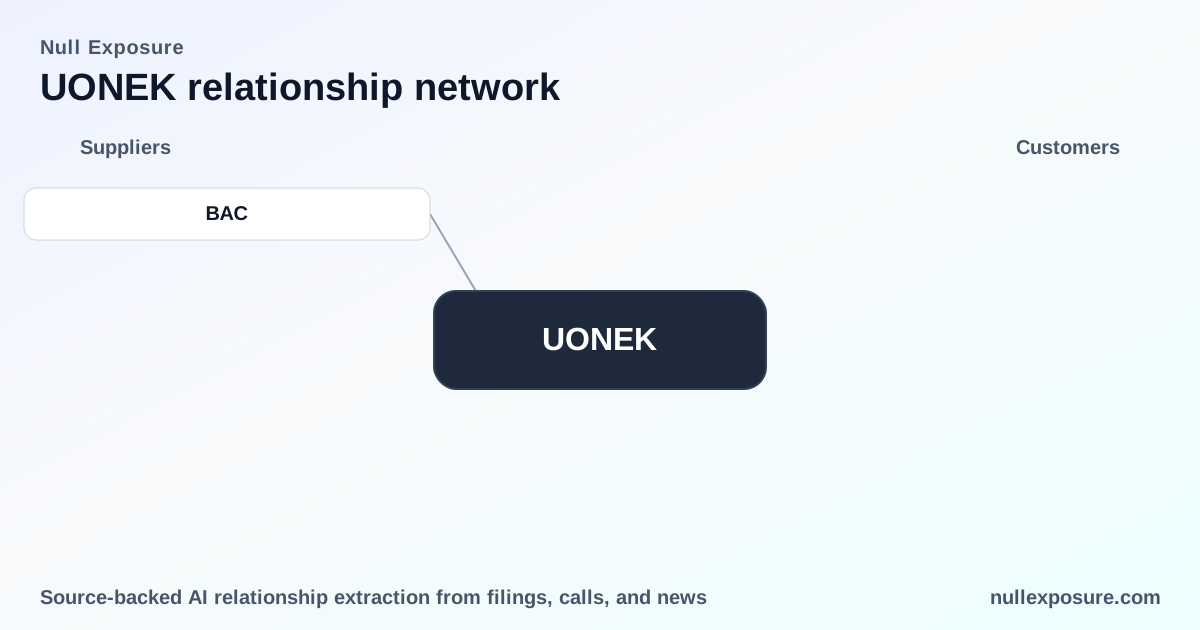
Urban One (UONEK) — supplier relationships, leverage posture and what the Bank of America linkage means for investors
Urban One operates as an urban-focused multimedia company that monetizes audio, video and digital audiences through advertising, content licensing and distribution agreements across radio, cable and digital platforms. The company’s economic model is advertising-driven with material fixed-cost commitments — long-term broadcast leases, content contracts and debt — and its supplier relationships reflect that capital intensity. Investors should treat supplier and lender linkages as core to liquidity and operating flexibility, not peripheral vendor noise. For a concise supplier risk snapshot and ongoing monitoring tools, visit https://nullexposure.com/.
Why the Bank of America amendment matters to shareholders
Urban One disclosed that on February 9, 2026 it amended its Amended and Restated Credit Agreement with Bank of America and other lenders to clarify the maturity date of its asset-based lending facility. According to a Globe and Mail press release covering FY2026 disclosures, the amendment was a direct action taken to address the company’s credit facility wording and helped Urban One regain Nasdaq compliance. This is a lender-driven operational lever: credit agreement amendments can reset covenant pressure, extend runway and preserve listing status, all of which are material to equity holders.
Complete supplier roll-call and the single relationship in scope
Bank of America (BAC)
Urban One amended its ABL facility documentation with Bank of America and syndicate lenders on February 9, 2026 to clarify the maturity date, an action tied to regaining Nasdaq compliance according to the Globe and Mail press release covering the FY2026 filing. This is a lender relationship with direct implications for liquidity and covenant testing. (Source: Globe and Mail / company filing, FY2026)
Company-level contract characteristics that shape supplier risk
Urban One’s public disclosures and the constraint excerpts provide several company-level signals about contract posture and exposure:
- Long-term obligations dominate operating posture. The company carries publicly disclosed debt with the 2028 notes (7.375% coupon, semi-annual interest) and non-cancelable operating leases for office, studio, broadcast towers and transmitter facilities extending across multiple decades. This demonstrates a high degree of maturity concentration in fixed costs that reduces near-term pricing flexibility.
- Licensing is structurally important and recurrent. Urban One is a licensee under collective rights arrangements; certain PRO licenses come up for renewal and are actively under negotiation, which creates periodic upward pressure on content costs.
- Spend magnitude is material but not enormous. Approximately $68.4 million of other operating commitments sit off the consolidated balance sheet as of December 31, 2024 — with roughly $20.9 million tied to cable content agreements and $22.2 million to employment commitments — which positions aggregate off‑balance commitments in the $10m–$100m spend band reported.
- Contract maturity and liquidity risk are company-level constraints. The maturity profile of the 2028 notes and long lease tenors indicate refinancing sensitivity between now and 2028, elevating the importance of the ABL facility and lender relationships for working capital and compliance.
These are company-level signals and are not assigned to any single supplier unless explicitly named in the constraint excerpts.
How these characteristics translate to investor action
Urban One’s financial profile underlines the supplier and lender story: trailing twelve-month revenue of $393.7 million and gross profit of $267.3 million sit alongside a negative EPS of -2.86 and a profit margin of -32.6%, while operating margin is positive at 6.03%. The combination of material fixed commitments, licensing renewal risk, and an active lender amendment creates a handful of priorities for underwriting and operations teams:
- Monitor lender covenants and ABL facility language closely; amendments like the February 2026 change are a leading indicator of covenant flexibility or stress.
- Treat long-term lease obligations and content commitments as structural cost bases when forecasting free cash flow; renegotiation upside is limited in the near term.
- Track licensing negotiations as a variable cost risk that can increase margins’ volatility if royalties or PRO fees step up on renewal.
- Given concentrated insider ownership (approximately 55% insiders) and relatively low institutional holdings (~26%), governance and related-party dynamics matter for negotiating strategic alternatives.
For investors and counterparties seeking a single place to track supplier- and lender-driven risk indicators for Urban One, see https://nullexposure.com/ for consolidated monitoring and alerts.
Operationally material implications for operators and counterparties
Operators contracting with Urban One — whether for content, towers, or studio services — should price for a counterparty that is capital constrained yet contractually sticky: long leases and multi-year content commitments reduce the company’s ability to quickly shed cost, while lending relationships and off-balance commitments can define the practical lifetime of those contracts. Lenders and major suppliers have structural leverage because of the company’s dependence on broadcast infrastructure and distribution agreements.
- Counterparty negotiation posture: Suppliers with replacement costs for towers/studios have superior bargaining power because switching is expensive for Urban One.
- Criticality: Broadcast infrastructure and PRO licenses are mission-critical to revenue generation; disruptions to those contracts would have disproportionate impact on cash flow.
- Concentration: Off‑balance content and employment commitments show concentrated spend categories that influence working capital and operating leverage.
Access a focused supplier-risk dashboard for media-sector counterparties at https://nullexposure.com/ to convert these observations into monitoring triggers.
What to watch next — triggers that will change the investment case
- Lender communications and any further amendments to the ABL or the 2028 notes. Additional concessions would ease short‑term liquidity pressure; stricter terms would compress equity optionality.
- Outcomes of PRO license renewals and any public disclosures of increased music license fees; rising content costs would pressure margins.
- Off‑balance contractual disclosures and any movement to recognize additional commitments on the balance sheet.
- Operating performance versus ad revenue trends given Urban One’s advertising-dependent monetization; revenue shocks will rapidly stress the existing capital structure.
For a pragmatic next step, suppliers and investors should maintain direct covenant monitoring and subscribe to ongoing updates at https://nullexposure.com/.
Bold takeaway: Bank of America’s amendment is not just paperwork — it is a balance-of-power event that preserved listing status and temporarily stabilized liquidity, while long-term leases and content commitments define the company’s structural cost base. Investors and operators need to treat lender covenants and licensing negotiations as first‑order variables when evaluating Urban One.