Upland Software (UPLD): supplier relationships that shape scalability and execution
Upland Software operates a portfolio of cloud-based enterprise work management applications and monetizes primarily through subscription and maintenance revenue, accelerated by targeted acquisitions and third‑party marketplace distribution. The company expands capability and distribution by acquiring niche products, migrating them into third‑party cloud environments, and listing key offerings in cloud marketplaces to widen reach and reduce go‑to‑market friction. For investors assessing supplier counterparty risk and operational execution, the focus is on how Upland integrates acquisitions, its dependence on cloud providers for hosting and distribution, and the commercial lift that marketplace presence delivers.
Explore deeper supplier exposure and relationship intelligence at https://nullexposure.com/.
How Upland structures its vendor footprint and why it matters
Upland’s operating model is acquisition‑driven growth plus a SaaS delivery posture. Company disclosures state clearly that Upland utilizes third‑party cloud providers for its cloud products and moves acquired products into those third‑party clouds as part of integration programs; in limited instances customers selecting perpetual licenses can have those installations hosted on third‑party data centers. That is a company‑level signal of a vendor strategy that prioritizes agility and cost control over owning data center infrastructure.
This posture produces a set of practical business model characteristics investors should track:
- Contracting posture: Predominantly vendor‑managed SaaS agreements delivered on third‑party clouds, reducing capital intensity but increasing supplier concentration risk.
- Concentration: Marketplace and cloud platform relationships (notably with major hyperscalers) function as distribution channels and hosting layers; this centralizes operational dependency on those providers.
- Criticality: Third‑party cloud partners are operationally critical — uptime, compliance, and pricing of those partners directly affect product availability and gross margin.
- Maturity: Upland’s repeated pattern of acquiring point solutions and migrating them to cloud platforms demonstrates a mature integration playbook but also introduces execution risk during consolidation.
The relationships you must evaluate (and what they mean)
Below I run through every supplier/partner relationship surfaced in publicly available reporting and describe the commercial relevance for investors.
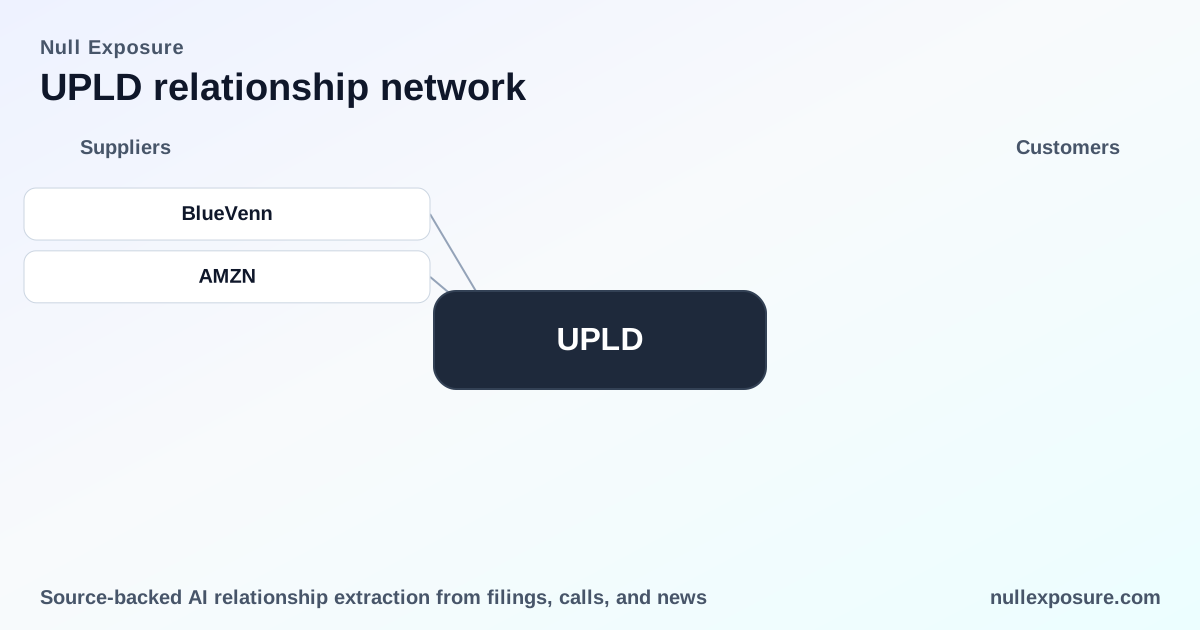
BlueVenn — acquisition expanded CDP capability
Upland acquired BlueVenn, a cloud‑based customer data platform, as part of its product expansion strategy; this deal bolstered Upland’s marketing and customer‑data capabilities and illustrates the company’s use of M&A to add adjacent software functionality. According to CityBiz reporting, the BlueVenn acquisition was announced as part of Upland’s prior acquisition activity in FY2021.
Amazon Web Services (AWS) — platform collaboration for AI search (BA Insight)
BA Insight, an acquired product within Upland’s portfolio, has an explicit collaboration with Amazon Web Services to deliver intelligent, secure, and scalable AI‑driven search solutions, signaling that Upland leverages AWS technology and services to build differentiated enterprise capabilities. InvestingNews coverage of BA Insight highlighted the AWS collaboration in its FY2026 reporting.
AWS Marketplace — distribution and product availability (RightAnswers and BA Insight)
Upland has listed Upland RightAnswers and Upland BA Insight in AWS Marketplace, including BA Insight’s listing under the AI Agents and Tools category, which materially improves discoverability and procurement speed for enterprise customers. Upland’s FY2025 results commentary in InvestingNews confirmed the marketplace availability and used it as a line item in its go‑to‑market updates.
What these relationships imply for investors and operators
The combination of targeted acquisitions (BlueVenn), platform collaboration (AWS), and marketplace distribution (AWS Marketplace) produces a coherent commercial strategy: buy capability, migrate to cloud partners, and sell through platform marketplaces to accelerate adoption. From an investor standpoint, that yields three clear implications:
- Revenue acceleration lever: Marketplace listings shorten procurement cycles for enterprise buyers and can increase ARR velocity with lower direct sales cost. AWS Marketplace placement is a visible execution win for scaling sales of RightAnswers and BA Insight.
- Operational dependency: Reliance on third‑party cloud providers is a structural operational dependency; outages, pricing shifts, or changes in marketplace terms at AWS would directly affect delivery and gross margin dynamics.
- Integration risk and modernization upside: Acquiring assets like BlueVenn and moving them into cloud environments creates near‑term integration costs but offers long‑term margin expansion and cross‑sell potential if migrations complete successfully.
Practical next steps for investors and procurement teams
- Perform diligence on contract terms and SLA exposure to cloud providers; ask for details on vendor failover strategies and cost pass‑through clauses.
- Monitor ARR mix coming from marketplace sales versus direct channel sales to assess the sustainability of distribution cost advantages.
- Track integration milestones and migration timelines for recent acquisitions to evaluate operating leverage realization.
If you want ongoing, deal‑level supplier visibility for Upland and its peers, review our supplier coverage at https://nullexposure.com/.
Final read: balance of growth and vendor concentration
Upland’s strategy is straightforward: use acquisitions to broaden product breadth, host and scale those products on industry cloud platforms, and leverage marketplace distribution to reduce friction in enterprise procurement. That approach lowers capital expenditure and accelerates GTM, but it simultaneously concentrates operational risk with cloud suppliers and places a premium on integration execution. For investors, the reward is recurring revenue growth unlocked by marketplace channels; the risk is platform dependency and migration execution.
For a structured supplier risk scorecard and continuous monitoring of Upland relationships, go to https://nullexposure.com/ and subscribe for updates.