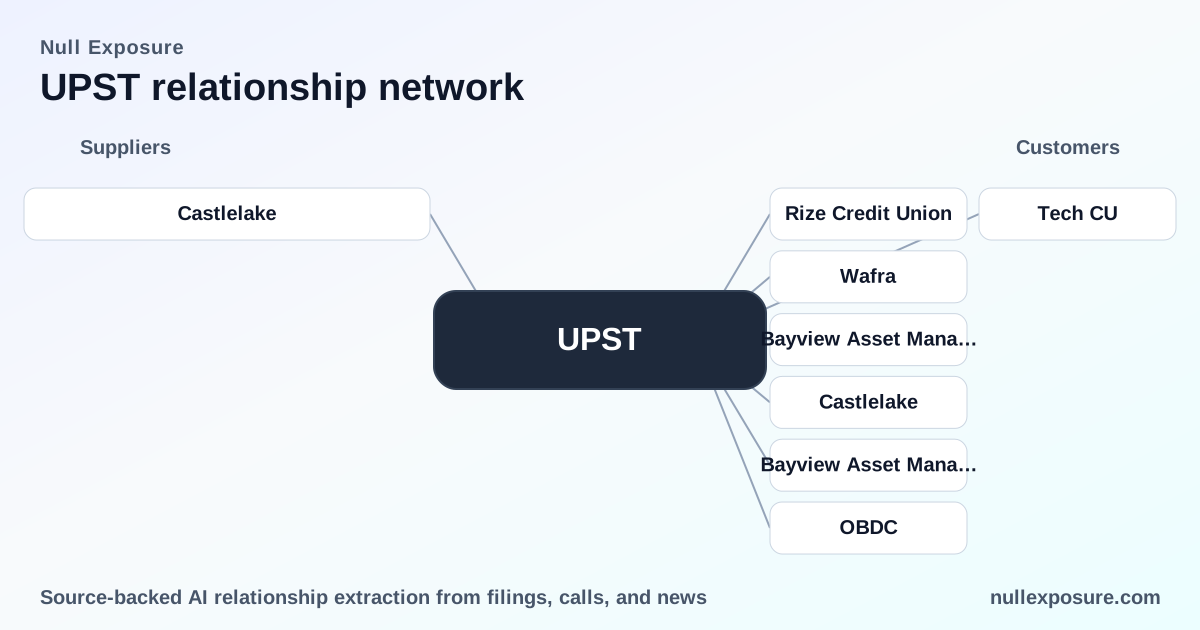
Upstart (UPST): How supplier and financing relationships shape capacity and risk
Upstart operates an AI-driven lending marketplace that originates consumer loans and sells or finances those credit assets through capital partners. The company monetizes via origination and servicing fees, interest spreads where it retains credit exposure, and by expanding throughput through forward-flow financing and bank/credit-union conduits that supply or warehouse funded loans. For investors and operators assessing counterparties, the critical questions are which counterparties provide funding capacity, which vendors execute operational work (collections, cybersecurity, compliance), and how those ties constrain growth or introduce concentration and operational risk. Visit https://nullexposure.com/ for further counterparty intelligence and modelled exposure profiles.
The single financing relationship flagged: Castlelake's forward-flow commitment
A March 2026 market note referenced a $1.5 billion forward-flow agreement with Castlelake, which the report attributes to materially expanding Upstart’s lending capacity. This is a financing relationship that supplies capital against originated loans and thereby increases originations without immediate retained balance-sheet risk. According to a TradingView summary of Zacks commentary dated March 10, 2026, “The $1.5 billion forward-flow agreement with Castlelake and continued additions of bank and credit union partners have expanded Upstart’s lending capacity.”
Why a forward-flow partner matters for investors
Forward-flow financing is an execution-level lever for volume: it directly increases Upstart’s ability to place loans, stabilizes throughput expectations, and shifts funding risk to the counterparty under the terms of the flow. For investors, the economics hinge on pricing, termination clauses, and any retained credit exposure; for operators, the arrangement affects origination cadence and capacity planning. The Castlelake commitment is a capacity multiplier and therefore a high-impact supplier relationship for growth execution.
Company-level supplier posture: outsourcing for risk management and collections
Upstart’s public disclosures state that the company engages third parties for cybersecurity design and testing and that borrower payment collections for loans more than 30 days past due or charged off are generally outsourced to third‑party collection agencies. Those excerpts are present in company filings and describe two distinct operational outsourcing vectors:
- “We engage assessors, consultants, auditors, or other third parties in connection with our risk assessment processes. These service providers assist us to design and implement our cybersecurity policies and procedures, as well as to monitor and test our safeguards.”
- “Borrower payment collections for loans that are more than 30 days past due or charged off are generally outsourced to third‑party collection agencies.”
These statements are company-level signals of a service-provider operating model (documented with a relationship_role confidence of 0.80), not attributes of any single capital partner. Outsourced cybersecurity and collections are integral to Upstart’s operating model and should be treated as critical dependencies for both governance and recovery performance.
What this implies about contracting posture, concentration, criticality, and maturity
- Contracting posture: Upstart combines capital-market partnerships (forward-flow financing) with outsourced operational services, indicating a hybrid model that relies on external funding while maintaining a platform and scoring IP. Forward-flow contracts are typically ongoing, capacity-oriented agreements rather than one-off trades, so they imply multi-period counterparty exposure.
- Concentration: The Castlelake deal is a large, named commitment and therefore creates concentration around a financing counterparty, but the company’s stated additions of bank and credit-union partners are a deliberate diversification signal that reduces single-counterparty funding risk.
- Criticality: Outsourced collections and cybersecurity providers perform functions that are operationally critical—collections affect recoveries and loss severity; cybersecurity vendors underpin regulatory and fraud controls—so vendor failures would have direct financial and regulatory consequences.
- Maturity: The use of professional assessors, auditors, and collection agencies is consistent with a mature fintech operating model that outsources specialized services while retaining marketplace control of borrower acquisition and underwriting models.
Relationship inventory (every supplier relationship in the record)
- Castlelake — The records show a $1.5 billion forward-flow financing agreement that expands Upstart’s lending capacity by providing committed capital to purchase or warehouse originated loans; this relationship is described in a TradingView/Zacks note dated March 10, 2026. (TradingView/Zacks, March 10, 2026)
No other named supplier relationships appear in the provided results.
Operational and investor takeaways
- Capital concentration is meaningful but being addressed. The Castlelake forward-flow commitment provides immediate capacity but creates a concentration node in funding; Upstart’s additional bank and credit-union partners are an explicit diversification strategy (TradingView/Zacks, March 2026).
- Operational dependencies are formalized. Company disclosures identify outsourced cybersecurity testing and collections as standard practice; these are non-trivial operational risks that require vendor governance, contract SLAs, and contingency planning (company filings language).
- Counterparty diligence should focus on contract terms and vendor controls. Assess the forward-flow agreement’s termination rights, credit retention, indemnities, and liquidity triggers; for operational suppliers, prioritize data-security attestations, audit scope, and collections performance metrics.
- Positive for throughput, conditional on execution. The Castlelake commitment supports near-term origination scale, but retained credit economics and vendor execution determine realized profitability.
Explore deeper counterparty profiles and modeled exposure scenarios at https://nullexposure.com/ to translate supplier commitments and outsourcing posture into actionable investment and operational priorities.
Final recommendation for investors and operators
Treat the Castlelake forward-flow deal as a material financing relationship that supports growth but requires active monitoring for concentration and contract risk. Simultaneously, elevate governance over outsourced cybersecurity and collections vendors because those suppliers are critical to loss control and regulatory compliance. For actionable counterparty intelligence and continuous monitoring of UPST counterparties, visit https://nullexposure.com/—subscribe to track changes in financing commitments and supplier constraints that affect credit throughput and operational resilience.