Upwork (UPWK) — Supplier Relationships, Constraints, and Investor Takeaways
Upwork operates an asset-light digital marketplace that connects businesses to independent professionals and monetizes primarily through transaction fees, membership and talent services, and value-added subscription offerings to clients and freelancers. The company leverages platform scale and data to capture take-rates on completed engagements, sells premium talent-matching and certification products, and increasingly packages AI-enabled upskilling as a revenue stream. For investors, the critical lens is whether Upwork can convert platform engagement into higher-margin services while maintaining stable supplier-side performance and manageable third-party infrastructure costs.
Explore detailed supplier intelligence and benchmarking on the NullExposure homepage: https://nullexposure.com/
What the single supplier relationship tells investors
OpenAI partnership — a concise read
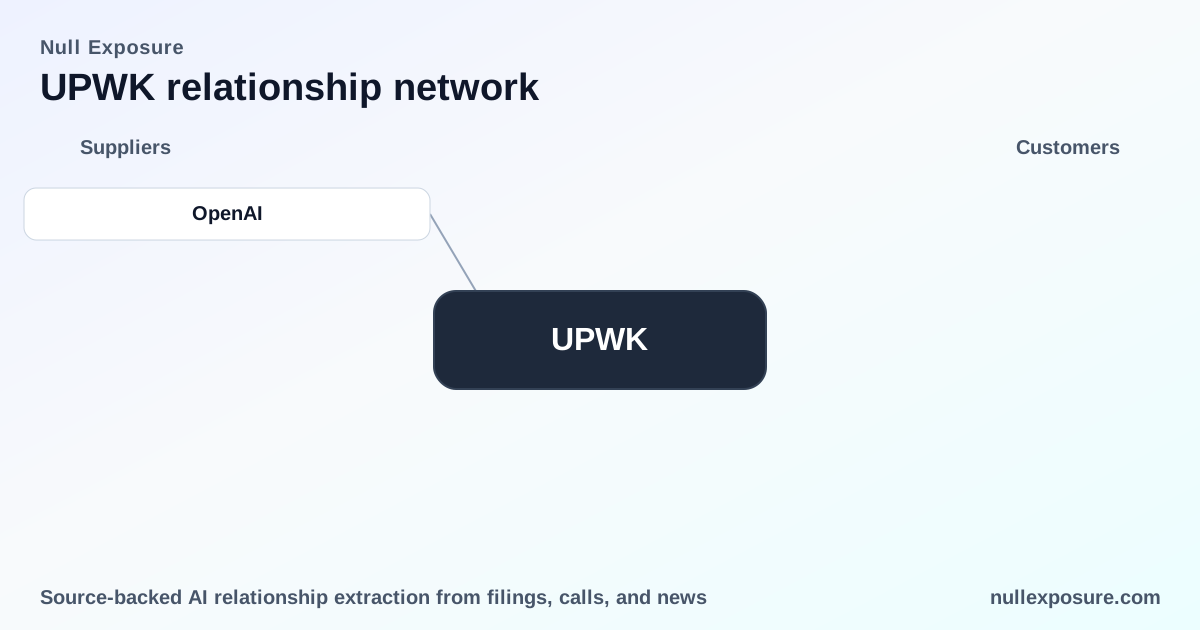
Upwork announced a partnership with OpenAI in FY2026 to deliver AI training, certifications, and upskilling to independent professionals on the Upwork Marketplace. This initiative positions Upwork to accelerate freelancer skill upgrades and create monetizable certification products tied to an industry-leading AI vendor (StockTwits, March 10, 2026). According to the FY2026 news mention, the OpenAI collaboration is oriented around training and marketplace credentialing rather than core infrastructure provisioning.
How supplier and company-level constraints shape the operating model
Contracting posture and supplier role
Upwork reports routinely engaging third-party service providers to support cybersecurity, data privacy, and user verification, and it recognizes vendor contract terminations and related costs as part of restructuring activity. This signals a contracting posture that relies on external specialists for non-core, high-skill operational functions rather than vertically integrating those services, which preserves capital flexibility but creates vendor management exposure.
Infrastructure commitments and spend profile
The company disclosed a non‑cancellable cloud infrastructure agreement signed in July 2024 with cumulative future purchase commitments of $40.0 million over two years, and reported $13.5 million remaining as of December 31, 2025. That disclosure places Upwork within a $10M–$100M supplier spend band for infrastructure commitments and establishes an important fixed-cost layer for platform availability and performance. Infrastructure spend at this scale is material to operating margins and is a recurring contractual obligation that constrains short-term free cash flow flexibility.
Concentration and criticality
There is no explicit constraint excerpt that names a single cloud provider, so concentration risk across specific infrastructure vendors cannot be pinned to a particular counterparty from this feed alone. Company statements, however, indicate that multiple external vendors are essential to cybersecurity, data privacy, and verification functions—critical operational capabilities that, if disrupted, would have direct customer and regulatory consequences. The OpenAI relationship is strategic for talent upskilling but does not, in the record provided, replace core infrastructure dependencies.
Maturity and commercial posture
The disclosures around vendor terminations tied to restructuring and the existence of multi-year cloud commitments indicate a maturing commercial posture: Upwork actively rebalances supplier relationships for efficiency while having already committed to meaningful multi-year infrastructure contracts. This combination suggests disciplined contract management coupled with an acceptance of multi-year vendor lock-ins where platform stability demands it.
Relationship-by-relationship review (complete)
- OpenAI — Upwork entered into a partnership to offer AI training, certifications, and upskilling to freelancers on the marketplace in FY2026, positioning Upwork to commercialize credentialing and training products; source: StockTwits news report, March 10, 2026 (news item summarizing FY2026 announcement).
Investment implications and risk-reward calculus
Upside drivers
- Monetization of training and certification: The OpenAI partnership creates a direct pathway to convert platform activity into recurring, higher-margin education and certification revenue, improving take-rate mix over time. This is a clear strategic move to capture value beyond transaction fees.
- Platform defensibility through skills supply: Certification programs tied to recognized AI capabilities strengthen Upwork’s supply-side value proposition for enterprise buyers that demand verified skills.
Cost and risk considerations
- Material infrastructure commitments ($40M over two years, $13.5M remaining as of Dec 31, 2025) create a fixed-cost baseline that constrains margin expansion in the near term; investors should treat infrastructure spend as a recurring operational leverage factor.
- Third-party dependency for security and verification increases operational risk if those vendors underperform or contracts are terminated as part of restructurings; Upwork’s reliance on outsourced specialists reduces capital intensity but raises vendor management as a core competency requirement.
- Concentration unknowns: Public disclosures in the feed do not specify single-vendor concentration for cloud or security services, so investors should probe vendor diversification in diligence calls.
Practical actions for investors and operators
- For investors: prioritize engagement questions about vendor concentration, remaining cloud commitments by counterparty, and revenue split from training/certification products to quantify how the OpenAI deal translates into near-term monetization. Consider scenario analysis where certification revenue grows to replace some low-margin transaction volume.
- For operators: focus on contract flexibility and SLAs in remaining cloud agreements, and design telemetry to demonstrate how certification programs increase engagement and client retention. Operational improvements in vendor oversight will directly de-risk margins and uptime.
Explore broader supplier intelligence and comparative analytics on NullExposure: https://nullexposure.com/
Final recommendations
Upwork’s supplier posture is hybrid: strategic partnerships like OpenAI expand monetization pathways while multi-year infrastructure commitments anchor the platform’s cost base. Investors should view the OpenAI relationship as a meaningful but incremental monetization lever and treat infrastructure spend as a tangible, contractually committed expense that will influence profitability in the next 12–24 months. Conduct targeted diligence on vendor concentration and the commercialization roadmap for training/certification products to validate upside assumptions.
Learn more about supplier-level investment signals and build a diligence playbook at NullExposure: https://nullexposure.com/