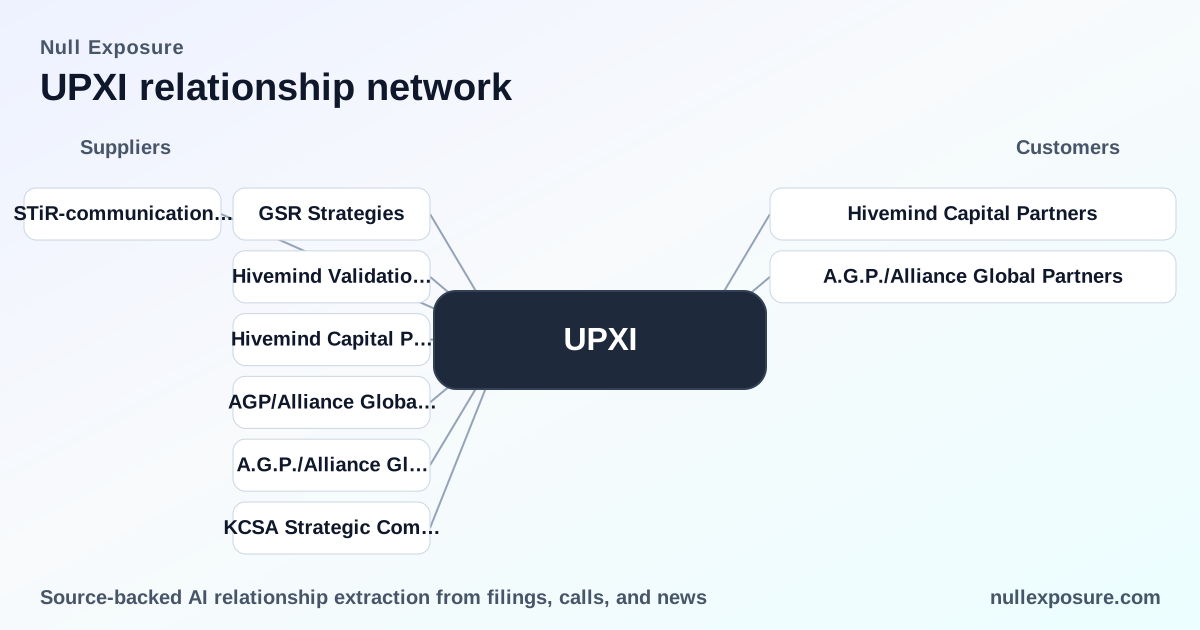
Upexi (UPXI) supplier map: financing partners, advisors and service providers that shape the treasury
Thesis — Upexi operates as a publicly listed firm that combines operational manufacturing with an actively managed cryptocurrency treasury and routine capital markets activity. The company monetizes through its core operations while treating its Solana holdings as a strategic treasury; capital is raised through registered-direct equity placements and structured in-kind convertible financings, while third-party managers, placement agents and communications firms execute and support those moves. For investors, the supplier footprint signals a treasury-driven financing strategy supported by a small, tightly coordinated set of external partners.
Learn more about supplier risk and counterparty mapping at https://nullexposure.com/
Upexi in one line: operational business + managed Solana treasury + repeated reliance on boutique capital and communications partners to execute financings.
Why this supplier map matters
- Capital formation and treasury management are outsourced and concentrated. Upexi uses a dedicated asset manager and at least one institutional convertible-note counterparty for crypto-denominated funding, while placing equity with a single placement agent on recent transactions.
- Contracts are meaningfully long-dated and usage-priced where relevant. The asset management relationship carries a long-term tenor with an asset-based fee that links vendor economics directly to treasury size.
- Operational supplier risk is light but consequential. Communications and investor-relations firms manage external messaging and investor access; custodians and the asset manager control custody and investment decisions for the company’s Solana holdings.
Key operating constraints and what they signal
- Upexi’s asset management arrangement was written as a long-term contract (the agreement runs to the twentieth anniversary of April 23, 2025), which implies a multi-year outsourcing posture and limited short-term flexibility to change managers without contract mechanics. This is a company-level signal that treasury execution is planned and persistent.
- The asset manager compensation is usage-based: an asset-based fee of 1.75% per annum payable monthly in advance, which aligns manager incentives to total assets under management and amplifies cost as the treasury grows—important for margin modeling and governance assessment.
- Upexi relies on service providers for custody and public-facing functions; the company does not self-custody its Solana and maintains multiple custodians to reduce single-point failure risk, indicating prudent operational segmentation but ongoing dependency on third parties.
- Capital and IR functions show concentration around boutique partners: a single placement agent handled a recent registered-direct offering, and communications/IR tasks are routed through named firms, which concentrates execution risk but can accelerate deal timelines.
- Spend signals such as ~$611,768 in leasehold improvements and a five-year CEO-owned facility lease place non-recurring capex and property commitments in the $100k–$1M range and indicate committed fixed-cost exposure over the medium term.
Supplier and partner relationships (plain-English summaries with sources)
-
GSR Strategies — Upexi terminated its asset management agreement with GSR Strategies according to news reporting in March 2026; previously GSR was the discretionary manager for the company’s cryptocurrency treasury under a long-term contract with an asset-based fee arrangement. According to Yahoo Finance (March 10, 2026), the asset manager relationship has been ended, shifting the custody/management landscape for Upexi’s Solana holdings.
Source: Yahoo Finance, March 10, 2026. -
Hivemind Validation Master Fund — Upexi entered a series of financing agreements centered on a secured convertible note funded by locked Solana with the Hivemind Validation Master Fund, reflecting a non-cash, crypto-denominated financing structure used to bolster the company treasury. TradingView reported this financing activity in March 2026, signaling alternative collateralized financing is part of Upexi’s capital toolbox.
Source: TradingView, March 10, 2026. -
Hivemind Capital Partners — The company disclosed a $36 million in-kind convertible note agreement with institutional investor Hivemind Capital Partners, one of the largest Solana-denominated treasury moves by a U.S. public company that year. Coinpaper covered the transaction in March 2026; this agreement materially expands Upexi’s Solana treasury while introducing counterparty exposure to a single institutional crypto investor.
Source: Coinpaper, March 10, 2026. -
A.G.P./Alliance Global Partners — A.G.P. served as the sole placement agent for Upexi’s registered-direct offering and associated warrants, supporting a $7.4 million financing completed in early 2026. Multiple releases including GlobeNewswire and QuiverQuant confirm A.G.P.’s exclusive placement role, which concentrates execution and distribution risk in a single adviser for that raise.
Sources: GlobeNewswire (Feb 6, 2026) and QuiverQuant (Feb 2026). -
KCSA Strategic Communications — KCSA is the named investor-relations contact for Upexi in press releases and event schedules, organizing one-on-one meetings and handling investor outreach around earnings and investor events in early 2026. GlobeNewswire and related conference notices list KCSA as the IR contact for scheduling and media relations. KCSA is therefore a primary conduit for investor access and messaging.
Sources: GlobeNewswire (Feb 6 & Feb 9, 2026) and TradingView event notices. -
STiR-communications.com — STiR is listed alongside KCSA for media relations questions and press routing in the same February 2026 communications, suggesting Upexi uses multiple specialist PR outlets to manage media engagement and event logistics. GlobeNewswire releases in February 2026 reference STiR as a media contact.
Source: GlobeNewswire (Feb 9, 2026).
Operational and balance-sheet implications for investors
- Funding model and counterparty concentration are top-line risks. The Hivemind in-kind convertible and the A.G.P.-led equity placement show Upexi leaning on structured, partner-mediated capital. The use of a crypto-backed convertible note expands treasury but ties value to Solana and to the negotiating posture of a single institutional lender.
- Cost of outsourcing scales with treasury size. The 1.75% asset-based fee structure transfers growth-linked cost directly to treasury management; as Solana holdings increase, periodic cash-equivalent fees will rise and must be modeled against any yield or trading gains the company expects to achieve.
- Communications and placement concentration accelerates execution but centralizes reputational risk. Reliance on KCSA and STiR for IR and a single placement agent for distribution reduces friction for fast financing but gives investors a small set of external actors who control timing and message.
What investors should watch next
- Monitor post-termination arrangements for GSR’s duties — new custody or management partners will determine operational risk and fee profile going forward.
- Track any amendments or credit support tied to the $36M in-kind convertible with Hivemind; contract economics and triggers will affect both liquidity and dilution scenarios.
- Review IR output from KCSA and STiR to gauge how transparently Upexi is communicating treasury strategy and counterparty terms.
If you want a consolidated counterparty map and risk brief for UPXI, see the supplier intelligence hub at https://nullexposure.com/ — our pages summarize counterparties, contract structures and actionable red flags for investors.
Conclusion — action points
- Short-term: Verify the successor arrangements for asset management and custody, and obtain the convertible note term sheet to price dilution and collateral terms.
- Medium-term: Stress-test the asset-based fee against treasury growth scenarios to quantify margin erosion.
- Ongoing monitoring: Watch A.G.P. activity and IR cadence from KCSA/STiR as leading indicators of future capital raises or messaging shifts.
To request a bespoke supplier-risk memo for UPXI or to map similar treasury-financed issuers, visit https://nullexposure.com/ and request a tailored report.