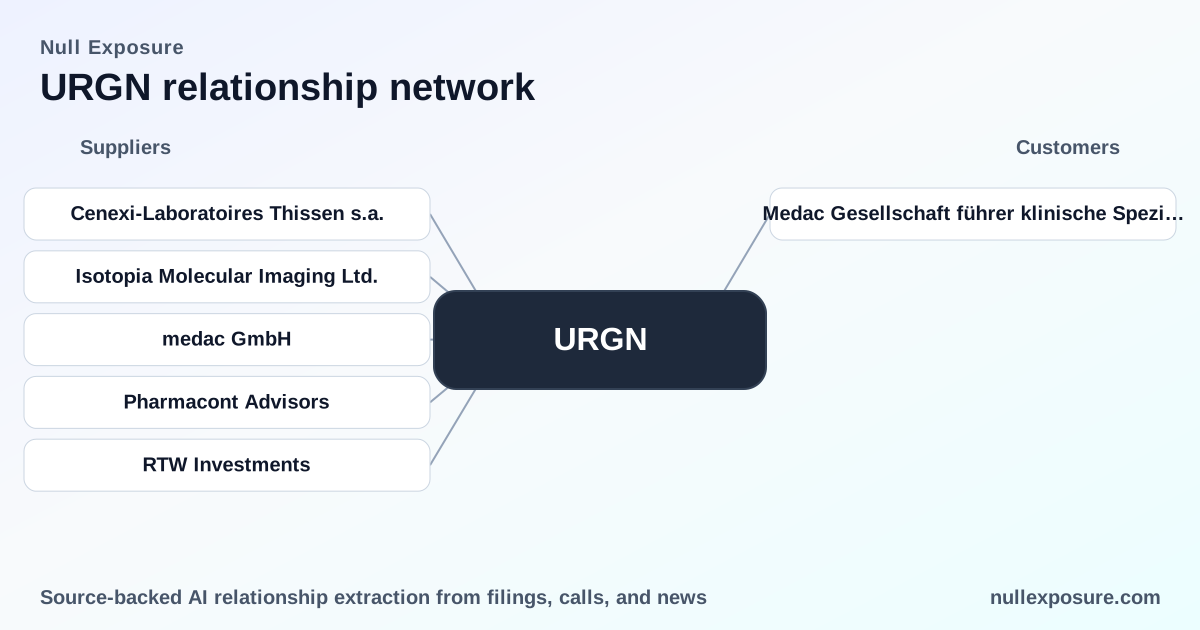
UroGen (URGN) supplier relationships: what investors need to know
UroGen monetizes by commercializing its RTGel drug-delivery platform (notably Jelmyto) and advancing a pipeline of intravesical oncology candidates, while outsourcing manufacturing, formulation and distribution functions to third parties and financing its operations through credit facilities and structured financings. Revenue depends on a mix of specialty pharmacy distribution and contract manufacturing relationships, while operating leverage is constrained by supplier concentration and financing costs. For more detailed counterparty mapping and ongoing coverage, visit https://nullexposure.com/.
One-line operating thesis for investors
UroGen is a small-cap specialty biotech that outsources critical manufacturing and supply-chain functions to third-party contractors and licenses formulation technology from partners, and funds growth through a combination of term debt and structured equity financing; this creates a business model where operational execution is highly dependent on a handful of external counterparties and financing counterparties.
How UroGen contracts, and why that matters
UroGen’s public disclosures make the company’s contracting posture explicit: the company relies on third‑party contract manufacturers and single‑source suppliers for raw materials, active ingredients and finished products. That posture produces three interlinked characteristics investors must price:
- Concentration risk: there are a limited number of suppliers for key inputs, which creates a single‑point failure in scaling commercial production.
- Criticality: suppliers are labeled as critical to commercial supply in company filings, so interruptions would have immediate revenue and trial‑timing consequences.
- Maturity and activity: relationships are active and oriented around manufacturing, distribution and service provision rather than in‑house production.
These characteristics are reported at the company level in UroGen’s filings and risk disclosures (FY2024 10‑K), which highlight single‑source arrangements and the need to secure alternate suppliers to avoid commercialization delays.
Who UroGen does business with (and why each relationship matters)
Below are the counterparties identified in public filings and news, with concise, source‑backed descriptions.
-
Cenexi‑Laboratoires Thissen s.a.: UroGen has a Manufacturing & Supply Agreement with Cenexi (originally dated April 24, 2020 and amended March 2, 2022) to support production needs for its products. According to UroGen’s FY2024 10‑K, this is a formal contract manufacturer relationship used to produce commercial or clinical supply. (Source: UroGen FY2024 10‑K)
-
Isotopia Molecular Imaging Ltd.: UroGen maintains a Manufacturing and Supply Agreement with Isotopia dated May 26, 2020 and extended August 25, 2022, positioning Isotopia as a supplier for certain manufacturing activities. The FY2024 10‑K lists this agreement and its extension as part of UroGen’s contract manufacturing network. (Source: UroGen FY2024 10‑K)
-
medac GmbH: UroGen’s commercial product ZUSDURI (RTGel formulation) incorporates a mitomycin formulation licensed from medac GmbH, combining UroGen’s RTGel with medac’s licensed compound, a detail disclosed in UroGen’s launch announcement and Q4/2025 results. (Source: GlobeNewswire press release, March 2, 2026)
-
Pharmacont Advisors: Pharmacont was the lender behind a prior $125 million term loan facility; UroGen reported interest expense on that facility of $15.3 million in 2025 versus $12.5 million in 2024, reflecting the cost of that financing. (Source: Q4 2025 earnings call transcript)
-
RTW Investments: UroGen records financing expense related to a prepaid forward obligation to RTW Investments, with financing expense of $18.5 million for 2025 compared with $23.4 million the prior year, indicating the ongoing PFO cost embedded in its capital structure. (Source: Q4 2025 earnings call transcript)
Financing counterparties are effectively operating partners
Pharmacont and RTW are not suppliers of raw materials, yet their economic terms materially affect UroGen’s runway and decision‑making. High interest and prepaid‑forward financing expenses directly reduce free cash flow available for inventory build and supplier qualification, and the company’s FY2025 results make those costs visible in the income statement (see the Q4 2025 earnings transcript coverage).
For ongoing counterparty monitoring and deeper investor research, visit https://nullexposure.com/.
Risk map investors should price into the valuation
UroGen’s disclosures and contract language create a clear set of operational risk drivers:
- Single‑source and limited supplier pools create concentrated supply risk. The FY2024 10‑K states that alternate suppliers may be necessary to avoid disruption and that sourcing changes would create delays and higher costs. That constraint is company‑level and applies across product candidates and Jelmyto commercial supply.
- Manufacturing and distribution are outsourced and active. The firm relies on contract manufacturers and specialty pharmacies to prepare and dispense product, so quality, lead times and regulatory compliance at third parties are immediate operational levers.
- Financing costs compress flexibility. The combination of term loan interest and prepaid forward financing produces recurring cash demands that compete with working capital needs for inventory and scale‑up.
These are not abstract risks: they are explicitly disclosed company signals and should be priced into scenario models for revenue ramp and margins.
What to watch next: objective triggers for re‑rating
Investors should track a short list of observable events that change the supply/income profile:
- Supplier audits and capacity confirmations from Cenexi and Isotopia; any amendments expanding capacity are positive.
- Wholesale availability and specialty‑pharmacy rollout metrics following the ZUSDURI launch; distribution scale‑up will validate the specialty pharmacy model.
- Refinancing or repayment of the $125M term loan and any change in the prepaid forward structure with RTW; changes will directly affect interest and financing expense.
- Regulatory approvals for pipeline candidates that would require scale‑up commitments from contract manufacturers.
A steady flow of supplier capacity confirmations and softer financing costs will justify multiple expansion; failure to secure alternate suppliers or to manage financing costs will compress value.
For a practical, counterparty‑focused monitor tailored to UroGen and peers, visit https://nullexposure.com/.
Bottom line for investors
UroGen’s business model delivers upside through product launches and an innovative delivery platform, but value realization is contingent on a small set of external manufacturers and distribution partners and on the company’s financing structure. These are transparent, company‑level constraints in public filings and earnings disclosures; successful execution depends on operational collaboration with Cenexi, Isotopia, medac and the financial counterparties that fund the business. Monitor supplier capacity, specialty pharmacy rollout and financing changes as leading indicators of whether the commercial story will scale into durable cash flow. For ongoing supplier intelligence and relationship monitoring, go to https://nullexposure.com/.