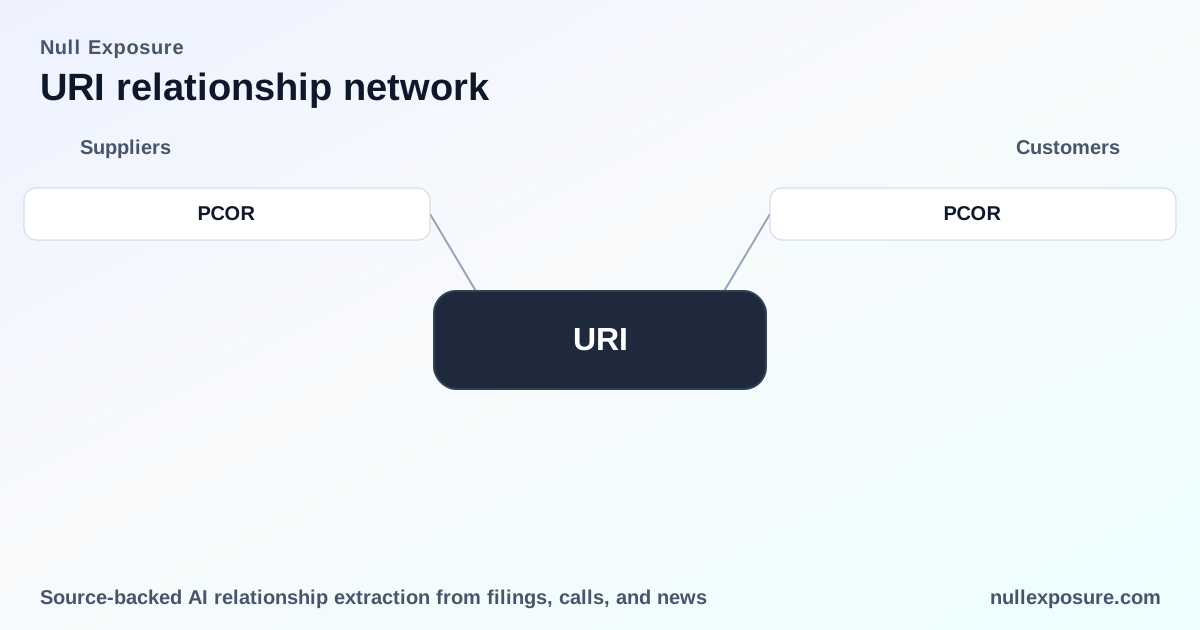
United Rentals (URI): Supplier relationships that underwrite scale and margin
United Rentals operates the largest equipment rental network in North America and monetizes through rental fees, fleet resale, and ancillary services (including telematics and maintenance). The company converts capital-intensive equipment ownership into recurring revenue by renting to contractors, utilities and industrial customers, then extracting residual value through used-equipment sales and service contracts. Key financial anchors: roughly $16.1B in revenue, $4.45B EBITDA and a $47.3B market capitalization as of the latest reporting, underpin a procurement-led operating model that drives pricing leverage and margin capture. For an executive-ready view of supplier exposure and strategic partners, read on — and visit https://nullexposure.com/ to explore related supplier intelligence.
What the relationships say about how United Rentals runs the business
United Rentals’ supplier posture is dual: it is a large-volume purchaser of equipment and consumables while also acting as a reseller/operator of OEM equipment on its rental fleet. The company’s scale gives it negotiating leverage on pricing, warranties and supply terms, which supports its gross and operating margins. At the same time, OEM relationships are operationally critical because equipment availability and technology integration (telemetry, remote diagnostics) directly affect fleet utilization and customer experience.
- Contracting posture: United Rentals buys equipment at scale and negotiates favorable terms. The company’s internal disclosures note that they “purchase large amounts of equipment, contractor supplies and other items, which enables us to negotiate favorable pricing, warranty and other terms with our vendors.”
- Supplier role mix: United Rentals both purchases from manufacturers and sells or rents their equipment; its filings state they “sell equipment such as aerial lifts, reach forklifts, telehandlers, compressors and generators from many leading equipment manufacturers.”
- Concentration and maturity: Scale reduces procurement concentration risk; the company’s historical market share (about 13% in North America as of 2019) and large balance sheet support long-term sourcing and fleet refresh programs.
- Criticality: OEM performance and telematics partners are mission-critical because fleet uptime and remote management drive utilization and margins.
These points are company-level signals drawn from United Rentals’ disclosures and public reporting; they inform supplier risk and opportunity without assigning any single constraint to a specific partner.
The public relationship: Procore Technologies — telematics integration that extends the platform
Procore Technologies and United Rentals announced a telematics integration in February 2026 that allows shared customers to feed United Rentals’ equipment data into Procore’s Resource Management platform to improve jobsite visibility and simplify equipment management across projects. This partnership converts United Rentals’ telematics data into a direct value-add for enterprise construction customers, improving equipment utilization and stickiness. A SimplyWall St. news piece in March 2026 covered the announcement and described the integration as focused on shared customers and resource visibility.
Source: SimplyWall St., news coverage of the Procore–United Rentals telematics partnership (FY2026).
Why the Procore tie matters to investors and operators
The integration with Procore represents a strategic extension of United Rentals’ services beyond raw rental hours into data-enabled workflow integration. That drives two investor-relevant outcomes:
- Revenue resilience and upsell: Embedding equipment telemetry into customer project management increases switching costs and surfaces upsell opportunities for connected services and premium equipment.
- Operational efficiency: Shared telematics reduces idle time and improves maintenance scheduling, which supports utilization and protects operating margin.
Operationally, this is not a defensive move but an offensive one: converting fleet telemetry into platform hooks that lock in enterprise accounts and compress the time-to-value for customers.
How supplier constraints shape operating risk and opportunity
United Rentals’ own disclosures provide two constraints that frame supplier risk and sourcing strength:
- The firm explicitly notes it purchases at scale, which offers pricing leverage and favorable warranty and service arrangements. This contracting posture reduces input cost risk and supports margin resilience across the fleet lifecycle.
- The company states it sells equipment from many leading manufacturers, indicating a diverse OEM ecosystem that reduces supplier concentration while creating dependency on manufacturer product roadmaps and parts availability.
Taken together, these constraints indicate a mature, procurement-heavy operating model: high negotiating power balanced against operational dependence on OEM technology and supply chains. Investors should treat OEM relationships and telematics partners as strategic assets, not peripheral vendors.
Financial and market signals that matter alongside supplier ties
United Rentals’ operating performance and market position give context to supplier importance:
- Revenue: $16.099B (TTM) with operating margin of 25.2% and profit margin ~15.5%, demonstrating strong margin capture for a capital-intensive model.
- Capital intensity and return: ROE ~28.4% and ROA ~8.65% indicate efficient use of capital within a fleet-heavy business.
- Volatility and valuation: Beta is elevated at 1.65, reflecting cyclical exposure to construction and industrial activity; forward P/E of ~15.95 implies expectations for continued earnings growth.
These metrics show why supplier and platform partnerships are strategically meaningful: small improvements in utilization or maintenance terms can have outsized impacts on EBITDA and free cash flow.
Practical takeaways for investors and operators
- Supplier leverage is a durable competitive advantage. United Rentals’ size converts into better procurement economics and service contracts that protect margins.
- Platform integrations increase customer stickiness. The Procore telematics tie exemplifies the move from equipment rental to integrated service offerings, enhancing renewal and upsell potential.
- OEM and telematics risk is operationally material. Parts shortages, technology fragmentation or failed integrations would directly reduce utilization and revenue per unit.
For deeper supplier-mapping and risk scoring on United Rentals and its partners, visit https://nullexposure.com/ and review the supplier relationships framework.
Final assessment and what to watch next
United Rentals combines scale-driven procurement muscle with active platform partnerships that increase customer dependency and operational efficiency. The company’s supplier relationships are not a cost center but a strategic lever: negotiated terms and integrated technology partnerships convert capitalized equipment into recurring, higher-margin cash flows. Watch the evolution of telematics integrations, OEM parts availability, and used-equipment resale channels — those variables will determine whether incremental margin flow-through sustains current valuations.
Explore supplier risk and partnership mapping for URI at https://nullexposure.com/ to see how these relationships affect counterparty concentration and operational resilience.