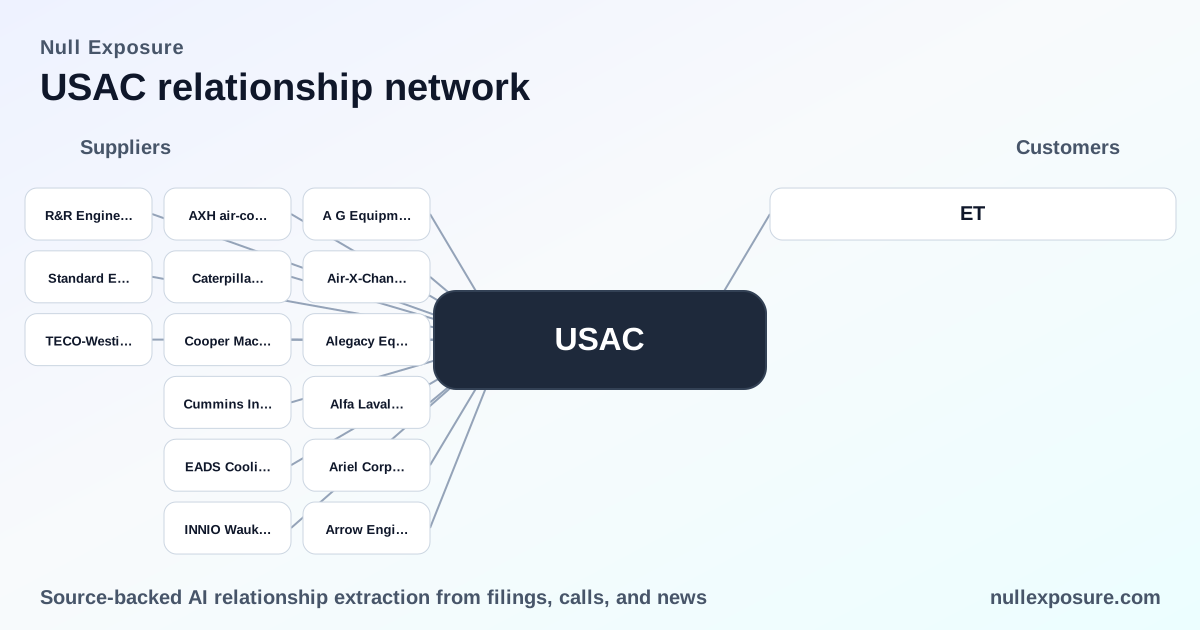
USAC Supplier Map: How USA Compression Sources Critical Compression Equipment
USA Compression Partners LP provides and operates gas compression services under fixed‑term contracts to oil companies and midstream operators, monetizing through contracted service fees and equipment rentals while outsourcing assembly and OEM components to a network of third‑party fabricators and original equipment manufacturers. The business captures recurring cash flow from long‑date contracts while relying on a concentrated set of suppliers for critical compression unit components and assembly — a structural dependency that directly ties operational uptime to vendor continuity. For a structured view of supplier exposure and next‑step diligence, visit https://nullexposure.com/.
What the supplier footprint tells investors about USAC's operating model
USA Compression does not vertically integrate compressor fabrication; it sources core components from established OEMs and uses three primary packagers/assemblers to build units to its specifications. The FY2024 Form 10‑K identifies a short list of component suppliers supplying the "substantial majority" of parts and three vendors responsible for packaging and assembly. This creates a two‑layer supplier posture: OEMs supply engines, frames, cylinders and coolers; assemblers package and integrate those parts into field‑ready units.
Key operating signals drawn from public filings:
- Contracting posture: the company operates under long‑term service agreements on the operating side and purchases equipment through multi‑vendor relationships; the services agreement with USAC Management was extended to December 31, 2027 per the Form 10‑K, reflecting multi‑year operational commitments.
- Concentration: several OEMs supply the bulk of components, while three vendors perform final assembly — concentration elevates supplier disruption risk.
- Criticality: components and engines from suppliers like Caterpillar, Cummins and TECO‑Westinghouse are mission‑critical for unit availability.
- Maturity and spend: supplier relationships are active and commercial spend with affiliates (Energy Transfer related reimbursements) is disclosed in the low millions, suggesting operational interdependence but not outsized single‑invoice exposure.
For a practical view into supplier ties and how they affect credit and operational diligence, see https://nullexposure.com/ — the supplier map there complements this analysis.
Vendor‑level notes investors should track
Below are plain‑English summaries for each supplier named in USA Compression’s FY2024 Form 10‑K, with source attribution. Each one is a confirmed supplier relationship referenced in the company’s annual filing.
- A G Equipment Company — USA Compression uses A G Equipment Company as one of three primary vendors that package and assemble its compression units, making A G Equipment a core integrator of finished units. According to USA Compression’s FY2024 Form 10‑K, the company relies primarily on A G Equipment Company for assembly services (FY2024).
- Air‑X‑Changers — Air‑X‑Changers supplies a substantive portion of components for USAC’s natural gas compression equipment, identified among the manufacturers providing the “substantial majority” of parts. The FY2024 Form 10‑K lists Air‑X‑Changers as a major component supplier (FY2024).
- Alegacy Equipment, LLC. — Alegacy Equipment is one of the three vendors named in the 10‑K as a primary packager and assembler responsible for building field units to USAC specifications. USA Compression’s FY2024 filing includes Alegacy Equipment as a principal assembler (FY2024).
- Alfa Laval (US) — Alfa Laval is cited as a supplier of components used in the compression fleet; the company’s FY2024 filing counts Alfa Laval among the key component vendors (FY2024).
- Ariel Corporation — Ariel Corporation is listed in the 10‑K as a significant supplier of compressor components that USAC sources for its natural gas equipment (FY2024).
- Arrow Engine Company — Arrow Engine Company is referenced specifically for compressor frames and cylinders, making it an important structural OEM for unit reliability. USA Compression names Arrow Engine Company for frames and cylinders in the FY2024 Form 10‑K (FY2024).
- AXH air‑coolers — AXH air‑coolers supplies cooling components to USAC’s compression systems and is included among the suppliers providing the substantial majority of components (FY2024 Form 10‑K).
- Caterpillar Inc. — Caterpillar is identified as a supplier of major components (engines and power systems), representing a critical OEM relationship for powertrain availability. The FY2024 Form 10‑K lists Caterpillar among the primary component suppliers (FY2024).
- Cooper Machinery Services (Gemini products) — Cooper Machinery Services, including Gemini product lines, supplies components used in USAC’s compression equipment as recorded in the FY2024 10‑K (FY2024).
- Cummins Inc. — Cummins is named as a supplier of engine and powertrain components for the compression fleet in the FY2024 Form 10‑K (FY2024).
- EADS Cooling Solutions, LLC — EADS Cooling Solutions supplies cooling system components for the compression units and is listed in the FY2024 filing as a component vendor (FY2024).
- INNIO Waukesha — INNIO Waukesha is included among the OEMs supplying engines or engine components for USAC’s equipment per the FY2024 Form 10‑K (FY2024).
- R&R Engineering Co. — R&R Engineering is listed as a supplier of components for natural gas compression equipment in the FY2024 filing (FY2024).
- Standard Equipment Company — Standard Equipment Company is named alongside A G Equipment and Alegacy as one of the three primary packaging and assembly vendors for USAC’s compression units (FY2024).
- TECO‑Westinghouse — TECO‑Westinghouse is specifically cited as an engine supplier, making it directly relevant to powertrain continuity and maintenance scheduling per the FY2024 Form 10‑K (FY2024).
How supplier structure changes the investment case
Supplier concentration materially affects operational risk: a disruption at a key OEM or assembler can reduce fleet availability and pressure revenue tied to fixed‑term contracts. The company’s disclosure that a “substantial majority” of components come from a limited set of suppliers and that three vendors perform assembly indicates an operational model optimized for cost and speed but less resilient to single‑vendor failures.
Company‑level constraint signals investors should fold into due diligence:
- Long‑term operating contracts with management (service agreement extended to December 31, 2027) underpin recurring revenue and stabilize cash flow.
- Active third‑party supplier relationships and engaged service providers for cybersecurity and audits indicate mature vendor management but also external dependence.
- Publicly disclosed related‑party spend (reimbursements and purchases in the low‑single‑digit millions for 2024) shows some affiliate operational interplay that is quantifiable and monitorable through filings.
Monitor supplier financial health, capacity constraints in the engine market, and assembler throughput during cyclical capital‑expenditure periods. These metrics will directly influence uptime, maintenance capex, and ultimately EBITDA conversion.
Actionable next steps for investors
- Monitor OEM order books and lead times for Caterpillar, Cummins, INNIO Waukesha and TECO‑Westinghouse; engine lead times drive replacement cycles.
- Assess assembler concentration risk at A G Equipment, Alegacy and Standard Equipment and track any announced shifts in assembly capacity or geographic concentration.
- Validate related‑party spend trends and the status of the services agreement that supports operations through 2027; changes to these arrangements will affect operating leverage and cost allocation.
For a consolidated supplier risk briefing and to track developments that impact USAC’s operational continuity, visit https://nullexposure.com/.
Investors evaluating USA Compression should treat supplier continuity as a first‑order risk to revenue realization and uptime — the company’s economics are robust under normal operations, but the concentrated supplier footprint demands active monitoring and periodic vendor stress testing. For further supplier intelligence and ongoing updates, see https://nullexposure.com/.