USA Rare Earth (USAR): supplier relationships and what they mean for investors
USA Rare Earth (NASDAQ: USAR) operates a vertical rare-earth mining-to-magnets platform, monetizing through the sale of critical metals, NdFeB alloy (strip-cast) and finished magnet products while building downstream processing capacity in the U.S. and Europe. The company generates value by integrating upstream oxide separation with alloy production and magnet manufacturing, and by monetizing capacity through long-term feedstock and tolling arrangements plus strategic acquisitions that shorten the supply chain. For investors and operators, the immediate focus is on USAR’s supplier, legal and advisory relationships that underpin production scale-up, financing and European expansion. Learn more about how these relationships map to operational risk and commercial optionality at https://nullexposure.com/.
A quick map of the partner ecosystem — who does what for USAR
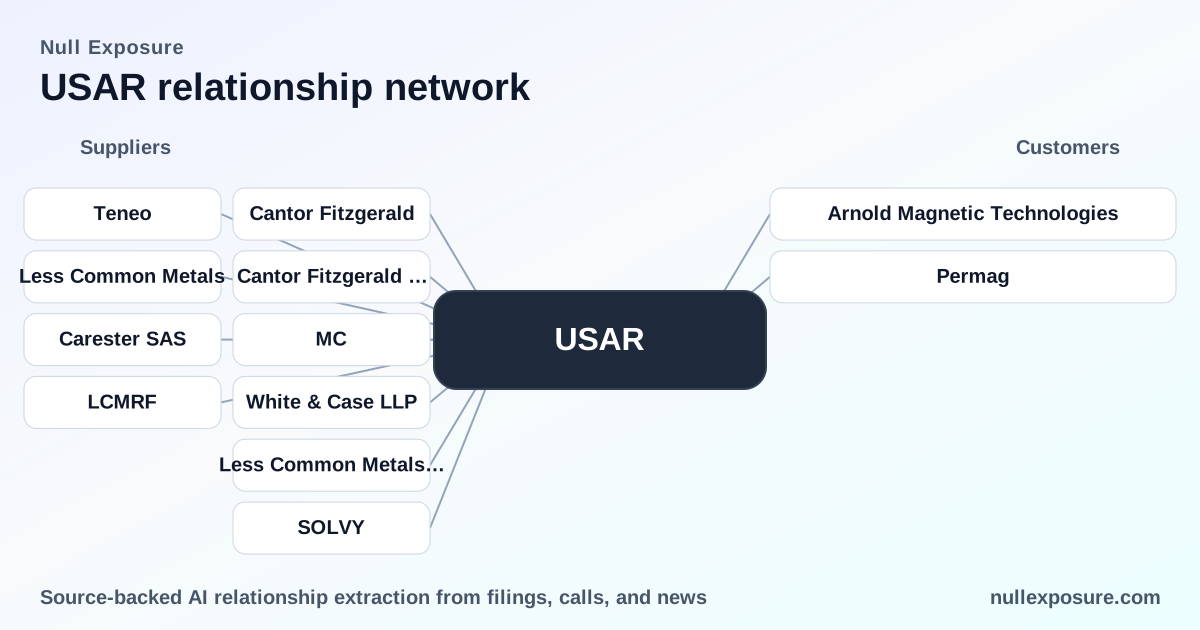
Below are every named relationship surfaced in public reporting and press releases, summarized in plain English with the cited source for each entry.
-
Cantor Fitzgerald (placement agent / funding nexus). Sahm Capital reported in March 2026 that Cantor Fitzgerald acted as the lead placement agent on a recent fundraising and that an ethics inquiry has focused on the affiliation of an executive tied to Cantor; this coverage highlights that Cantor’s role was central to the PIPE placement. (Sahm Capital, March 2026) — https://www.sahmcapital.com/news/content/ethics-probe-puts-usa-rare-earth-funding-and-valuation-in-the-spotlight-2026-03-01
-
Cantor Fitzgerald & Co. (lead placement agent on PIPE). A GlobeNewswire release carried by Manila Times (Jan 29, 2026) states Cantor Fitzgerald & Co. served as lead placement agent in USAR’s $1.5 billion PIPE closing, positioning Cantor as a primary capital markets intermediary on that transaction. (GlobeNewswire / Manila Times, Jan 29, 2026) — https://www.manilatimes.net/2026/01/29/tmt-newswire/globenewswire/usa-rare-earth-announces-closing-of-15-billion-pipe-financing/2267755/amp
-
Moelis (co-placement agent). The same Jan 29, 2026 press release identifies Moelis as a co-placement agent on the PIPE, which indicates USAR engaged multiple investment banks to syndicate the financing. (GlobeNewswire / Manila Times, Jan 29, 2026) — https://www.manilatimes.net/2026/01/29/tmt-newswire/globenewswire/usa-rare-earth-announces-closing-of-15-billion-pipe-financing/2267755/amp
-
White & Case LLP (legal advisor to USAR on PIPE). The Jan 29, 2026 transaction disclosure notes White & Case acted as legal counsel to USA Rare Earth for the PIPE, while DLA Piper advised the placement agents — a conventional market structure for large equity placements. (GlobeNewswire / Manila Times, Jan 29, 2026) — https://www.manilatimes.net/2026/01/29/tmt-newswire/globenewswire/usa-rare-earth-announces-closing-of-15-billion-pipe-financing/2267755/amp
-
Less Common Metals Ltd. (acquired supplier / alloy producer). A Globe and Mail press release (FY2025) confirms USAR closed the acquisition of Less Common Metals (LCM), which will supply Neodymium Iron Boron strip-cast alloy to USAR’s Stillwater magnet facility and broaden USAR’s alloy production footprint. (Globe and Mail press release, FY2025) — https://www.theglobeandmail.com/investing/markets/stocks/USAR/pressreleases/36177444/usa-rare-earth-closes-acquisition-of-less-common-metals/
-
Solvay (oxide separation input to LCM processes). A December 2025 market report noted that LCM will produce samarium using oxides separated by Solvay, indicating Solvay’s role as an upstream chemical processing supplier feeding USAR’s alloy production chain. (TechSite summary, Dec 4, 2025) — https://ts2.tech/en/usa-rare-earth-usar-stock-soars-on-new-supply-deal-latest-news-forecasts-and-outlook-as-of-december-4-2025/
-
Teneo (media relations / communications contact). The PIPE closing disclosure lists Teneo as media relations contact for USAR, signaling the company’s use of a professional communications firm to manage public messaging around financing and corporate developments. (GlobeNewswire / Manila Times, Jan 29, 2026) — https://www.manilatimes.net/2026/01/29/tmt-newswire/globenewswire/usa-rare-earth-announces-closing-of-15-billion-pipe-financing/2267755/amp
-
Less Common Metals (additional coverage of acquisition). Sahm Capital covered USAR’s acquisition of Less Common Metals in January 2026, emphasizing the strategic intent to secure magnet production capacity and create a mine-to-magnet supply chain. (Sahm Capital, Jan 21, 2026) — https://www.sahmcapital.com/news/content/usa-rare-earth-acquisition-and-stillwater-progress-highlight-valuation-opportunity-2026-01-21
-
Carester SAS (European co-location partner in Lacq). Sahm Capital reported in January 2026 that USAR’s new European facility will be co-located with Carester SAS’s Caremag oxide processing plant in Lacq, which is intended to establish a full-scale EU processing and metal production platform. (Sahm Capital, Jan 20, 2026) — https://www.sahmcapital.com/news/content/usa-rare-earth-stock-jumps-on-expansion-rare-earths-real-gains-2026-01-20
-
LCM / LCMRF (UK-based LCM acquisition coverage). Additional market commentary in March 2026 characterized the LCM purchase as securing rare-earth magnet production capacity, with LCM referenced under ticker LCMRF in market notes. This reinforces LCM’s centrality to USAR’s downstream push. (Sahm Capital / market commentary, Mar 3, 2026) — https://www.sahmcapital.com/news/content/usa-rare-earth-buys-lcm-to-build-mine-to-magnet-supply-chain-2026-03-03
What the relationship mix tells you about USAR’s operating model
-
Capital markets-driven expansion. Engagements with Cantor Fitzgerald, Moelis and White & Case underline that USAR’s near-term scale is funded primarily through capital raises and structured financings; the PIPE closing in early 2026 is the funding event around which advisory relationships cluster. This implies a contracting posture that prioritizes financing partners for rapid scale rather than incremental organic cashflow.
-
Vertical integration and supplier consolidation. The acquisition of Less Common Metals and the operational link to Solvay and Carester indicate USAR is consolidating alloy and oxide processing to control feedstock availability and move margin downstream into magnet production — a manufacturer posture that reduces reliance on third-party strip-cast suppliers.
-
Service and communications maturity. Use of Teneo for media relations and established external legal counsel reflects a maturing corporate governance and disclosure posture appropriate for a public growth company managing reputational and regulatory exposure.
-
Material long-term contracting signal. Public excerpts describe a long-term Metal Sales and Tolling Framework Agreement (effective through 2028) committing USAR to purchase a material share of NdFeB feedstock for phased magnet capacity — this is a company-level indicator of multi-year feedstock commitments and supply concentration even if the counterparty name is not disclosed in the excerpt.
-
Service provider relationships and related spend. Disclosed services agreements and fees (monthly services to certain sponsor-provided executives totaling ~$27k/month and service spend in the low hundreds of thousands in 2023–2024) show outsourced executive and sponsor support is a visible component of USAR’s cost base and governance structure.
-
Related-party and individual counterparty exposure. Filings show borrowing and convertible note arrangements involving named individuals (e.g., a $2.5m convertible note facility with a chairman-level individual), which is a company-level red flag for concentration of financial support and potential governance entanglement.
For detailed partner tracking and contract-level analysis, visit https://nullexposure.com/ to see how these relationships affect supplier risk and contract exposure modeling.
Investor implications — risk, upside, and what to watch
-
Upside: Vertical integration via LCM and European processing partnerships creates the potential for margin capture across the rare-earth value chain and reduces exposure to imports for critical NdFeB feedstock. If operational execution meets guidance, USAR’s revenue pathway is structurally improved.
-
Risks: The financing posture—reliance on large PIPE transactions and prominent placement agents—raises execution and reputational risk if market access tightens or if advisor-related controversies persist. Counterparty concentration in long-term feedstock commitments is a key supply risk to monitor.
-
Near-term catalysts: Commissioning timelines for the Stillwater magnet facility, the Lacq co-located processing plant, and the integration of LCM’s operations will determine whether capital raises convert into reproducible revenue streams.
Explore structured supplier-risk dashboards and deal-level tracking at https://nullexposure.com/ for bespoke investor diligence and supplier mapping.
Bottom line
USA Rare Earth’s supplier and advisory network shows a focused strategy: finance-led scale-up combined with targeted vertical consolidation to control alloy and magnet production. The partnership roster — from placement agents and law firms to acquired manufacturers and European co-location partners — creates both the means for rapid capacity build and the vectors for execution risk. Monitor operational rollouts and counterparty concentrations closely; these will determine whether USAR’s integrated model converts capital into sustainable cashflow.