U.S. Bancorp (USB) — supplier relationships and third‑party risk profile investors should price in
U.S. Bancorp operates as a diversified regional bank that monetizes through net interest margin, fee income from payments and wealth services, and mortgage and trust product fees. In its role as a large bank holding company, USB outsources specific operational functions and purchases external services that support mortgage underwriting, payments, and technology platforms — creating supplier linkages that are operationally material to product delivery and regulatory compliance. For a focused view on supplier exposures and third‑party governance, visit Null Exposure.
Why suppliers matter to USB’s earnings and risk profile
U.S. Bancorp’s economics depend on stable originations, low operational disruption in payments and custody services, and discipline around credit underwriting. Third‑party service providers that feed underwriting pipelines, payment rails, or cloud and data services can directly affect revenue flow and regulatory risk, especially in mortgage and consumer banking lines. USB’s market metrics — a trailing P/E near 11 and a Price/Book around 1.36 — imply the market prices in a mature regional bank with predictable earnings but sensitivity to credit cycles and operational shocks. Supplier failures that interrupt loan funding, degrade payments processing, or trigger compliance lapses would translate into immediate franchise risk.
For clients and investors who want a supplier‑focused lens on counterparty and operational exposures, see the intelligence at Null Exposure.
What our results show — the specific supplier relationships surfaced
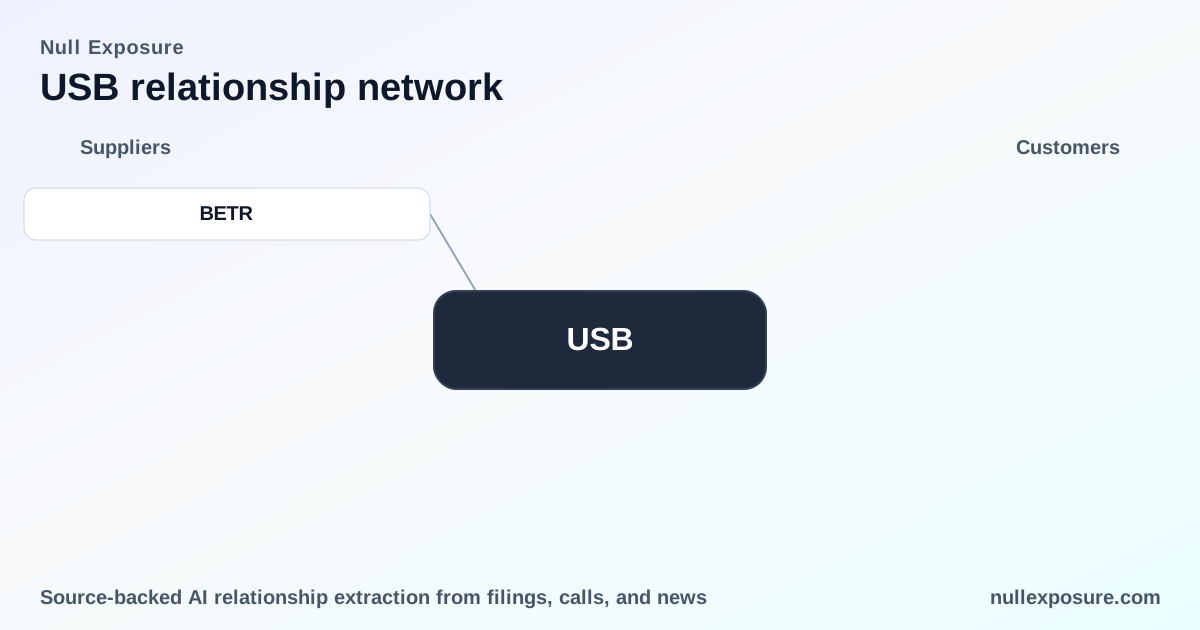
Only one supplier relationship was returned in the review set: Better.com.
Better.com — Better is a fintech mortgage provider whose underwriting and automation platform is used by institutional mortgage investors and banks. Investing.com reported on March 10, 2026 that Better.com’s platform provides underwriting capabilities for more than 45 institutional mortgage investors, explicitly naming U.S. Bank among banks using the platform, putting USB in the cohort of lenders outsourcing parts of the mortgage underwriting workflow. (Investing.com, March 10, 2026)
This single documented linkage is business‑relevant because mortgage underwriting is a front‑line revenue activity and a regulatory focus for banks. The presence of Better.com in USB’s supplier universe indicates reliance on third‑party technology for loan adjudication or flow processing; the precise contractual scope and economic dependence were not disclosed in the single article.
How U.S. Bancorp structures supplier governance — constraints as company signals
The intelligence includes three company‑level constraint signals that frame USB’s contracting posture and supplier maturity:
-
Service provider oversight is formalized. Company disclosures emphasize a third‑party risk management program that oversees outsourced operations and identifies risks including cybersecurity threats to vendors — a sign that USB maintains centralized governance and monitoring of suppliers. The firm’s posture is consistent with a large regulated bank operating under exam expectations for vendor oversight.
-
Supplier relationships are actively managed. The record flags an “active” relationship stage and references due diligence performed with a risk‑based approach in selecting and monitoring third‑party service providers, indicating ongoing monitoring rather than a purely transactional relationship model.
-
Supplier activity sits in the services segment. The coverage categorizes third‑party links as services, reinforcing that the bank purchases operational, technology, and processing capabilities rather than minority equity stakes or simple product purchases.
These constraints present company‑level signals about contracting posture: centralized, risk‑based, and operationally mature governance. Confidence levels on these signals are moderate to strong in the source material — they reflect disclosed governance frameworks rather than granular contract language.
What investors and operators should take away
-
Concentration matters. Even a single named provider for underwriting workflows is material because mortgage processing is revenue sensitive; confirm whether Better.com is one of many parallel providers or a concentrated counterparty for specific product lines. Concentrated supplier exposure increases operational and reputational risk.
-
Operational criticality demands contractual controls. For suppliers that touch underwriting, payments, or data, ensure robust SLAs, recovery time objectives, testable business continuity plans, and on‑site/exam access in contracts. USB’s public governance signals suggest these controls are in place at the policy level; the contract portfolio determines practical resilience.
-
Cybersecurity and regulatory oversight are non‑negotiable. The company’s own disclosures highlight vendor cybersecurity risk as a primary oversight dimension. Banks distributing loan flows to fintech platforms must maintain audit trails, model governance for automated underwriting, and regulatory reporting capabilities.
Operational recommendations:
- Maintain an inventory of suppliers by criticality and revenue impact.
- Require quarterly controls attestations and annual penetration test results for high‑criticality vendors.
- Include exit and data portability clauses for underwriting and payments providers to preserve funding continuity.
A pragmatic risk framework for valuation and diligence
For investors, supplier exposure should be folded into both downside stress tests and franchise valuations. If a vendor outage were to interrupt mortgage originations for a quarter, translate that operational hit into lost fees and net interest income timing — then price in remediation and reputational costs. For operators, the governance signals from USB’s disclosures support a centralized vendor risk program model; execution quality — not the existence of the program — determines ultimate exposure.
Mid‑report note: if you want an investor‑grade mapping of suppliers by criticality and contractual controls, explore the research options at Null Exposure.
Final read — what this means for portfolio positioning
U.S. Bancorp runs a mature supplier governance program and the visible supplier linkage to Better.com places mortgage underwriting workflows within the outsourced services footprint. Key decision points for investors are vendor concentration, operational SLAs, and the bank’s ability to replicate or replace critical vendor functions under stress. The market already prices USB as a stable regional bank; supplier governance quality is a differentiator for downside protection in regulatory or operational shock scenarios. For targeted supplier intelligence tied to investment decisions, schedule a deeper review at Null Exposure.
Bold, corporate‑level supplier governance is in place; the remaining diligence tasks are tactical and contract‑level: confirm concentration, test recovery plans, and validate cybersecurity attestations to fully quantify supplier risk into the valuation mix.