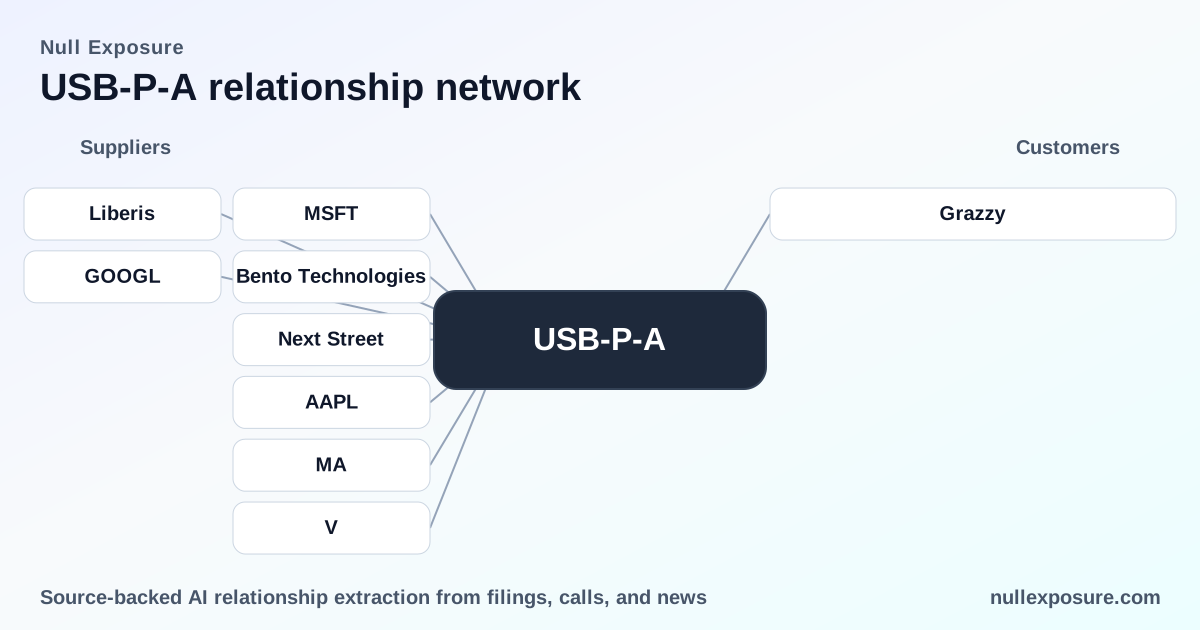
U.S. Bancorp (USB-P-A) supplier map: the partner set that underwrites payment and channel growth
U.S. Bancorp operates as a diversified bank holding company that monetizes through deposit-taking, lending, payments processing, trust and wealth services, and commercial banking product distribution; USB-P-A represents a preferred equity claim that benefits indirectly from the bank’s fee-based franchise and payment volume growth. The partnership roster visible in public reporting shows a deliberate mix of cloud providers, card networks, fintech acquisitions, and specialist vendors that drive scale in payments, expand SMB distribution, and reduce legacy technology drag—factors that matter for preferred holders because they influence earnings stability, cost trajectory, and systemic operational risk. For a deeper supplier-risk view and commercial intelligence on similar financial counterparties, visit https://nullexposure.com/.
What investors should watch: partner categories that move the needle
U.S. Bancorp’s listed relationships cluster into three functional groups: core infrastructure (cloud), payments rails and networks (Visa, Mastercard, Apple/Android payments), and SMB/embedded finance (acquisitions and fintech partners). Core infrastructure contracts are critical for availability and cost; payment network licenses are critical for revenue and product distribution; fintech partners accelerate product rollouts and revenue diversification. That composition supports predictability in fee income while concentrating operational risk in a small number of large suppliers.
- Contracting posture: The bank’s posture is enterprise-grade—expect long-term, high-value contracts with major cloud providers and card networks that embed switching, licensing and compliance obligations.
- Concentration: The supplier set shows concentration around large tech and card partners, implying single-vendor exposure on cloud and payment rails.
- Criticality: Cloud and card network relationships are mission-critical to transaction processing and product delivery; fintech partners are strategically important for SMB distribution and product innovation.
- Maturity: Partners range from global incumbents to acquired fintechs, reflecting a hybrid maturity profile that reduces go-to-market friction but increases integration and operational complexity.
For more granular supplier signals and contract-level intelligence on financial operators, check https://nullexposure.com/.
Relationship roll call — what each partner does and why it matters
Microsoft
U.S. Bank has selected Microsoft Azure as its primary cloud provider for bank applications, representing a major modernization investment in core infrastructure. According to an FF News report (FY2022), this places U.S. Bancorp squarely on a hyperscaler platform that standardizes operations and centralizes a critical dependency.
Bento Technologies
U.S. Bank integrated fintech capabilities through the acquisition of Bento Technologies to build workflows and merchant-facing SMB products. A Tearsheets feature noted that Bento (acquired in 2021) is central to the bank’s multi-year strategy to scale business banking products for small firms (FY2025).
Next Street
U.S. Bank launched U.S. Bank Business Resources Central, an educational and financial-literacy platform, in partnership with Next Street to reach small enterprises. PYMNTS covered this collaboration as part of the bank’s SMB engagement strategy (FY2025), signaling channel expansion rather than a revenue-sharing arrangement.
Apple
Elavon, a U.S. Bank subsidiary, added Apple Tap to Pay to its merchant acceptance toolkit, expanding contactless acceptance capabilities. American Banker reported this (FY2023), which strengthens card-present equivalents and merchant conversion metrics for the bank’s payments business.
Mastercard International Incorporated
U.S. Bank’s Focus Card program is issued under license from Mastercard, embedding Mastercard’s network and brand into the bank’s card issuance. A PR Newswire release covering the program noted the Mastercard license (FY2025), confirming continued dependence on principal-card network relationships for product issuance.
Visa U.S.A. Inc.
The Focus Card program is likewise issued pursuant to a license from Visa, meaning U.S. Bank leverages multiple network rails for card issuance and clearing. The same PR Newswire release (FY2025) documents Visa’s role, underscoring dual-network access strategies for routing and acceptance.
Liberis
Elavon expanded a partnership with embedded-finance lender Liberis to launch Quick Capital, a revenue-based financing product for small businesses. American Banker detailed this expansion (FY2025), demonstrating U.S. Bancorp’s strategy to monetize underwriting and embedded lending through third-party fintech partners.
Elavon added Android softPOS capability (Android Tap-to-Pay) alongside Apple Tap to Pay, broadening acceptance across mobile form factors. American Banker covered the Android deployment (FY2023), which complements Apple integration and reduces platform-level acceptance gaps.
Operational constraints and company-level signals
There are no explicit contractual constraint excerpts in the public relationship signals provided here; that absence itself is a signal—U.S. Bancorp’s supplier disclosures in these sources emphasize strategic alignment and product rollouts rather than granular contractual risk language. For investors, interpret that as a company-level signal that public communications prioritize commercial milestones and capability announcements over detailed vendor-limit disclosures.
- Signal on contracting terms: Expect enterprise, multi-year agreements with standard regulatory and SLAs typical of banks, but no public evidence here of unusual contingent liabilities or restrictive covenants.
- Signal on dependence: The bank’s reliance on hyperscalers and card networks is evident; these are single points of operational and compliance concentration.
- Signal on integration risk: Acquisitions and fintech partnerships accelerate product timelines but introduce integration and credit-underwriting complexity that affects operational cost and earnings volatility.
Bottom line for preferred investors
U.S. Bancorp’s supplier set is strategically coherent: cloud providers underpin processing scale, card networks enable issuance and fees, and fintech partners accelerate SMB-focused revenue streams. For USB-P-A holders, the primary risk channels are operational concentration (hyperscaler and network dependency) and integration risk from fintech deals, while the principal upside is steadier fee income and product-driven growth that supports cashflow stability.
If you want a supplier-risk brief or a counterparty concentration heatmap tailored to a preferred-holdings analysis, explore our research and subscription services at https://nullexposure.com/.
Closing actionable item: evaluate the bank’s next quarterly disclosures for contract renewals with cloud or network partners and monitor Elavon product announcements for revenue attribution—then compare those signals against funding coverage for preferred dividends. For supplier-risk intelligence and commercial due diligence on financial operators, visit https://nullexposure.com/.