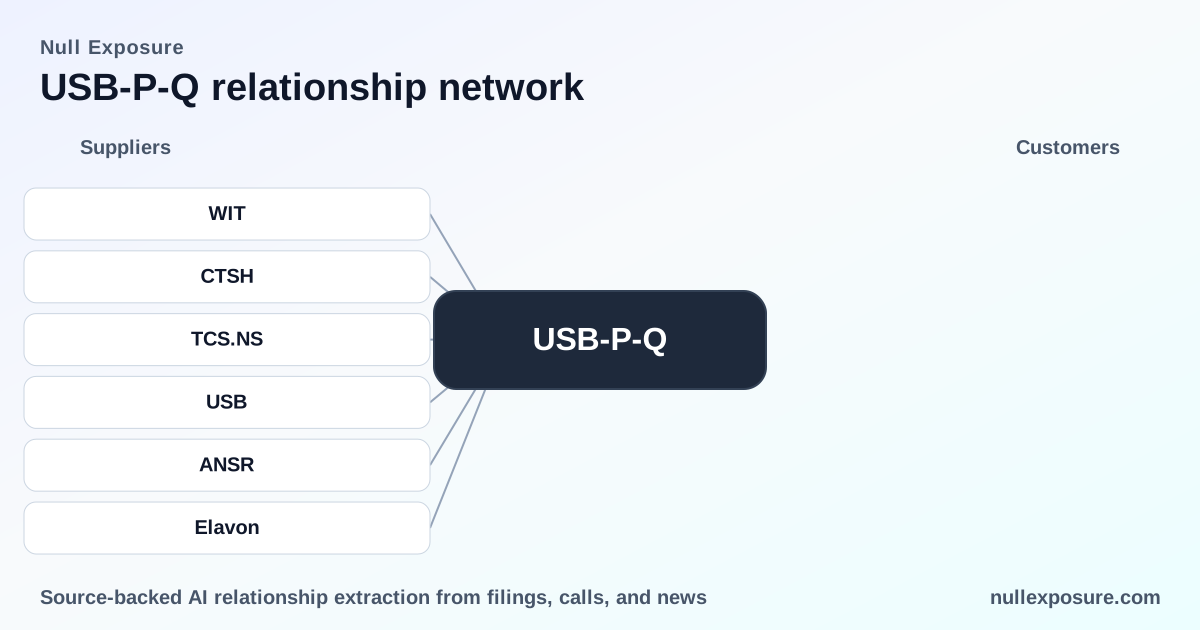
USB-P-Q: What U.S. Bancorp’s supplier map tells fixed-income and operational investors
U.S. Bancorp operates as a diversified bank holding company that earns from net interest spread, fee-based services, payments processing, mortgage and trust operations, and merchant services. For holders and analysts of USB-P-Q preferred paper, the supplier footprint is a window into operational resilience: technology and advisory partnerships drive cost structure and execution risk, while merchant and payments relationships affect revenue capture in increasingly competitive fee channels. For a concise vendor risk brief and ongoing supplier monitoring, visit https://nullexposure.com/ for actionable supplier intelligence.
How to read supplier signals for a preferred-holder thesis
Supplier relationships are not ancillary: they shape execution risk, capital allocation, and the durability of fee streams. From the evidence in recent coverage, U.S. Bancorp is executing a two-track model:
- Outsourced technology capacity for scale and cost arbitrage (India GCC build), balanced with
- In-house merchant capabilities (Elavon) to own payment economics and distribution.
The company-level constraints dataset returned no explicit contractual limitations or supplier-specific covenants, which is itself a signal: there are no disclosed supplier-imposed constraints captured in this profile, indicating the firm’s current public filings and press coverage do not show vendor contractual restrictions that would limit strategic flexibility. Investors should treat that as a neutral company-level indicator and pursue standard diligence on counterparty concentration and SLA exposure.
The supplier roster and what each relationship means for investors
Wipro: shortlisted for India GCC work
U.S. Bancorp has shortlisted Wipro among bidders to set up two global capability centres (GCCs) in India, indicating an intent to expand offshore technology and operations capacity. According to Communications Today (March 2026), Wipro is one of several majors competing for the mandate. (https://www.communicationstoday.co.in/us-bancorp-taps-tcs-wipro-cognizant-ansr-for-india-gcc-mandate/)
Cognizant: in the mix for capability centre mandates
Cognizant is also named as a key bidder for U.S. Bancorp’s planned India GCCs, reflecting the bank’s preference for established IT services partners to deliver scale and modernization work. Communications Today covered Cognizant’s inclusion in the shortlist in March 2026. (https://www.communicationstoday.co.in/us-bancorp-taps-tcs-wipro-cognizant-ansr-for-india-gcc-mandate/)
Tata Consultancy Services (TCS): a prime contender for offshore capability
TCS appears on the shortlist for the two GCCs, signaling U.S. Bancorp’s willingness to engage tier-one Indian vendors for large-scale transformation and capacity projects. This sourcing posture favors cost-efficient delivery and established vendor governance frameworks, as reported by Communications Today in March 2026. (https://www.communicationstoday.co.in/us-bancorp-taps-tcs-wipro-cognizant-ansr-for-india-gcc-mandate/)
ANSR: specialized GCC operator under consideration
ANSR is part of the shortlist for the India GCC mandate, which suggests U.S. Bancorp is considering providers with specialist capability-centre expertise alongside global IT integrators. Communications Today listed ANSR among the bidders in March 2026. (https://www.communicationstoday.co.in/us-bancorp-taps-tcs-wipro-cognizant-ansr-for-india-gcc-mandate/)
BTIG: longstanding equity capital markets adviser
U.S. Bancorp has worked with BTIG since 2014 as its equity capital markets referral partner, indicating a durable adviser relationship that supports capital markets activity and deal execution. Finviz news coverage (March 2026) references the long-standing BTIG connection. (https://finviz.com/news/301951/ubs-nudges-us-bancorp-usb-target-higher-while-holding-a-neutral-view)
Elavon: merchant services arm driving BNPL distribution
U.S. Bancorp is relying on Elavon, its merchant services subsidiary, to drive the bank’s push into buy now/pay later (BNPL) lending, demonstrating a strategy to monetize payments flows through an owned distribution channel. American Banker covered U.S. Bancorp’s BNPL strategy centred on Elavon in 2023. (https://www.americanbanker.com/payments/news/u-s-bank-is-leaning-on-elavon-for-bnpl-reach)
Goldman Sachs: advisor on recent transactions
Goldman Sachs served as an adviser on a recent deal alongside BTIG and Sheumack GMA, signaling the bank’s continued use of global investment banking partners for substantial corporate transactions. Finviz reported the advisory lineup in March 2026. (https://finviz.com/news/301951/ubs-nudges-us-bancorp-usb-target-higher-while-holding-a-neutral-view)
Sheumack GMA: boutique adviser in the advisory mix
Sheumack GMA participated as an adviser on the same deal alongside BTIG and Goldman Sachs, indicating U.S. Bancorp’s use of both large and specialized advisers for strategic transactions. Finviz noted Sheumack GMA’s advisory role in March 2026. (https://finviz.com/news/301951/ubs-nudges-us-bancorp-usb-target-higher-while-holding-a-neutral-view)
For additional context and ongoing monitoring of these supplier relationships, see the supplier intelligence hub at https://nullexposure.com/.
What these relationships imply for investors: concentration, criticality and contracting posture
The mix of shortlisted global IT services firms (TCS, Wipro, Cognizant, ANSR) reveals a strategic push to offshore scale and modernize technology at lower unit cost, while the reliance on Elavon for BNPL distribution reflects a deliberate decision to internalize payments economics rather than ceding fee pools to third-party fintech partners. That combination reduces some middlemen risk but shifts importance to vendor delivery on large-scale transformation programs.
- Contracting posture: U.S. Bancorp is executing competitive procurement—shortlisting multiple bidders for GCC mandates—indicating a bilateral negotiation posture rather than single-sourced dependence. This posture favors better pricing and stronger contractual terms.
- Concentration: No single external supplier dominates the disclosed shortlist; the advisory function uses both global banks and boutiques. However, Elavon represents concentration on the internal merchant services route for payments distribution, making its operational stability strategically critical to payment-fee capture.
- Criticality and maturity: The BTIG relationship dates back to 2014, evidencing a mature, long-term adviser tie that reduces execution risk for capital markets transactions. The shortlisted IT relationships indicate transformational work that will be critical in the medium term and requires disciplined program governance.
- Public constraints signal: There are no recorded supplier constraints in the retrieved profile, which suggests freedom to re-contract or rebalance supplier exposure, but investors should confirm contractual terms and SLAs—especially for any long-term GCC arrangements.
Risk checklist investors should use when underwriting USB-P-Q exposure
- Confirm the status and contractual terms of any GCC awards and transition timelines; transformation delays increase execution and cost risk.
- Evaluate Elavon’s operational redundancy and capital allocation, as merchant services are directly tied to BNPL distribution and fee revenue capture.
- Track adviser roles for major deals, as adviser selection informs deal pricing and execution complexity.
- Monitor regulatory and data-residency implications of offshore GCC work, which can affect compliance costs and timelines.
For a deeper supplier risk profile and alerts tied to U.S. Bancorp, explore tailored monitoring at https://nullexposure.com/.
Bottom line for investors
U.S. Bancorp’s supplier footprint shows a dual strategy: outsource large-scale technology execution to established offshore vendors while retaining payments distribution through an owned subsidiary (Elavon) to capture fee upside. Advisory relationships with BTIG, Goldman Sachs and Sheumack GMA support capital markets execution. There are no captured supplier constraints, which points to contractual flexibility but requires active due diligence on vendor SLAs and the timelines of transformational programs. For investors focused on preferred securities, the supplier map translates directly into operational and execution risk that underpins credit assessment and yield adequacy—track vendor awards, Elavon performance, and adviser-led deal activity as proximate indicators of credit and business-model stability.
For ongoing supplier intelligence and deal-aware monitoring, visit https://nullexposure.com/.