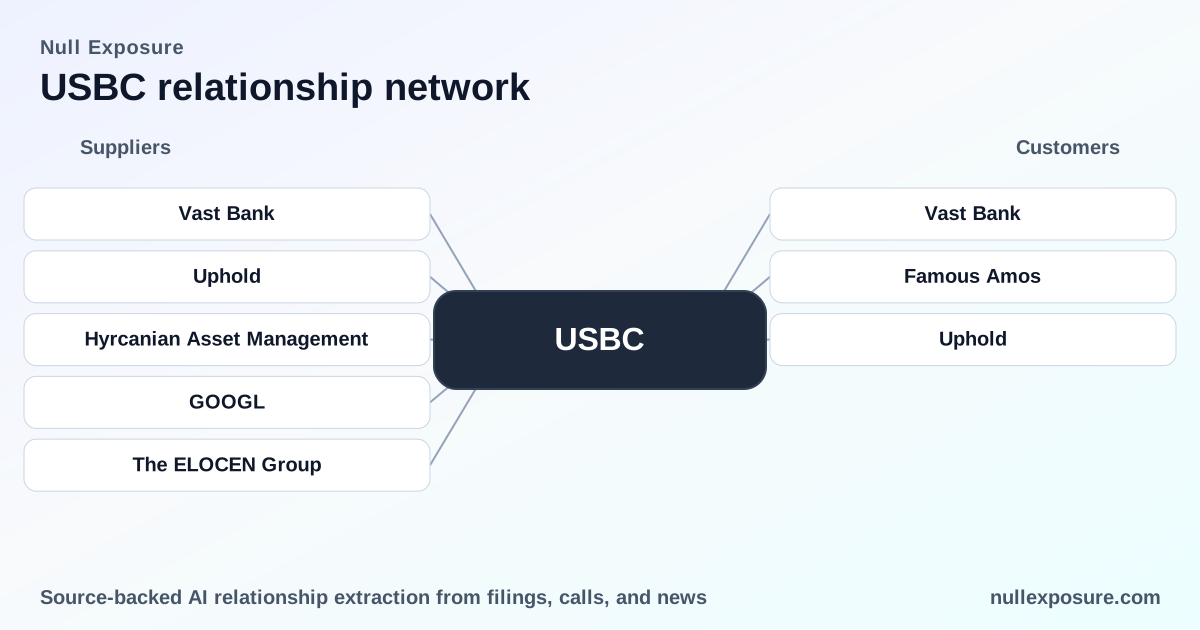
USBC supplier map: tokenized deposits, Bitcoin custody and the service-provider posture investors need to price
USBC presents as a public company that is monetizing through two distinct lines of activity: commercializing technology to enable tokenized U.S. bank deposits and operating a corporate Bitcoin treasury managed via third‑party asset managers and custodians. The firm’s recent press releases and definitive agreements position it as a conduit between regulated banking (Vast Bank), on‑chain infrastructure (Uphold) and discretionary treasury managers (Hyrcanian), while older public profiles list legacy operations; investors should value USBC as a small‑cap technology play with concentrated operational dependencies. For immediate access to supplier intelligence, visit https://nullexposure.com/.
Why this matters: partner selection determines regulatory posture, execution risk and the revenue path—USBC’s suppliers are not ancillary vendors but the platforms and service providers that will enable product delivery and custody of volatile treasury assets.
What the partner list reveals about USBC’s operating model
- Contracting posture — fixed and medium-term commitments. USBC maintains at least one multi-year real estate lease that locks in occupancy costs through 2027, signaling established operational footprint and non-trivial fixed overhead.
- Concentration and criticality — custodial counterparties are mission critical. Management discloses that it holds substantially all Bitcoin with a U.S. institutional custodian; that custodial relationship is described as a primary counterparty risk and therefore central to any valuation or operational continuity analysis.
- Relationship role — service‑provider heavy; external managers power the treasury strategy. Multiple disclosures show USBC relies on third‑party auditors, tax preparers and a discretionary manager for its Bitcoin options strategy (Hyrcanian).
- Maturity — partnerships range from newly executed strategic deals (Uphold/Vast Bank in 2026) to amended, operationally mature agreements (Hyrcanian asset management).
These signals combine into a business model that is platform‑dependent, capital‑light in production but capital‑sensitive in treasury, and highly reliant on a small set of regulated partners—a profile that compresses upside if partnerships scale, and intensifies downside if counterparties falter.
For a deep supplier snapshot and monitoring, see https://nullexposure.com/.
Partnerships that drive the thesis — one‑line takeaways and sources
Vast Bank
USBC is partnering with Vast Bank to issue tokenized bank deposits under U.S. regulatory standards, with press coverage noting that tokenized deposits will be issued through Vast Bank (FY2025–FY2026). A technology news report covering the premarket reaction and coin‑focused coverage referenced the bank’s role in the arrangement (see CoinCentral and TS2 coverage, 2026: https://coincentral.com/usbc-uphold-and-vast-bank-unite-to-launch-the-worlds-first-tokenized-deposit-platform/; https://ts2.tech/en/usbc-stock-jumps-in-premarket-after-uphold-vast-bank-tokenized-deposit-deal/).
Uphold
USBC executed a definitive agreement positioning Uphold as the on‑chain finance infrastructure provider in a strategic partnership to advance tokenized deposit capabilities (announced January 2026). The GlobeNewswire press release and subsequent wire coverage document the finalized terms with Uphold as infrastructure partner (GlobeNewswire, Jan 2026: https://www.globenewswire.com/news-release/2026/01/26/3226020/0/en/USBC-Executes-Definitive-Agreement-with-Uphold-and-Vast-Bank-to-Advance-Tokenized-Bank-Deposit-Initiative.html).
Hyrcanian Asset Management
USBC amended and restated a Digital Asset Management Agreement with Hyrcanian to clarify how Hyrcanian provides discretionary treasury management services for the company’s Bitcoin strategy, including buying and selling Bitcoin call options (FY2025). This updated contract signals a formalized, manager‑led approach to corporate crypto exposure (TradingView report, 2026: https://www.tradingview.com/news/tradingview:dd9f3e7b94fc7:0-usbc-signs-amended-and-restated-digital-asset-management-agreement-with-hyrcanian-asset-management/).
Google (historical programmatic partnership)
An earlier collaboration cited U.S. Black Chambers, Inc. (USBC) working with Google to increase visibility for Black‑led businesses via Google My Business and Google Analytics; this is a historical marketing and outreach relationship referenced in 2020 coverage (Revolt, Aug 2020: https://www.revolt.tv/article/2020-08-01/72760/how-google-is-making-it-easier-to-identify-black-owned-businesses). While not central to the tokenized‑bank thesis, this shows legacy programmatic partnerships in the organization’s broader history.
The ELOCEN Group
USBC’s acquisition of a former BET campus to create a Black business incubator was executed with guidance from The ELOCEN Group leadership, suggesting community‑facing, M&A or real estate advisory engagement with that firm (Insideradio coverage, FY2025: https://www.insideradio.com/free/usbc-acquires-former-bet-campus-to-create-black-business-incubator/article_964ee7ed-a0de-444f-83ae-843cec90726a.html).
How these relationships map to risk and opportunity
- Execution leverage: The Uphold/Vast Bank arrangement is the primary commercial channel for tokenized deposits; revenue realization depends on their regulatory compliance and operational integration, not on USBC’s in‑house banking licenses.
- Custody concentration: Management’s disclosure that it stores substantially all Bitcoin with a U.S. institutional custodian elevates that counterparty to a critical control; custodial failure or regulatory action would directly impair the company’s treasury assets.
- Manager dependence: The Hyrcanian amendment converts what could be a proprietary trading approach into an outsourced, discretionary program; that reduces internal operating complexity but transfers execution risk to the manager’s competence and counterparty arrangements.
- Balance‑sheet and governance signals: Public filings show near‑total insider ownership and minimal institutional holdings, which creates governance concentration and potential liquidity risk for minority investors.
Investor implications and action points
- Short‑term trade idea: Market moves around the January 2026 press release show sensitivity to partnership announcements—trade catalysts are announcement‑driven until transaction volumes validate recurring revenue.
- Due diligence focus: Prioritize verification of the custodial counterparty, the commercial terms with Vast Bank and Uphold, and contract terms of the Hyrcanian agreement (fees, termination rights, indemnities).
- Risk controls: Stress‑test scenarios where custody or partner regulatory changes restrict token issuance or freeze treasury assets.
For a consolidated supplier due diligence package and ongoing monitoring of these counterparties, visit https://nullexposure.com/.
Final assessment
USBC’s current supplier matrix is dominated by a small number of high‑impact partners: Vast Bank and Uphold are the distribution and compliance rails for tokenized deposits, Hyrcanian runs the Bitcoin options strategy, and an institutional custodian holds the treasury assets. This configuration creates a binary outcome profile: scale and recurring revenues if partners integrate and regulatory clarity stabilizes; material downside if any mission‑critical counterparty fails or regulatory developments constrain tokenized deposit issuance. For investors evaluating positions, the valuation should embed both the upside of platform monetization and the concentrated counterparty risk identified above.
Want continuous supplier analytics and alerts on USBC counterparties? Review our monitoring tools at https://nullexposure.com/.