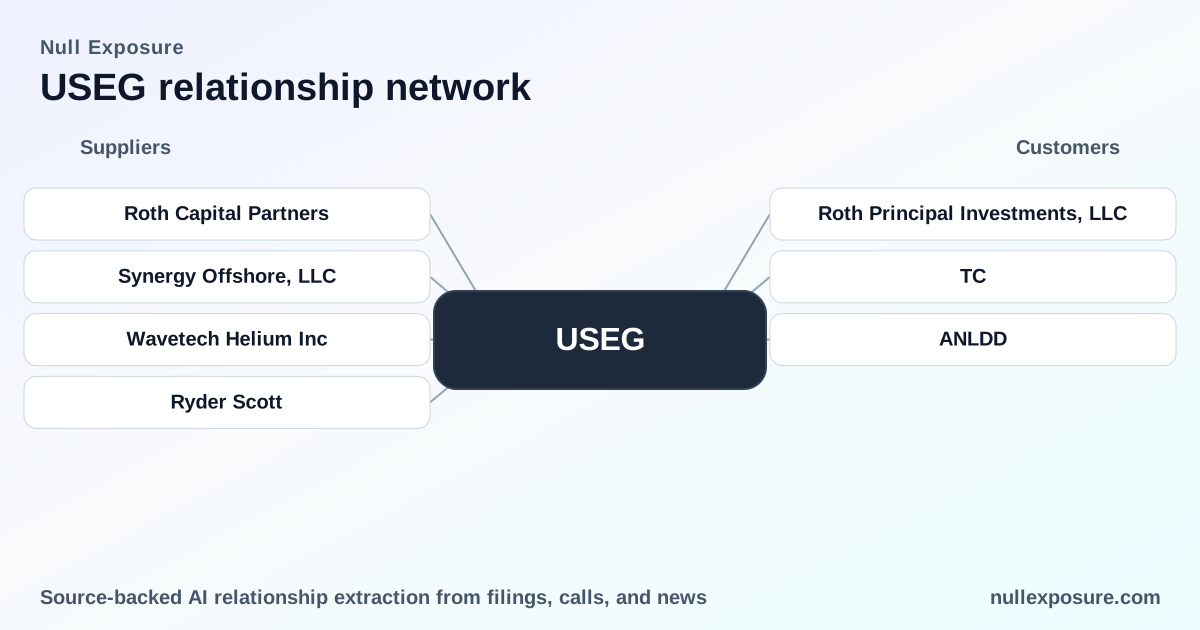
US Energy Corp (USEG) — supplier map and commercial takeaways for investors
US Energy Corp operates as a small-cap oil & gas explorer and producer focused on helium and conventional hydrocarbons; it monetizes through acreage acquisition, development and targeted resource commercialization while supplementing capital needs via equity underwritings and credit facilities. Revenue generation is asset-driven (Kevin Dome acreage and associated industrial gas prospects) while financing partners and professional services provide critical non-production capabilities. For investors evaluating supplier risk and opportunity, the balance between operated acreage control and dependence on third-party technical and capital providers is the central theme.
Explore the full supplier intelligence offering at https://nullexposure.com/ for more detailed supplier assessments.
What the company’s operating model looks like in practice
US Energy pursues contiguous acreage consolidation and develops targeted industrial gas (helium) prospects; it funds that growth through a mix of equity offerings and credit facilities while buying technical validation and outsourced services. Monetization comes from bringing acreage to producing status and selling gas or royalties; financing partners accelerate that timeline but dilute ownership and impose financial covenants. Operationally the company demonstrates a mix of in-house and outsourced functions: technical reserve certification, accounting back-office outsourcing, and capital-market intermediaries for equity issuance.
Supplier landscape: the counterparties that move the needle
The following relationships are drawn from company releases and press reporting and reflect the core external providers and counterparties disclosed by USEG.
Roth Capital Partners — the equity underwriter
Roth Capital Partners is acting as the sole book-running manager for recent underwritten offerings, handling pricing and distribution of common stock to supply growth capital. According to a March 2026 press announcement, Roth is the sole book-runner on that offering, which directly influences USEG’s liquidity and shareholder base. (GlobeNewswire / March 2026)
Synergy Offshore, LLC — acreage LOI and consolidation partner
USEG executed a non‑binding letter of intent to acquire operated acreage from Synergy Offshore, expanding a largely contiguous position across the Kevin Dome to roughly 164,000 net acres. The July 2024 company release details this LOI as part of a strategic acreage consolidation for helium development. (GlobeNewswire / July 2024)
Wavetech Helium Inc — asset seller and joint-development counterparty
USEG closed on an agreement to acquire operated acreage from Wavetech targeting helium production on the Kevin Dome structure; the transaction establishes operated control of those specific assets. The company’s July 2024 announcement confirms the Wavetech transaction as a core component of its acreage buildout. (GlobeNewswire / July 2024)
Ryder Scott — independent technical evaluator
Ryder Scott prepared industrial gas resource reports for volumes in place on USEG’s initial target development area across Kevin Dome, providing authoritative resource quantification used in planning and capital-raising. USEG disclosed Ryder Scott’s report in both August 2025 and November 2025 operational updates. (GlobeNewswire / August 2025; GlobeNewswire / November 2025)
Constraints and company-level signals that matter to investors
Company disclosures and contract excerpts reveal structural characteristics of USEG’s operating posture:
- Contracting posture: presence of long-term agreements. Company documents reference agreements with multi-year terms (for example an initial term expiring January 1, 2027 with automatic two‑year renewals and a four‑year credit agreement signed in January 2022), indicating a preference for multi-year arrangements that stabilize counterparties and financing. This is a company-level signal of contractual maturity and predictability.
- Service outsourcing is material to operations. USEG has outsourced substantial day‑to‑day accounting and uses external providers for reserve estimates and cybersecurity guidance, signaling an operational model reliant on external service providers for core non-field functions.
- Spend concentration on development-phase capital. The company disclosed it agreed to be responsible for 100% of capital costs up to $20 million related to Wavetech’s 17.5% interest—this shows direct capital exposure tied to an asset purchase and demonstrates how development risk translates into near-term cash requirements (this constraint explicitly references Wavetech and therefore applies to that relationship).
- Spend band and scale. The disclosed capital commitment places certain supplier/partner spend in the $10M–$100M band, a level that is material to a small-cap balance sheet and will influence financing cadence.
These constraints collectively indicate a controlled but capital-intensive operating model that relies on external technical validation and equity markets to scale.
Investment implications — opportunity and risk, succinctly
- Upside: Contiguous acreage consolidation (Synergy, Wavetech) combined with independent resource reports (Ryder Scott) de-risks resource economics and strengthens capital-raising credibility; underwriter support (Roth) facilitates near-term liquidity.
- Downside: Outsourced back-office and heavy near-term capital commitments create execution risk if financing conditions deteriorate; a small institutional ownership base and high insider ownership concentrate governance and execution decisions.
- Catalysts to watch: Ryder Scott updates, definitive acquisition documents converting LOIs to closed deals, and the cadence and pricing of Roth-led equity offerings.
If you want structured supplier risk scoring or counterparty concentration analysis, start here: https://nullexposure.com/.
Tactical next steps for investors and operators
- Prioritize monitoring Ryder Scott resource updates and firm documentation that converts LOIs with Synergy into closed transactions; those documents will materially change reserve-backed valuation.
- Track Roth Capital’s underwriting calendar and any follow-on placements; equity pricing and timing directly affect dilution and available development capital.
- Model the $20 million capital responsibility tied to Wavetech into cash-flow and covenant stress tests given the company’s small market cap and negative EBITDA.
For a tailored supplier diligence package and to benchmark USEG’s counterparty network against peers, visit https://nullexposure.com/.
Bottom line
US Energy runs a classic small-cap E&P playbook: asset consolidation plus external validation and capital-raising to transition acreage into production. Key suppliers—Roth Capital (equity underwriting), Wavetech and Synergy (acreage counterparties), and Ryder Scott (technical certifier)—are strategically critical and collectively determine the company’s financing runway and development trajectory. Investors should weigh the clear upside of contiguous acreage and third‑party certification against the capital intensity and reliance on equity markets and outsourced services for execution.