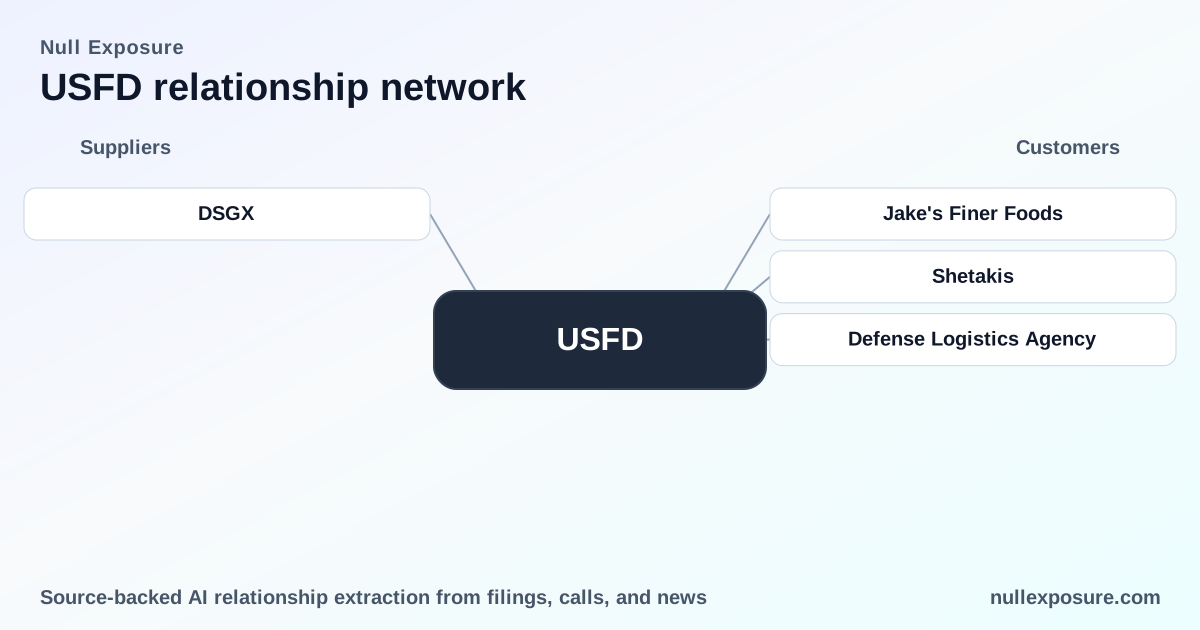
US Foods (USFD) — supplier relationships, operational constraints, and what matters to investors
US Foods operates as one of the largest food distribution platforms in the U.S., monetizing scale through wholesale distribution of national and private-label food products to restaurants, hospitality and institutional customers. Revenue is driven by unit volumes across a broad product portfolio, while EBITDA converts on narrow operating margins that depend on logistics efficiency, fuel cost management and supplier incentive programs. For investors this is a volume-and-operations business: margin expansion comes from route productivity, procurement economics and the recognition of purchase-based incentives.
If you want a focused supplier-risk briefing for portfolio or operating decisions, start here and then see the broader supplier intelligence offering at https://nullexposure.com/.
Why supplier relationships are a structural lever for US Foods
US Foods runs a high-throughput distribution model: national-brand and private-label purchases flow through a dense dc-and-truck network, which means supplier terms and logistics technology directly translate into margin per case. The company discloses it typically uses short-term supplier contracts and participates in purchase-based rebate programs, which produces a supplier posture that is both flexible and operationally demanding. Short contracting reduces stranded commitments but increases sensitivity to spot input prices and the timing of promotional rebates. As a result, operating leverage is realized through process improvements (e.g., routing efficiency) and through capture of supplier incentives when purchasing patterns align.
Company filings show material fuel exposure—$34 million in diesel forward purchase commitments as of December 27, 2025—and explicit statements that the company “typically do[es] not have long-term contracts with suppliers,” underscoring a sourcing model built on flexibility rather than long-duration guarantees.
Supplier mention: Descartes — routing and AI productivity (news item)
According to a Finviz summary of US Foods’ Q4 remarks, the company referenced productivity gains from deployment of AI-driven MOXe features and Descartes routing, listing route optimization as a direct contributor to operational productivity. (Finviz, March 10, 2026: https://finviz.com/news/315870/5-insightful-analyst-questions-from-us-foodss-q4-earnings-call)
Supplier mention: Descartes — measurable delivery gains in 2025 (earnings transcript)
An earnings-call transcript published by InsiderMonkey reported that Descartes was fully deployed across the distribution network in 2025 and drove roughly a 2% improvement in cases-per-mile on broad-line deliveries year-over-year, indicating tangible efficiency gains from the routing platform. (InsiderMonkey Q4 2025 earnings call transcript, March 10, 2026: https://www.insidermonkey.com/blog/us-foods-holding-corp-nyseusfd-q4-2025-earnings-call-transcript-1695379/)
What the supplier signals collectively indicate about the business model
- Contracting posture: short-term and usage-linked. The company explicitly states it “typically do[es] not have long-term contracts with suppliers” and relies on purchase-based rebate programs. That creates operational flexibility but also means margin is sensitive to buying cadence and timing of promotional incentives.
- Payment and incentive structure: usage-based rebates. US Foods recognizes incentives when products are purchased, so earnings are exposed to the timing and predictability of promotions rather than fixed supplier credits.
- Counterparty profile: large national suppliers. Suppliers are generally large corporations selling national brands or private-label items, which reduces counterparty credit risk but keeps US Foods anchored to national brand price dynamics.
- Critical cost exposures: fuel and logistics. The stated diesel forward purchase commitments (roughly $34 million as of late 2025) are in the $10M–$100M spend band and indicate fuel is a material variable cost that the company actively manages through short-term hedging.
- Maturity and operational tech: progressing. The full deployment of Descartes routing and AI-driven MOXe features—tied to a measured 2% cases-per-mile improvement—shows a maturing logistics stack that converts technology investments into unit-cost savings.
These constraints are company-level signals; they define how US Foods negotiates, budgets and captures margin across suppliers.
If you need an integrated supplier-risk dashboard or supplier-by-supplier analysis, see our platform at https://nullexposure.com/.
Investor implications: what to watch and how to weight the signals
For portfolio managers and operators, the combination of short supplier contracts, usage-based incentives and measurable routing gains produces a set of actionable priorities:
- Near-term margin sensitivity: monitor gross margin and rebate accruals closely—because incentives are recognized on purchase, quarter-to-quarter variability is the primary earnings risk.
- Logistics productivity as a margin lever: track cases-per-mile and other routing KPIs; the Descartes deployment has already delivered a ~2% improvement, which scales across volumes.
- Fuel exposure and hedging: the $34M diesel commitment shows active management; track fuel purchase commitments and fuel cost pass-through mechanisms for customers.
- Supplier concentration and pricing power: national-brand relationships limit some pricing discretion but simplify procurement counterparty risk; watch private-label penetration as a margin diversification metric.
- Operational execution risk: short-term contracts imply procurement flexibility but raise the importance of forecasting and inventory discipline.
These are the levers that translate supplier relationships into investable earnings outcomes.
Quick checklist for active managers and operators
- Confirm quarterly rebate recognition and the assumptions management uses to estimate incentive consideration.
- Validate cases-per-mile trends post-Descartes and ensure productivity gains are sustainable as volumes normalize.
- Review the evolution of diesel hedging commitments and the company’s exposure to wholesale fuel price swings.
- Monitor the balance between national-brand and private-label purchasing to assess supplier price leverage.
Bottom line and recommended next steps
US Foods operates a high-volume, logistics-driven distribution business where supplier terms, fuel commitments and routing technology are direct profit drivers. The rollout of Descartes and AI-driven routing is already producing measurable gains, while short-term contracting and usage-based incentives create both opportunity and volatility in margin recognition. For investors, the path to upside runs through logistics productivity and disciplined capture of supplier rebates; downside arises from fuel cost swings and unpredictable promotional timing.
For a deeper supplier-risk read and operationally focused exposure analysis, visit https://nullexposure.com/ to explore tailored intelligence and supplier relationship profiles.