US GoldMining (USGO): supplier map and what it means for investors
U.S. GoldMining (USGO) is an exploration-stage mining company focused on advancing the Whistler gold–copper project in Alaska. The company generates value by advancing exploration results, engineering studies and permitting to create optionality for a future development decision; near-term monetization depends on attracting project finance, offtake partners or strategic capital rather than operating revenue. Investors should evaluate USGO through the lens of project development execution, capital markets access, and the vendor ecosystem that supplies drilling, engineering, metallurgical and market-facing services. For a deeper vendor-risk view, visit https://nullexposure.com/.
Quick thesis: supplier relationships are execution-critical and financing-sensitive
USGO’s supplier network is a mix of technical service firms that directly affect resource definition and metallurgical outcomes, and capital markets intermediaries that shape access to funding. Technical vendors drive project economics and timeline; capital-market agents control dilution and liquidity. Changes in either class of supplier are immediate signals for project risk and financing posture.
Visit https://nullexposure.com/ to review supplier analytics and relationship timelines.
Who is supplying USGO — plain-English relationship summaries
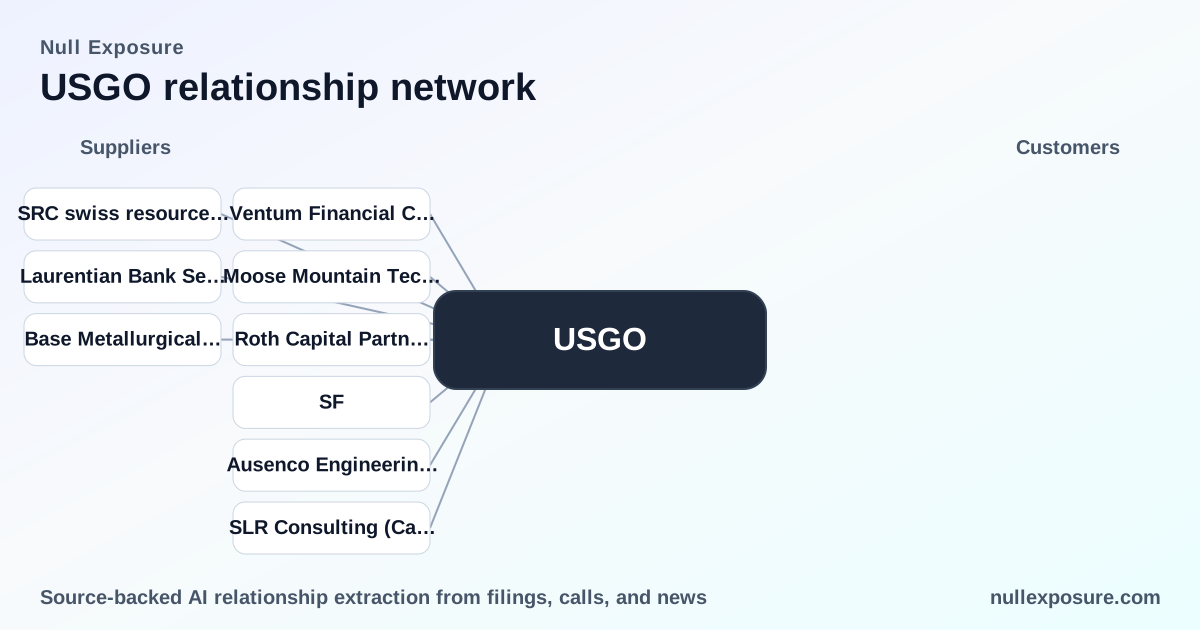
- Ventum Financial Corp. — Added as a co-agent to USGO’s ATM offering as part of a refresh of capital markets intermediaries, indicating a change in the company’s distribution and placement strategy. This was disclosed in a Globe and Mail press release updating the ATM offering (March 2026).
- Stifel, Nicolaus & Company, Incorporated (Stifel) — Named a new co-agent on the updated ATM facility, positioning Stifel to handle placement activity and liquidity support for share issuance under the plan; the change was recorded in the same Globe and Mail release (March 2026).
- Laurentian Bank Securities Inc. — Previously a co-agent on the ATM offering and formally terminated from that role in the March 2026 ATM update, signaling a deliberate change in USGO’s capital markets counterparties per the Globe and Mail press release.
- Roth Capital Partners, LLC — Similarly terminated as co-agent in the ATM update, removing a previously active placement intermediary from the company’s ATM structure as reported in the Globe and Mail release (March 2026).
- Ausenco Engineering Canada ULC — Lead author of the Positive Preliminary Economic Assessment (PEA) for the Whistler project; Ausenco delivered the engineering study with contributions from technical specialists, per USGO’s PEA announcement (March 2026).
- Moose Mountain Technical Services (MMTS) — Provided technical contributions to the PEA and supported geological and resource assessment work for Whistler, listed as a contributor in the company’s PEA release (March 2026).
- SLR Consulting (Canada) Ltd. — Executed the 2025 scout drilling program using helicopter-portable Shock Auger rigs to sample the overburden–bedrock interface, a fieldwork role central to prospect definition, as described in the company’s PR on new porphyry targets (March 2026).
- Base Metallurgical Laboratories Ltd. — Conducted flotation and leach metallurgical test work that improved reported gold recoveries, providing data that directly affects projected processing recoveries and the PEA’s assumptions (PR Newswire, FY2025 metallurgical report).
- SRC swiss resource capital AG — Engaged under an investor relations/advisory agreement to distribute promotional material related to USGO and related companies, a marketing/IR relationship disclosed in a distributed article (Resource-Capital, 2026).
Each of these relationships intersects with either project definition (drilling, metallurgical testing, engineering) or capital markets (ATM co-agents, IR advisors), and each was publicly reported in company releases or third‑party news in early 2026.
What the constraints tell investors about USGO’s operating model
The company-level constraints extracted from recent filings and press material are consistent and actionable for underwriting supplier risk:
- Contracting posture: service-provider heavy. USGO relies on independent consultants and contractors for land acquisition, drilling, environmental baseline work, stakeholder engagement and database management; consulting fees were a material line item ($1.29m in the referenced period). This is an operational model typical of exploration-stage miners where fixed staff are limited and vendors deliver execution.
- Spend patterns reflect mid-size vendor commitments. Drilling accounted for roughly $2.34m in the reported year, camp and field support about $1.27m, and transportation/fuel/aircraft charter roughly $906k — these are multi-hundred-thousand to multi-million dollar engagements that make certain vendors operationally critical.
- Concentration and capitalization signals. The company is exploration-stage with no operating revenue; insiders control a large majority of shares (~78.5% insider ownership) and institutions hold a small share (~7.1%), indicating governance and financing dynamics that favor insider influence over market pressure.
- Government counterparty exposure. USGO is contractually required to make annual land payments of $230,605 to the Department of Natural Resources of Alaska to keep the Whistler project in good standing, creating a predictable, recurring permitting-related cash obligation and direct public-land dependency.
- Maturity: early-stage but technically advancing. The presence of a formal PEA prepared by Ausenco and metallurgical improvements from Base Metallurgical indicates progression from pure exploration toward pre-feasibility inputs, but the business model remains dependent on financing events rather than operating cash flow.
Capital-market supplier churn is a signal, not noise
The simultaneous exit of Laurentian Bank Securities and Roth Capital and the addition of Ventum and Stifel as ATM co-agents is more than administrative housekeeping. Swapping placement agents changes the liquidity ladder and investor reach for incremental share issuances, which affects dilution timing and the ease of raising exploration capital. This transaction-related supplier churn was disclosed in the Globe and Mail ATM update (March 2026).
Mid-article note: if you are modeling project financing timelines and vendor-critical path, review detailed supplier timelines at https://nullexposure.com/.
Risk and opportunity implications
- Operational risk clusters around drilling, camp support and metallurgical testing: failure or delay from SLR, Base Metallurgical or camp contractors would directly set back resource definition and PEA inputs. These vendors are single points of execution for core technical milestones.
- Financing risk is concentrated in the ATM and capital markets relationship set: changes to co-agents alter placement capacity and investor access. Liquidity and timing of equity raises are primary near-term value drivers.
- Opportunity emerges from technical gains: improved metallurgical recoveries reported by Base Metallurgical and a positive Ausenco PEA raise project economics, which should improve financing terms and attract strategic counterparties if sustained (PR Newswire and company PEA announcements, March 2026).
Bottom line and recommended investor actions
USGO’s supplier ecosystem is a two-part engine: technical vendors move the project forward; capital-market agents move capital into the company. Both must perform to validate the Whistler project economics and fund the next stages. Monitor vendor delivery milestones (PEA inputs, metallurgical test validation, drill program results) and capital markets activity around the ATM for signs of funding sufficiency or dilution pressure.
For investor dashboards, vendor timelines, and relationship risk scoring, start with the supplier intelligence suite at https://nullexposure.com/. If you want a project-focused supplier risk memo or a consolidated delivery timeline aligned to financing scenarios, request a bespoke analysis at https://nullexposure.com/.
Key takeaway: USGO has progressed technically with external engineering and metallurgical providers while actively reshaping capital-market intermediaries; the next material valuation moves will be determined by technical confirmations from service providers and the company’s ability to execute fundraising through its new co-agents.