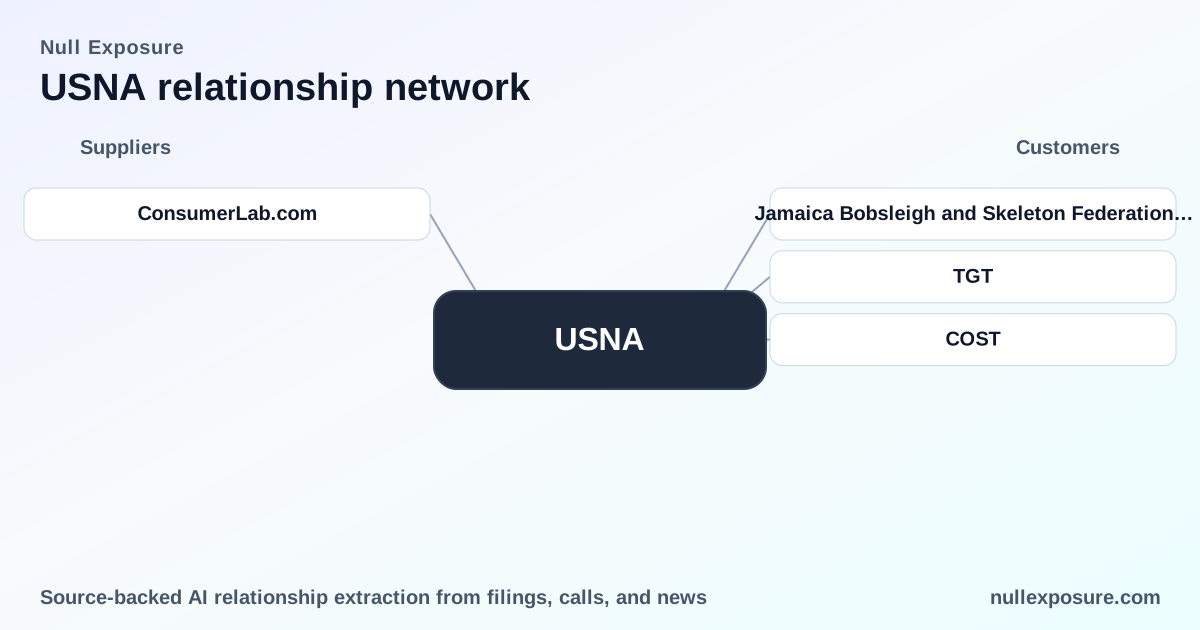
USANA Health Sciences: supplier signals from product validation to contractual posture
USANA develops, manufactures and sells science-based nutritional and personal care products and monetizes through global product sales — a model that converts R&D and brand credibility into recurring revenue from consumers and independent sellers. With roughly $925M in trailing revenue and gross margins that support scale, USANA’s supplier relationships are critical to product quality and distribution economics. If you evaluate counterparty risk or supplier opportunity, the combination of independent third-party manufacturing, short-term contracting and recent third-party product validation are the most material inputs to model. For operational diligence and supplier monitoring, visit https://nullexposure.com/.
Why recent product validation matters to supplier economics
USANA’s portfolio strength increasingly depends on third-party validation to differentiate commoditized supplements. The company’s top-rated probiotic earning an external seal strengthens pricing power and reduces the marketing lift required to convert customers — a direct positive for supplier throughput and inventory turns.
ConsumerLab.com Seal — SahmCapital press report (Dec 16, 2025)
USANA’s probiotic earned the ConsumerLab.com Seal of Approval, a credential that supports the product’s quality claims and can accelerate retailer and consumer acceptance. According to a SahmCapital news release dated December 16, 2025, the company announced the recognition publicly (source: https://www.sahmcapital.com/news/content/trust-your-gut-usanas-probiotic-earns-consumerlabcom-seal-of-approval-2025-12-16).
ConsumerLab.com Seal — StockTitan coverage (same announcement)
The same ConsumerLab.com recognition was distributed through other news aggregators; StockTitan carried the release noting the Seal of Approval and the company announcement. This duplicate coverage reinforces the visibility of the validation across investor and trade channels (source: https://www.stocktitan.net/news/USNA/trust-your-gut-usana-s-probiotic-earns-consumer-lab-com-seal-of-nxanmzaco4ds.html).
What the supplier constraints tell investors about operational risk
USANA’s supplier posture is best understood as a mix of outsourced manufacturing with short contracting horizons, which drives both flexibility and potential volatility.
- The company discloses unconditional purchase obligations for IT-related services and advertising that are generally paid within one year, listed at $6,746 and $8,018 as of December 28, 2024 and December 30, 2023, respectively; this signals a short-term contracting posture for non-core services and marketing spend that reduces long-term fixed commitments and preserves liquidity for product investment (company filing, year-end 2024).
- USANA contracts with third-party suppliers and manufacturers for production, with those third-party manufacturers accounting for approximately 31% of product sales in 2024; this is a material outsourcing footprint that concentrates manufacturing risk outside the corporate boundary (company filing, 2024).
- With the exception of China, raw material and product purchases are transacted in U.S. dollars, simplifying currency exposure for most supplier agreements but leaving localized FX and geopolitical risk in China.
Taken together, these constraints create a supplier profile that is operationally flexible but partially concentrated: short contracts reduce fixed-cost drag and give procurement agility, while a meaningful share of outsourced production (31%) elevates supplier criticality and requires active quality oversight and contingency planning.
How supplier signals affect valuation and execution
From a valuation and operational perspective, the supplier profile produces a set of observable implications for investors and operators.
- Quality validation reduces sales risk. Third-party seals such as ConsumerLab.com function as marketing multipliers that improve sell-through and can protect margin by reducing promotional discounting. This is an earnings-accretive event if adoption follows.
- Outsourcing amplifies supply-chain dependency. With 31% of product sales produced externally, supplier failures, capacity constraints, or quality lapses can cause episodic revenue disruption and higher logistics or rework costs; diligence should focus on counterparty concentration and dual-sourcing plans.
- Short-term purchasing contracts lower capital commitment but increase renewal risk. Short horizons on IT and advertising contracts preserve flexibility but create recurring renegotiation exposure; in inflationary or competitive markets, cost escalation at renewal could compress operating margin.
- Currency posture simplifies procurement outside China. Dollar-denominated buying limits FX volatility for most inputs, though localized exposure in China remains a discrete risk to monitor.
These factors should be integrated into unit economics and scenario stress tests: model the upside from improved sell-through following product validation and the downside from supplier disruption that impacts the 31% outsourced revenue bucket.
For a structured supplier intelligence workflow and ongoing monitoring, see how we operationalize these signals at https://nullexposure.com/ — tools that help translate validation events and contract disclosures into measurable supplier risk scores.
Practical next steps for investors and operators
For investment due diligence and supplier management, prioritize three lines of inquiry:
- Confirm the identity and concentration of the third-party manufacturers that constitute the 31% outsourced production; assess lead times, capacity and geographic concentration.
- Map renewal timelines and escalation clauses in short-term supplier contracts for IT, advertising and other service lines to quantify near-term margin pressure.
- Track product validation flow-through to orders and inventory turns — specifically, measure monthly sell-through for the probiotic post-ConsumerLab recognition.
If you require systematic monitoring or want tailored supplier risk analysis, start here: https://nullexposure.com/.
Bottom line: supplier dynamics are a double-edged sword
USANA’s business converts scientific positioning into consumer revenue, and third-party validation strengthens that conversion, directly supporting top-line efficiency. However, meaningful outsourced manufacturing (31%) and a short-term contract posture expose operations to supplier-side concentration and renewal risk. For investors, the thesis is straightforward: product quality endorsements de-risk demand, while manufacturer dependency and contract renewals are the principal operational vulnerabilities to quantify in any valuation or partnership decision.
For ongoing supplier tracking and to integrate these signals into your investment process, visit https://nullexposure.com/ and begin mapping supplier exposures against revenue and quality outcomes.