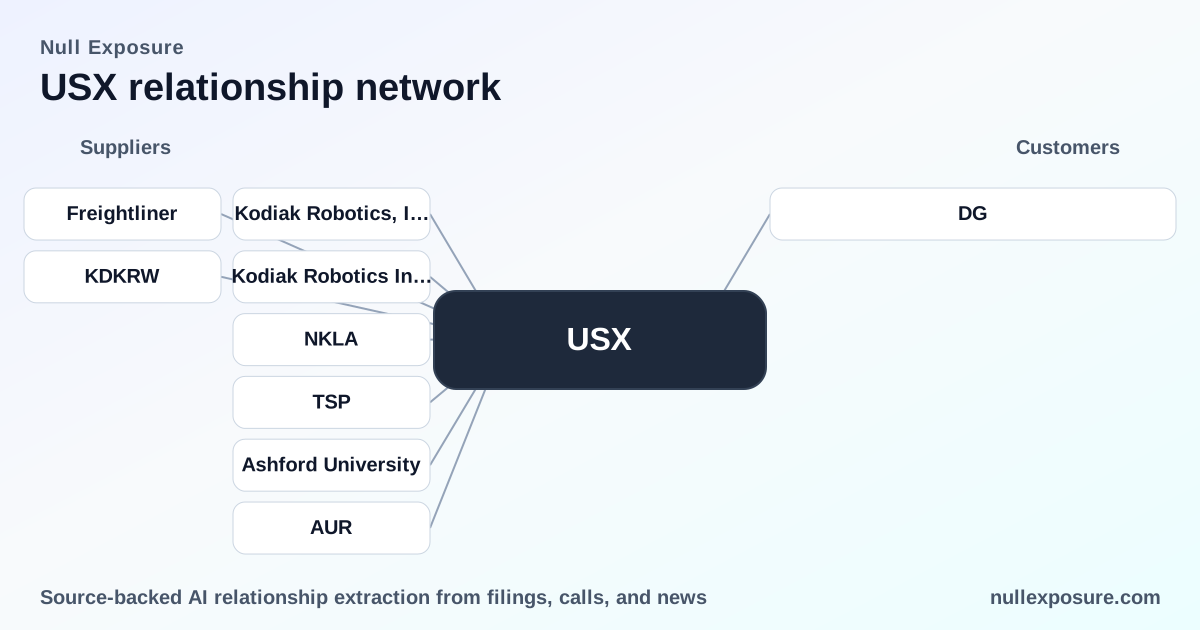
US Xpress (USX) — Supplier Relationships Drive Technology Transition and Cost Profile
U.S. Xpress operates as an asset-heavy truckload carrier that monetizes by moving freight across national lanes, generating revenue from linehaul services and driver/tractor asset utilization; the company is actively leveraging supplier relationships — particularly in autonomous driving and zero-emission vehicle technology — to lower operating cost per mile and defend margins as freight markets normalize. For investors, supplier partnerships are not ancillary: they are strategic levers that affect future capital intensity, unit economics, and fleet transition risk. Learn more about supplier risk for transport operators at https://nullexposure.com/.
Why supplier relationships are material U.S. Xpress’s supplier posture is pragmatic and technology-forward: it contracts with vehicle OEMs and autonomy developers to pilot next-generation trucks while maintaining core diesel capacity for current volumes. That posture creates a mixed set of characteristics investors should evaluate:
- Contracting posture: Primarily supplier pilots and fleet tests rather than full captive manufacturing; agreements historically ranged from evaluations to conditional fleet orders.
- Concentration: Suppliers span multiple technology tracks (autonomy, hydrogen/battery, OEMs, and education/HR partners), which lowers vendor concentration risk but raises integration complexity.
- Criticality: Partnerships with autonomy developers and truck OEMs are strategically critical because they influence long-term fuel & labor cost structure.
- Maturity: Relationships sit across a maturity spectrum — long-standing pilots (TuSimple since 2019), mid-term evaluations (Nikola tests in 2016–2019), and more recent autonomous-Hybrid runs in 2022–2026.
No explicit contractual constraints were returned in the available relationship records; treat these as company-level signals that supplier commitments are mostly pilot- and test-focused rather than heavily contracted long-term purchase obligations.
Supplier map and what each partner contributes Below are the supplier relationships identified in public reporting and the plain-English implications for US Xpress.
Kodiak Robotics — autonomous trucking partner and lane hauler
U.S. Xpress ran an autonomous trucking route in which a Kodiak autonomous tractor picked up and delivered U.S. Xpress pre-loaded trailers over long-haul lanes, demonstrating commercial integration of trailers and autonomy across networked routes. According to coverage in The Trucker (March 2026), Kodiak tractors hauled U.S. Xpress trailers on extended routes that tested operational continuity. (Source: https://www.thetrucker.com/trucking-news/equipment-tech/us-xpress-operates-autonomous-trucking-route-for-more-than-6k-miles, Mar 2026)
Kodiak Robotics — continued lane operations between Dallas and Atlanta
Kodiak will continue hauling freight for U.S. Xpress on the Dallas–Atlanta corridor and other Kodiak network lanes, indicating recurring operational engagements rather than a one-off pilot. CCJ Digital reported on the completion of a 6,350‑mile autonomous run that used U.S. Xpress trailers on Kodiak equipment. (Source: https://www.ccjdigital.com/equipment-controls/article/15290376/us-xpress-kodiak-robotics-complete-6350-mile-131-hour-autonomous-run, Feb 2026)
TuSimple — strategic investor/test partner since 2019
U.S. Xpress has worked with TuSimple since 2019 and began testing TuSimple’s autonomous tech on selected shipping lanes for major customers, showing an early and sustained commitment to autonomy pilots to reduce driver cost and improve lane efficiency. The Trucker covered U.S. Xpress’s multi-year engagement and testing activity. (Source: https://www.thetrucker.com/trucking-news/business/us-xpress-makes-significant-financial-investment-in-autonomous-trucking, 2026 reporting citing the multi-year effort)
Aurora — exploration of the Aurora Driver within Variant operations
U.S. Xpress announced a collaboration with Aurora to explore deployment of the Aurora Driver in its Variant division, signaling interest in integrating third-party autonomy stacks into existing fleet operations. CCJ Digital summarized the collaboration as exploratory deployment testing. (Source: https://www.ccjdigital.com/equipment-controls/article/15290376/us-xpress-kodiak-robotics-complete-6350-mile-131-hour-autonomous-run, Feb 2026)
Nikola Motor Co. — earlier electric/hydrogen truck tests and potential orders
U.S. Xpress was an early adopter in tests of Nikola’s hydrogen-electric Class 8 trucks and anticipated placing multimillion-dollar orders as part of its clean-fleet evaluations, indicating historical interest in zero-emission powertrains as a component of its transition strategy. TTNews documented U.S. Xpress’s plans and test agreements dating back to 2016 and subsequent coverage through 2019. (Source: https://www.ttnews.com/articles/us-xpress-anticipates-placing-multimillion-dollar-orders-nikola-electric-trucks, Dec 2016; https://www.ttnews.com/articles/nikola-moves-closer-marketing-hydrogen-electric-trucks, 2019)
Freightliner — OEM collaborations on next-generation tractors
U.S. Xpress has collaborated with Freightliner on Next-Generation Cascadia equipment, reflecting continued direct engagement with established OEMs to acquire incremental efficiency gains while tests with alternative-power suppliers proceed. TTNews captured remarks from U.S. Xpress leadership emphasizing work with Freightliner to evaluate cutting-edge technologies. (Source: https://www.ttnews.com/articles/us-xpress-anticipates-placing-multimillion-dollar-orders-nikola-electric-trucks, Dec 2016)
Ashford University — driver education and retention program
U.S. Xpress sponsors a Full Ride scholarship program allowing drivers and their dependents to earn degrees at Ashford University at no cost, a clear HR and retention-oriented supplier relationship that supports long-term driver pipeline stability. MultiVu published the program details highlighting the education benefit as part of driver recruitment and retention efforts. (Source: https://www.multivu.com/players/English/8386851-us-xpress-full-ride-scholarship-truck-drivers-dependents/, 2025)
Strategic implications and investment risks The supplier mix reveals a deliberate hedging strategy: U.S. Xpress is simultaneously piloting autonomy (Kodak/Kodiak, TuSimple, Aurora), testing zero-emission trucks (Nikola), and refreshing core diesel fleet relationships (Freightliner). That dual-track approach reduces single-vendor dependency but increases capital and integration risk during the transition.
Key takeaways:
- Upside: Successful autonomy deployments could materially lower driver-hour costs and extend asset utilization, improving unit economics.
- Operational risk: Pilots that do not convert to scalable fleet deployments will still require sunk investment and integration expense.
- Balance sheet impact: Transitioning to alternative powertrains or autonomy at scale will influence near-term capex and maintenance patterns.
For a deeper supplier-risk evaluation and tailored scenario workups, visit https://nullexposure.com/ — our research covers contract posture and capex implications in detail.
What investors and operations leaders should watch next Monitor these metrics to convert supplier developments into investment signals: pilot-to-scale conversion timelines, fleet capex commitments, published pilot performance (miles between interventions), and changes in driver payroll per mile. Watch for firm purchase orders versus ongoing testing language — that shift converts optionality into balance-sheet commitments. Also, pay attention to customer acceptance of autonomous lanes, which determines revenue durability for those routes.
Final view and action items U.S. Xpress uses supplier relationships as a capital-light route to test transformational technologies while preserving legacy fleet capacity; this strategic plurality is a strength if management converts pilots into measurable cost savings without overcommitting capital. For investors, the central questions are timing and conversion: when pilot gains become fleet-wide improvements and how those changes alter unit economics.
Explore more supplier-driven risk analytics and scenario modeling at https://nullexposure.com/ — our platform provides operator-focused insight into supplier contracts and transition exposure.