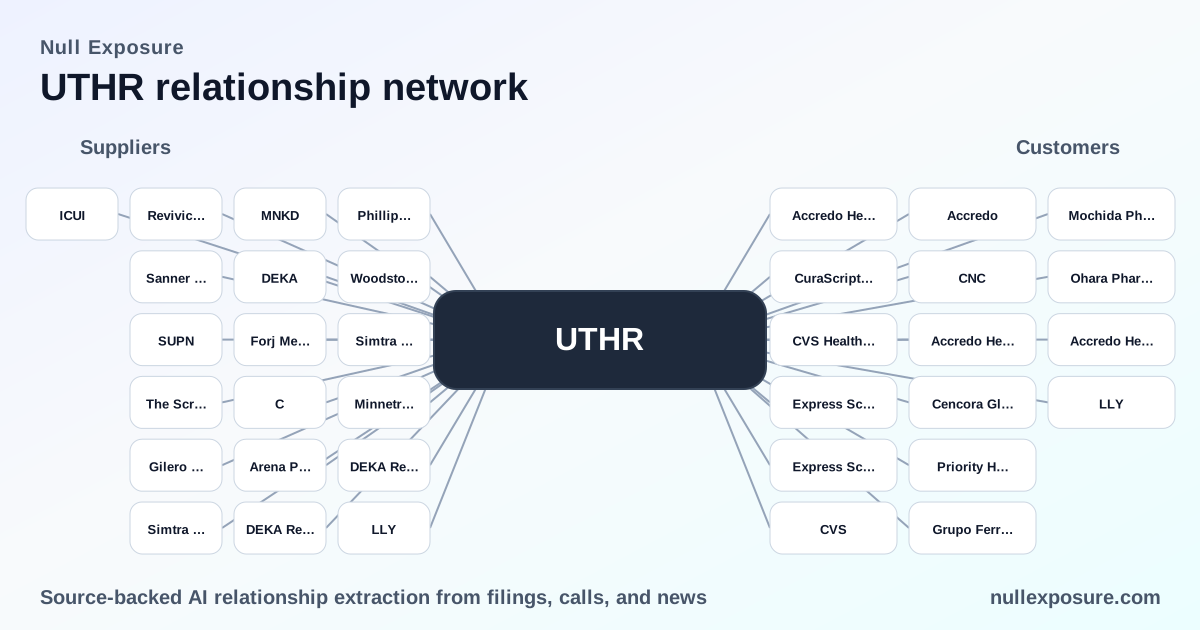
United Therapeutics (UTHR) — supplier architecture that underwrites and constrains revenue
United Therapeutics develops and commercializes specialty therapies for chronic and life‑threatening diseases and monetizes through product sales, licensing income and royalties, and device partnerships that bundle drug and delivery systems. Revenue is concentrated in a small set of branded products (Remodulin, Tyvaso, Adcirca, etc.) and is supported by long-term manufacturing and supply arrangements with third parties, creating predictable gross margins today and supplier-driven operational risk over the medium term. For a granular supplier view and benchmarking, visit https://nullexposure.com/.
Operating model: United Therapeutics outsources critical manufacturing and device production while retaining commercial and regulatory control for core products; monetization is a hybrid of direct product sales and royalty/license payments. Given the size of reported manufacturing costs and the firm’s active capital return program, supplier performance directly affects free cash flow and share repurchase capacity.
Why suppliers matter for valuation and risk
United Therapeutics runs a highly outsourced operating model where manufacturing partners are not peripheral vendors but operational necessities. The company’s 10‑K discloses a Supply Agreement with an initial term through December 31, 2031 with automatic two‑year renewals thereafter, indicating a deliberate long‑term contracting posture that trades flexibility for continuity. That same filing highlights substantial supplier activity in China and Taiwan, signaling exposure to APAC manufacturing ecosystems and related geopolitical, logistics and quality risks.
Financially, the company disclosed variable manufacturing payment obligations totaling $179.8 million in 2024 (and $130.4 million in 2023)—placing United Therapeutics firmly in the >$100M spend band for supplier payments and making supplier performance material to margins and cash generation. These structural traits create both stability (predictable supply) and concentrated counterparty risk (single‑source or limited‑source suppliers for specific devices or products).
For a supplier risk scorecard and comparison to peers, see https://nullexposure.com/.
How contract terms shape strategic optionality
- Long‑term supply agreements lock in production but limit quick supplier replacement; this supports stable gross margins but elevates vendor dependency risk.
- Manufacturer role is explicitly acknowledged—the company reimburses affiliates for manufacturing costs and relies on contract manufacturers for device components, which increases operational concentration around a small number of suppliers.
Supplier relationships, one by one
Below I cover every supplier relationship cited in the filings and news items relevant to United Therapeutics’ supplier posture.
-
Phillips‑Medisize Corp. — Manufactures the nebulizer used in the Tyvaso Inhalation System and is one of two contract manufacturers for Tyvaso nebulizers; named in United Therapeutics’ FY2024 10‑K. (FY2024 10‑K)
-
Minnetronix Inc. — Identified alongside Phillips‑Medisize as a manufacturer of the Tyvaso nebulizer, reinforcing dual sourcing for the inhalation system; disclosed in the FY2024 10‑K. (FY2024 10‑K)
-
Woodstock Sterile Solutions — Serves as an additional manufacturer of nebulized Tyvaso drug product, providing capacity redundancy for the product’s drug formulation; noted in the FY2024 10‑K. (FY2024 10‑K)
-
Simtra BioPharma Solutions (formerly Baxter Pharmaceutical Solutions, LLC) — FDA and EMA–approved contract manufacturer for Remodulin, used in both U.S. and international supply chains; stated in the company’s filings. (FY2024 10‑K)
-
Forj Medical — Named as the other contract manufacturer alongside Phillips‑Medisize for the Tyvaso Inhalation System, indicating United Therapeutics uses two sources for device production; referenced in the FY2026 10‑K summary. (StockTitan repost of 10‑K, FY2026)
-
DEKA Research & Development Corporation (DEKA) — Under a supply agreement since November 2019 to manufacture and supply the Remunity pump; United Therapeutics pays DEKA product fees and a single‑digit royalty and “relies entirely” on DEKA affiliates to manufacture those pumps, per the company’s 10‑K disclosures. (StockTitan repost of 10‑K, FY2026)
-
Eli Lilly & Co. (Lilly) — Manufactures and distributes Adcirca on United Therapeutics’ behalf through Lilly’s wholesaler network; the 10‑K states United Therapeutics relies entirely on Lilly for Adcirca manufacturing and that the in‑license expires December 31, 2026. (StockTitan repost of 10‑K, FY2026)
-
MannKind Corporation — Responsible for manufacturing and supplying Tyvaso DPI under a supply agreement; United Therapeutics pays a 10% royalty on net sales of Tyvaso DPI and relies entirely on MannKind for finished drug product and inhalers, with no backup planned per the filing. (StockTitan repost of 10‑K, FY2026)
-
Citi / Citibank, N.A. (C) — Counterparty on accelerated share repurchase agreements totaling $1.5 billion (part of a $2.0 billion buyback program), signaling management’s use of capital markets to return cash while supply investments continue; reported in market news in 2026. (TradingView and CityBiz reporting, 2026)
-
Arena Pharmaceuticals, Inc. — Subject to a licensing arrangement where United Therapeutics will owe a low double‑digit, tiered royalty on net sales of ralinepag plus milestone payments tied to regulatory events, per the filings. (StockTitan repost of 10‑K, FY2026)
-
Revivicor — Former securityholders of Revivicor are entitled to a 5% royalty on net product sales of UHeart, UKidney and UThymoKidney plus certain milestones, indicating ongoing royalty outflows for xenotransplantation assets. (StockTitan repost of 10‑K, FY2026)
-
Sanner GmbH — Identified as the exclusive manufacturer of FDA‑cleared cartridges for use with the MS‑3 pump to administer Remodulin; United Therapeutics “relies entirely” on Sanner for these cartridges. (StockTitan repost of 10‑K, FY2026)
-
Supernus (SUPN) — United Therapeutics pays a single‑digit percentage royalty on net product sales of Orenitram under its license agreement with Supernus; this is a recurring royalty obligation. (StockTitan repost of 10‑K, FY2026)
-
The Scripps Research Institute — Receives a 1% royalty on sales of Unituxin, indicating an academic licensing royalty arrangement. (StockTitan repost of 10‑K, FY2026)
-
Gilero LLC — A third‑party contract manufacturer that obtained FDA clearance for a cartridge to be used with the MS‑3 pump in June 2023; Gilero was later acquired by Sanner GmbH, consolidating cartridge supply. (StockTitan repost of 10‑K, FY2026)
-
ICU Medical — Discontinued manufacturing the MS‑3 pump and specialty pharmacy distributors reported MS‑3 supplies were exhausted, leaving only limited refurbished pumps available; this creates discreet distribution risk for subcutaneous Remodulin delivery. (StockTitan repost of 10‑K, FY2026)
-
Smiths Medical, Inc. (now part of ICU Medical) — Historically manufactured pumps (CADD‑MS 3 and CADD‑Legacy) used by most Remodulin patients in the U.S., a fact that explains the legacy dependency on those manufacturing lines. (StockTitan repost of 10‑K, FY2026)
-
MannKind (FY2024 10‑K note) — Under the FY2024 disclosure, United Therapeutics is responsible for global development and commercial activities for Tyvaso DPI while sharing manufacturing responsibilities with MannKind. (FY2024 10‑K)
Investment implications and action points
United Therapeutics’ supplier map delivers predictability in supply and cost control, but also concentration risk in several product lines (notably Adcirca, Tyvaso and Remodulin device ecosystems). The company’s long‑term supply agreements and >$100M annual manufacturing spend create durable operating leverage; conversely, single‑source manufacturing and reliance on third‑party distributors for device availability are immediate operational risk factors. For investor due diligence and counterparty monitoring tools, consult https://nullexposure.com/.
Actionable items:
- Monitor the Adcirca in‑license expiry (December 31, 2026) and any contract renewal announcements from Lilly—this is a discrete revenue and sourcing event.
- Watch MannKind and DEKA contract performance and any capacity disclosures for cartridge/pump supply, since critical device shortages would have rapid clinical and commercial effects.
- Track capital allocation: recent ASR activity with Citibank indicates management prioritizes buybacks while still funding outsourced manufacturing.
United Therapeutics’ model is profitable and cash‑generative today, but valuation should price in supplier concentration and contract milestones that will re‑shape margins and cash flow over the next 12–36 months. For a deeper supplier risk analysis and benchmarking versus peers, start your review at https://nullexposure.com/.