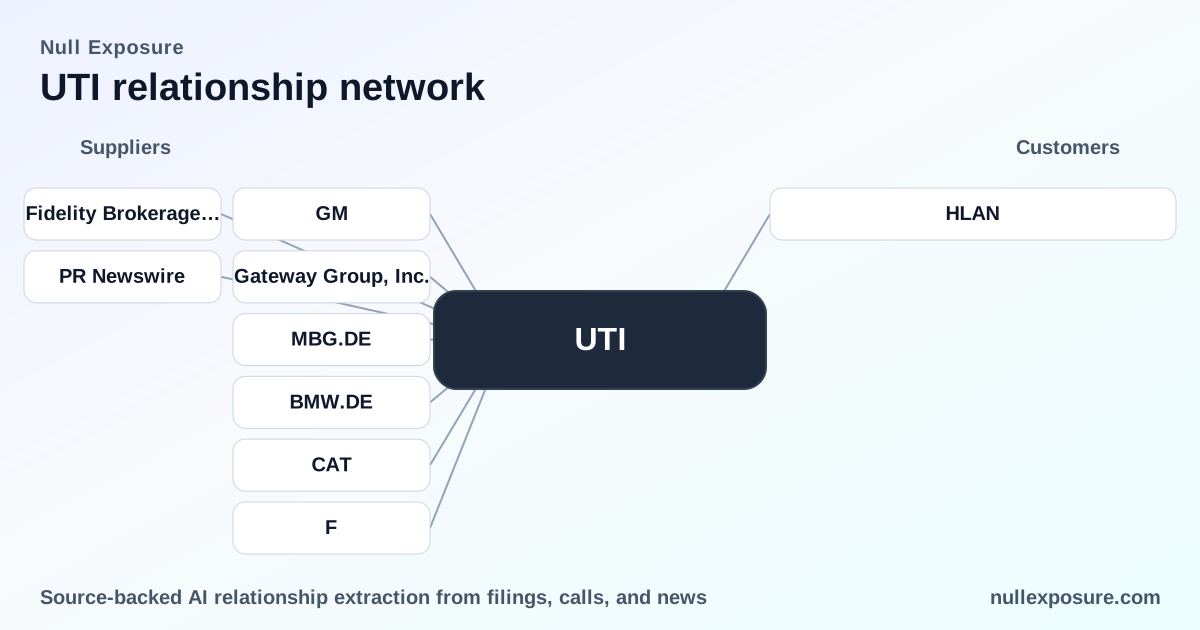
Universal Technical Institute (UTI): supplier relationships that deliver training access and operational leverage
Universal Technical Institute operates career-focused technical colleges and monetizes by enrolling students in fee-based training programs, selling aligned curriculum services and equipment access, and maintaining manufacturer-sponsored training partnerships that enhance placement rates and program demand. UTI’s revenue mix is tuition-driven but materially supported by OEM and vendor relationships that supply curriculum, diagnostic tools, and promotional equipment credits—assets that translate into both cost offsets and differentiation in student outcomes. Learn how these supplier ties affect risk and value at https://nullexposure.com/.
Why suppliers matter for an education services franchisor
UTI’s operating model depends on two supplier dynamics: securing manufacturer‑specific training (which preserves relevance to employers) and maintaining vendor arrangements that reduce capital cost for labs and tools. These relationships are not ancillary marketing deals; they are embedded into curriculum delivery and capital planning, which makes supplier performance and contract terms direct drivers of operating margin and capital expenditure. For investors, that means supplier counterparty risk maps directly onto program competitiveness and near-term working capital.
If you want a concise map of how these relationships influence valuation or operational risk, visit https://nullexposure.com/ for a deeper vendor-risk primer.
The supplier roster you need to know
Below I cover every relationship captured in the source set and what it practically means for UTI’s operations.
Ford
UTI lists Ford among its strategic OEM partners that provide manufacturer-specific training and access to diagnostic tools, supporting curriculum relevance for Ford-certified technicians. This ties directly into placement outcomes and student demand (MarketBeat, Jan 2026).
GM
UTI maintains a strategic partnership with GM to provide manufacturer-specific training and access to the latest diagnostic tools, which strengthens UTI’s position in training GM-aligned technicians and supports employer placement channels (MarketBeat, Jan 2026).
BMW
UTI’s relationship with BMW supplies manufacturer-specific curriculum and diagnostic tool access, positioning UTI to certify students on BMW systems and improving its value proposition to luxury OEM employers (MarketBeat, Jan 2026).
Mercedes‑Benz
UTI partners with Mercedes‑Benz to deliver manufacturer-specific training and tooling access, reinforcing premium-brand technician pipelines that can command stronger placement outcomes (MarketBeat, Jan 2026).
Caterpillar
UTI lists Caterpillar among its OEM partners, extending its training reach into heavy equipment and diesel sectors where Caterpillar-specific competence boosts employability for graduates in industrial and construction applications (MarketBeat, Jan 2026).
Gateway Group, Inc.
Gateway Group is cited repeatedly as UTI’s investor relations contact and PR intermediary for conference calls and releases, indicating use of an external communications/IR vendor for market engagement and disclosures (PR Newswire and Finviz/Yahoo press notices, Jan–Feb 2026).
Fidelity Brokerage Services LLC
Fidelity is identified as the broker‑dealer in a Form 144 filing and was the execution channel for a proposed insider sale of 30,000 shares reported on March 2, 2026, signaling standard brokerage relationships for equity transactions by insiders (Form 144 filing reported on StockTitan, March 2026).
PR Newswire
PR Newswire is the distribution channel for UTI’s Jan 14, 2026 press release announcing its Q1 FY2026 conference call, confirming use of established wire services to reach investors and the press (PR Newswire, Jan 14, 2026).
Snap‑on Tools (contracted vendor; evidenced in SEC filings)
UTI has an active agreement with Snap‑on that allows UTI to purchase promotional tool kits at discounted list prices and to earn redeemable credits for equipment used in training; the agreement generates prepaid expense and credit balances ($0.7m as of Sept. 30, 2025) and expires December 2027, illustrating a structured vendor credit program that reduces lab capital costs (company filings, consolidated balance sheets as of Sept. 30, 2025; Form language on vendor agreement).
What constraints reveal about UTI’s vendor posture and risk profile
The collected constraints and excerpts paint a clear, actionable picture of how UTI manages supplier relationships.
- Contracting posture — active, managed relationships. UTI discloses a risk‑based third‑party oversight program that covers vendors and service providers, indicating formal vendor management processes and ongoing monitoring rather than ad hoc buying (company cybersecurity and third‑party oversight language).
- Relationship maturity — medium-term operational commitments. The Snap‑on agreement explicitly expires December 2027, which implies rolling multi-year vendor contracts that create predictable supply for lab equipment but also calendarized renewal risk.
- Financial scale — economical but material. A reported prepaid/credit balance of roughly $0.7 million with Snap‑on (Sept. 30, 2025) places vendor spend in the $100k–$1m band for at least some procurement lines, meaning these vendors are not immaterial to working capital.
- Criticality and concentration — supplier mix supports diversification. OEM partnerships span global auto and heavy-equipment manufacturers (Ford, GM, BMW, Mercedes‑Benz, Caterpillar), which lowers concentration risk in training content sourcing, while vendor credits like Snap‑on are operationally critical because they supply tools that students and labs use daily.
Taken together: UTI runs a diversified OEM partnership model combined with targeted vendor credit programs that lower capital intensity for training labs, but these arrangements carry renewal and vendor-performance risk over multi-year horizons.
Investor takeaways and risk checklist
- Positive: OEM relationships deliver direct program differentiation and placement leverage, which supports tuition demand and justifies premium pricing in certain programs. Evidence: MarketBeat OEM list (Jan 2026).
- Watch: Vendor credit balances and contract expirations (Snap‑on: credits of ~$0.7m; agreement expires Dec 2027) create timing risk to lab refresh cycles and potential FY capex spikes when credits are exhausted (company filings, Sep 30, 2025).
- Operational signal: Use of external IR and wire services (Gateway Group, PR Newswire) and standard brokerage channels (Fidelity for Form 144) indicates professional investor communications and on‑market insider handling, reducing market‑communication friction.
If you need a supplier risk scorecard or a partner‑level impact analysis for UTI, start here: https://nullexposure.com/.
Conclusion: supplier relationships are an operational asset and a governance lever
UTI’s supplier ecosystem is a deliberate part of its business model — OEM partnerships underpin curriculum credibility while vendor credit programs control capital intensity. For investors, the central questions are renewal outcomes for vendor agreements (notably Snap‑on through 2027) and the durability of OEM ties to sustain placement rates. Monitor company filings around contract renewals and prepaid/credit balances for early signals of margin or capex pressure.
For a deeper dive into how supplier contracts translate into valuation risk and opportunity, visit https://nullexposure.com/ for tailored research and supplier‑centric diligence tools.