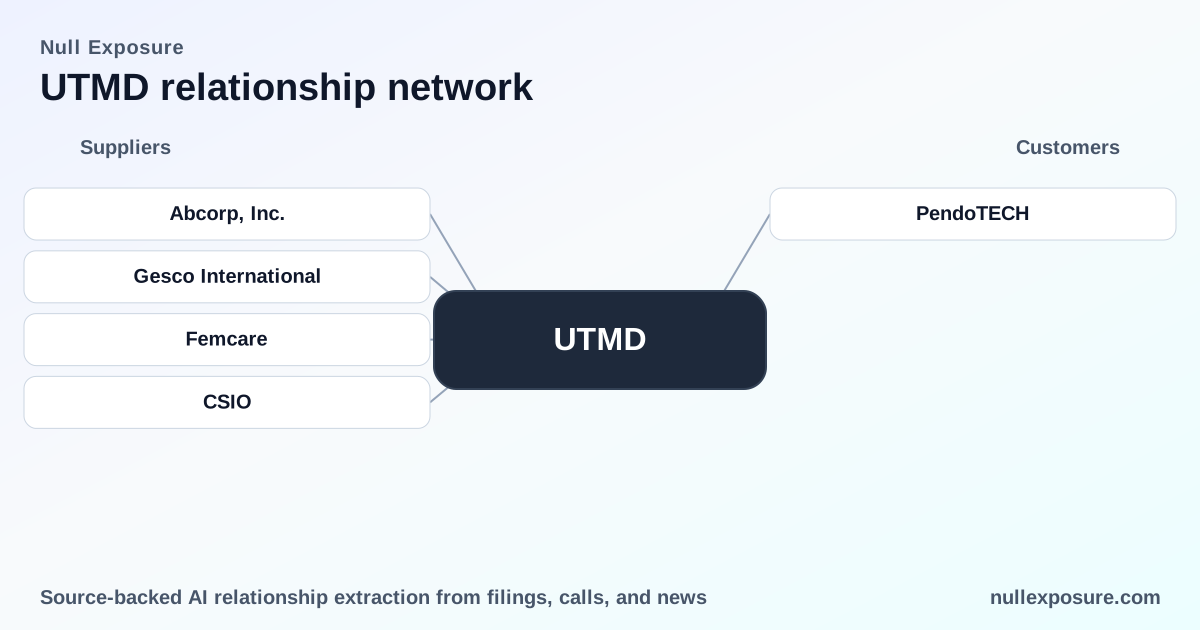
Utah Medical Products (UTMD): Supplier relationships, strategic posture, and what investors should know
Utah Medical Products manufactures and sells a narrow portfolio of medical devices through a mix of direct sales, OEM supply contracts, and exclusive distribution arrangements. The company monetizes by selling end-user devices to hospitals and clinics, supplying components and subassemblies to other manufacturers (OEM sales), and holding exclusive U.S. distribution rights for certain third‑party products, notably the Filshie device. That combination—product manufacturing plus selective distribution exclusivity—creates recurring revenue streams with outsized importance on a few legacy product lines. For a deeper look at supplier mapping and relationship risk for healthcare suppliers, visit https://nullexposure.com/.
Operational snapshot: UTMD runs a small-cap, high-margin manufacturing business with steady profitability (TTM profit margin ~29%, operating margin ~31%) and a conservative balance between direct sales and OEM/distribution revenue. These financials underpin a contracting posture that blends in-house production with strategic acquisitions and licensing to secure product continuity and market access.
How UTMD locks in supply lines and revenue: acquisitions and exclusive deals
UTMD’s historical strategy shows repeated use of acquisitions and exclusive agreements to control upstream supply and downstream distribution. Acquisitions of supplier lines and the purchase of exclusive distribution rights for the Filshie device are not one-off events; they are structural. This operating choice reduces upstream supply risk and preserves margin capture on manufactured items, while also creating dependency on specific third‑party relationships where UTMD acts as distributor.
- Contracting posture: UTMD’s posture is defensive and ownership‑oriented—securing supply via acquisition and buying distribution rights rather than relying on short-term vendor contracts.
- Concentration: Revenue is concentrated by product family and contractual relationships; the company itself defines domestic sales as direct, OEM, and Filshie device sales, indicating the Filshie relationship is a distinct revenue bucket.
- Criticality and maturity: Many products are legacy clinical devices (neonatal monitoring, fetal belts, Filshie), indicating recurring clinical demand with low churn but limited high-growth optionality.
- Supplier maturity: The firm’s supplier‑to‑owner evolution (acquiring supplier lines) suggests mature manufacturing processes and long product life cycles, which supports predictable cash flow and dividend payments.
For investors tracking supplier risk, UTMD’s model reduces raw-material and component unpredictability through vertical integration but concentrates strategic risk in a handful of partner relationships and legacy product lines. If you evaluate supplier concentration in healthcare, see more mapping examples at https://nullexposure.com/ to compare peers.
The complete list of supplier and distribution relationships disclosed
Below are every relationship mentioned in the available disclosures and news hits, each summarized in plain English with a source note.
Abcorp, Inc.
UTMD acquired Abcorp, Inc. in 2004 to control its supply of fetal monitoring belts, converting a supplier relationship into an owned product line and integrating that capability into UTMD’s manufacturing base. According to UTMD’s FY2024 Form 10‑K, the acquisition traces to securing that specific component supply (FY2024 10‑K).
Gesco International
UTMD purchased the neonatal product line of Gesco International (a subsidiary of Bard Access Systems and C.R. Bard) in 1998, folding neonatal products into its portfolio and extending UTMD’s footprint in neonatal monitoring devices. This acquisition is documented in UTMD’s FY2024 Form 10‑K (FY2024 10‑K).
Femcare
The Filshie device—an important separate revenue category for UTMD—is manufactured by Femcare and distributed in the U.S. by UTMD, making Femcare a critical upstream manufacturing partner for that product line. A company press release discussing first-quarter 2022 financials defines domestic sales to include Filshie device sales manufactured by Femcare and distributed by UTMD (GlobalNewsWire, April 26, 2022).
CSI (related to Filshie distribution rights)
UTMD paid $21,000 in early 2019 to acquire the remaining exclusive U.S. Filshie distribution rights from CSI, with the purchase price amortized straight-line (reported amortization of $1,105 per quarter). The company noted this amortization relative to quarterly sales in a 2022 press release, highlighting the structure and limited book value of the acquired distribution rights (GlobalNewsWire, April 26, 2022).
What these relationships say about operational risk and upside
UTMD’s supplier relationships and historical acquisitions reveal a clear strategic pattern: when a supply or distribution relationship is strategically important, UTMD acquires or pays for exclusivity to internalize margin and control continuity. That reduces supplier-side volatility but also concentrates commercial risk in the longevity and performance of specific product lines like Filshie and neonatal/fetal monitoring belts.
- Upside: Ownership of supply lines and exclusive distribution rights protects margins and provides predictable cash flows—evidenced by strong operating margins and a steady dividend policy.
- Downside: Concentration risk exists: a meaningful share of domestic revenue is carved into three components by company reporting—direct, OEM, and Filshie sales—so adverse developments in any of these channels could have outsized impact.
Investors should weigh the stability of legacy clinical demand against limited growth vectors. UTMD’s FY2025 metrics and a market capitalization of around $205 million suggest a small‑cap industrial healthcare profile—stable, profitable, and dependent on a few contractually important relationships.
Practical investor takeaways and monitoring checklist
- Monitor exclusivity renewals and litigation risk around Filshie distribution and OEM contracts; those agreements directly affect a distinct revenue bucket.
- Watch product lifecycle signals for neonatal and fetal monitoring lines—these are mature products, so growth will rely on penetration and pricing rather than rapid innovation.
- Track OEM order trends as they signal other manufacturers’ sourcing decisions; OEM customers can be both revenue stabilizers and concentration risks.
For a deeper, comparative look at supplier concentrations across healthcare small-caps, visit https://nullexposure.com/.
Conclusion: a defensively structured supplier profile with concentrated exposures
UTMD runs a deliberately defensive manufacturer/distributor model: over decades it has transformed critical suppliers into owned lines and bought distribution rights to secure revenue streams. That model yields durable margins and predictable cash flows but leaves the company exposed to a handful of relationships and legacy product demand patterns. For investors, UTMD is a high-quality small-cap industrial healthcare name with stability and concentration trade-offs that require active monitoring of its exclusive distribution and OEM arrangements.
For more detailed supplier maps and relationship intelligence, see https://nullexposure.com/.