Utz Brands (UTZ): supplier relationships, operating posture, and what investors should price in
Utz Brands operates and monetizes as a branded snack manufacturer that combines in-house production, strategic acquisitions, licensed brand extensions, and a growing direct-to-consumer channel to sell salty snacks across the United States. The company captures margin through scale manufacturing, brand licensing, and accelerated distribution reach—while buying-forward commodity contracts and targeted acquisitions expand capacity and regional market share. For investors, the supply-side picture is one of domestic sourcing, concentrated manufacturing decisions, and deliberate outsourcing where it preserves margin or speed-to-market. Learn more about supplier risk and partner exposures at https://nullexposure.com/.
How Utz runs its supply chain and what that means for returns
Utz is a U.S.-centric operator: nearly all inputs and manufacturing are domestic, which reduces tariff and FX exposure while concentrating operational risk inside U.S. logistics and labor markets. The company uses a mix of in-house manufacturing and co-manufacturing for specific brands (notably On The Border tortilla chips and related salsas/quesos), and it distributes through a blended model that includes direct-store-delivery (DSD), third-party distribution, and parcel carriers for DTC. Financially, Utz reported roughly $1.44B in revenue and $92.7M in EBITDA (TTM), with material spend that is substantively large relative to revenue.
Key operating constraints are evident from company disclosures: Utz locks commodity costs using buying-forward arrangements covering three to 18 months, with about 45% of 2026 budgeted direct materials under contract as of year-end 2025; the business therefore carries short- to medium-term pricing commitments that protect margin volatility but require active procurement management. The firm also reports meaningful lease duration (weighted average remaining lease term ~18 years), signaling capital commitments to plant and distribution infrastructure. These are company-level signals that define procurement sensitivity, contract maturity, and capital intensity for investors.
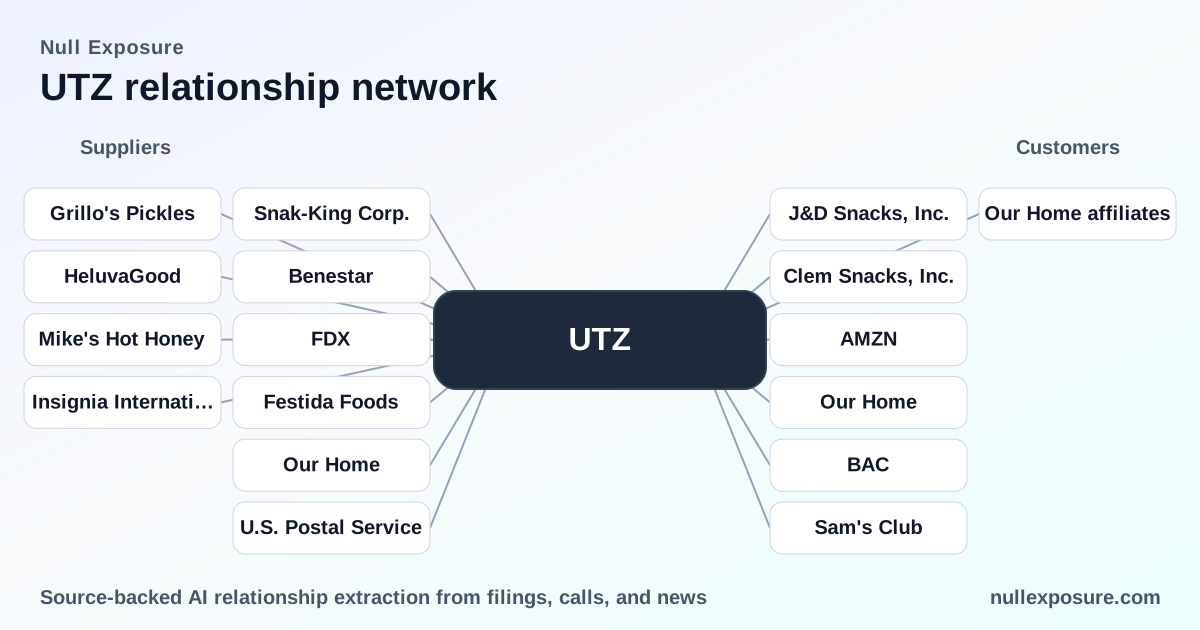
A concise relationship map — who Utz works with and why it matters
-
Snak‑King Corp. — Utz acquired the Vitner’s snack brand from Snak‑King for $25 million, extending Utz’s presence in the Chicago metropolitan market and adding localized shelf share. This transaction was announced in FY2021 and reported by Fox43 and CSPDailyNews. (Source: Fox43/CSPDailyNews, FY2021.)
-
Benestar — Benestar was identified as a supplier of pork pellets from its Chicago operations to Utz, supporting snack ingredient or co-packing inputs tied to Midwest production. The relationship surfaced in coverage of Utz’s Kings Mountain facility expansion in FY2022. (Source: PotatoPro, FY2022.)
-
FedEx (FDX) — Utz uses FedEx as a carrier for its expanding direct-to-consumer shipments from its central warehouse to consumers, reflecting a growing DTC channel and higher parcel logistics spend. The role of FedEx is documented in Utz’s FY2026 annual report filing. (Source: Utz FY2026 10‑K filing via StockTitan, FY2026.)
-
U.S. Postal Service — Alongside FedEx, the U.S. Postal Service is a named carrier for DTC shipments, indicating Utz’s reliance on parcel networks to reach consumers directly and the operational need to manage carrier costs and service levels. This is stated in the FY2026 Form 10‑K. (Source: Utz FY2026 10‑K filing via StockTitan, FY2026.)
-
Grillo’s Pickles — Utz licenses third‑party brand names, including Grillo’s Pickles, for use on packaged products; licensing supports portfolio breadth without vertical brand-building costs. The licensing arrangement is noted in Utz’s FY2026 disclosures. (Source: Utz FY2026 10‑K filing via StockTitan, FY2026.)
-
HeluvaGood — HeluvaGood is another licensed brand that Utz leverages to extend product SKUs across its manufacturing footprint, demonstrating a licensing-first strategy to expand assortments. This appears in the FY2026 company filing. (Source: Utz FY2026 10‑K filing via StockTitan, FY2026.)
-
Mike’s Hot Honey — Mike’s Hot Honey is included in the roster of third‑party brands licensed by Utz, underscoring the company’s strategy of capturing adjacent flavor and condiment trends through brand licenses rather than organic development. (Source: Utz FY2026 10‑K filing via StockTitan, FY2026.)
-
Insignia International — Utz acquired Insignia International’s DSD distribution assets across California and the Midwest to accelerate market penetration in California, the largest U.S. salty‑snack market by retail sales; this deal changes Utz’s distribution footprint and DSD reach. The acquisition is disclosed in the FY2026 filing. (Source: Utz FY2026 10‑K filing via StockTitan, FY2026.)
-
Festida Foods — Utz acquired Michigan-based Festida Foods in September 2024 to bolster supply for its On The Border tortilla chips and deepen Midwest manufacturing capacity, signaling acquisition-driven capacity expansion and vertical integration for key SKUs. (Source: MillingMEA, FY2024 announcement.)
-
Our Home — Utz completed a transaction (valued at US$182.5M) that includes co‑manufacturing agreements with Our Home, allowing Utz to focus on core brands while outsourcing certain manufacturing tasks where scale or specialization improves economics. The co‑manufacturing terms appeared in the FY2024 acquisition coverage. (Source: MillingMEA, FY2024.)
What these supplier relationships tell the market
-
Acquisitions drive share and distribution control. Utz’s purchases (Vitner’s, Festida Foods, Insignia DSD assets) are deliberate moves to expand regional manufacturing and DSD reach, which reduce third‑party margin leakage and accelerate shelf presence.
-
Licensing extends assortment at lower capital cost. Multiple licensed brands (Grillo’s, HeluvaGood, Mike’s Hot Honey) broaden product appeal without equivalent manufacturing R&D expense.
-
Logistics and parcel carriers are a growing cost center. The DTC channel shifts spend from retail pallet shipments to parcel carriers (FedEx, USPS), increasing per‑package cost but improving margin capture from direct sales.
-
Procurement posture is short- to mid-term. Utz’s explicit buying‑forward coverage for 3–18 months and ~45% coverage of 2026 materials establishes a short‑term hedging posture that stabilizes margins while requiring active renewal cycles.
For a deeper supplier‑risk profile and supplied partner mapping, see the full coverage on Null Exposure: https://nullexposure.com/.
What investors should monitor next
- Integration and synergies from Festida and Insignia DSD assets—track incremental sales and DSD contribution, especially in California and the Midwest.
- Co‑manufacturing performance and quality metrics under the Our Home arrangement, which will determine whether outsourcing preserves or erodes gross margins.
- Commodity coverage renewal and its impact on gross margin variances; Utz’s strategy to lock prices 3–18 months out makes procurement cadence a quarterly earnings driver.
- Parcel cost trends and DTC margin trajectory as FedEx/USPS expense scales with online growth.
Utz is executing a blended strategy of targeted M&A, licensing, and selective outsourcing to convert scale into margin. The company’s supply footprint is domestic, concentrated, and increasingly vertically integrated through acquisitions—factors that reduce international volatility but increase the importance of U.S. logistics and procurement execution.
For portfolio managers and operators evaluating counterparty risk or supplier exposure, review Utz’s partner map and contract posture at https://nullexposure.com/ and request tailored supplier intelligence to inform underwriting and operational playbooks.