Universal Security Instruments (UUU): Supplier Risk and Operational Profile for Investors
Universal Security Instruments designs, markets and distributes residential and commercial safety products and monetizes by selling branded smoke and carbon monoxide alarms and related devices through wholesale and retail channels. The company sources substantially all of its product supply from China and depends heavily on a single principal manufacturer, which drives both gross margin economics and concentrated operational risk.
For a quick orientation on supplier exposures and strategic implications, see more at https://nullexposure.com/.
A concise investor thesis: single-sourced manufacturing drives margins and risk
Universal Security Instruments leverages an outsourced manufacturing model: it outsources production of its branded residential alarms to manufacturers in the People’s Republic of China and focuses on sales, distribution and brand management. This arrangement delivers low fixed-capex and higher gross-margin potential, but it also creates a single-source dependency that is materially critical to operations and procurement. Given the company’s modest market capitalization and lean operating base, supplier interruptions would transmit directly to revenue and inventory cycles.
Explore supplier intelligence and relationship mapping at https://nullexposure.com/ for more supplier-specific diligence.
What to know about how UUU contracts and sources products
Universal’s operating model is characterized by concentrated manufacturing sourcing, cross-border import exposure and third-party service providers supporting corporate processes:
- Geographic concentration: Substantially all safety products are imported from the PRC, which centralizes logistics, tariff and regulatory exposure to APAC trade dynamics.
- Material concentration: The majority of purchases come from a principal manufacturer; this supplier relationship accounted for approximately 96.3% of purchases in FY2025 and 84.3% in FY2024, making the vendor critical to supply continuity.
- Role and maturity: The principal supplier functions as the manufacturer for Universal’s branded products and is described as an active, ongoing partner across the fiscal periods referenced.
- Service providers: Beyond manufacturing, Universal relies on third-party providers for audit and transfer-agent services that support governance and shareholder communications.
These characteristics create an operating posture that is low capital intensity but high counterparty concentration, exposing the company to supplier performance, quality control, and trade-policy shocks.
Supplier relationships you need to evaluate
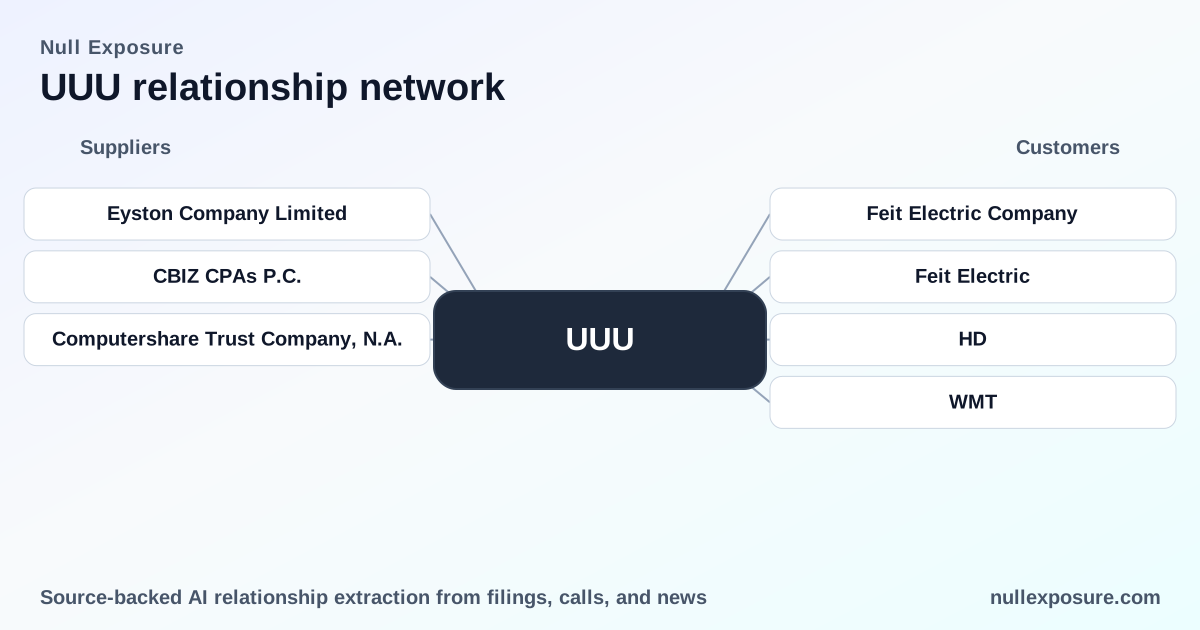
Eyston Company Limited — the core manufacturer
Universal states that its line of residential smoke and carbon monoxide alarms under the “UNIVERSAL” and “USI Electric” trade names were manufactured by Eyston Company Limited in the People’s Republic of China, and that Eyston served as a principal supplier during the reported period. Eyston is functionally the company’s single-source manufacturer and accounted for the vast majority of purchases in FY2025 and FY2024, which makes this relationship operationally critical. According to Universal’s FY2025 Form 10‑K, Eyston manufactured the company’s core alarm products in the PRC (FY2025 10‑K).
CBIZ CPAs P.C. — the independent external auditor
Universal engaged CBIZ CPAs P.C. to perform its financial statement audits, with audit fees of approximately $293,000 for the fiscal year ended March 31, 2025 and $258,000 for FY2024; the Board asked shareholders to ratify CBIZ as the independent auditor for the year ending March 31, 2026 in its FY2026 proxy. This is a standard governance supplier relationship that supports transparency and financial reporting (Definitive Proxy Statement, filed March 2026).
Computershare Trust Company, N.A. — transfer agent and shareholder services
The company uses Computershare Trust Company, N.A. as its transfer agent and for shareholder meeting logistics; registered stockholders holding shares through Computershare were directed on virtual meeting registration in the FY2026 proxy materials. This relationship underpins shareholder communications and proxy mechanics rather than product supply (Definitive Proxy Statement, filed March 2026).
Operational constraints that shape the business model
The filings and disclosures establish several company-level signals that investors should treat as structural:
- APAC sourcing concentration: Company-level disclosure states that substantially all safety products are imported from the PRC, creating exposure to Chinese manufacturing capacity, freight and import regulation.
- Critical supplier dependence: The supplier concentration statistic (96.3% of purchases from the principal manufacturer in FY2025) signals single-supplier dependence that is core to revenue delivery and difficult to replace without operational disruption.
- Manufacturer role and active engagement: The principal supplier is a contract manufacturer producing Universal’s branded SKUs; the relationship is ongoing and operationally embedded.
- Segment focus on manufacturing outsourcing: The business strategy emphasizes outsourced manufacturing rather than vertical integration, keeping capex low but outsourcing execution risk.
Collectively, these constraints form a supplier-led operating model: low fixed investment, high reliance on a single external manufacturer, and material cross-border supply exposure.
Investment implications and risk checklist
- Concentration risk is the dominant supplier hazard. With most purchases from a single manufacturer in China, any disruption—quality, capacity, export controls or logistics—would directly impair sales and inventory replenishment.
- Margin stability depends on the manufacturer relationship. Because Universal does not vertically integrate production, gross margins and product availability are contingent on contract terms, unit economics from Eyston, and international freight.
- Governance and continuity are supported by external providers. Auditor and transfer-agent relationships are conventional but important for governance, investor access and financial transparency.
- Operational options are limited short-term. Replacing or diversifying a principal OEM relationship typically requires lead time, requalification and cost—factors that are non-trivial for a small-cap industrial supplier.
If you need a deeper supplier risk assessment or to map supplier concentration across peers, start with strategic due diligence at https://nullexposure.com/.
Concluding view and recommended next steps
Universal Security Instruments runs an asset-light distribution and brand model that achieves operating leverage through outsourced manufacturing but carries high supplier concentration risk. For active investors and operators, the priority actions are: validate contract terms with the principal manufacturer, quantify inventory and lead-time buffers, and stress-test scenarios for Chinese export disruptions. Governance suppliers like CBIZ and Computershare support continuity, but they do not mitigate primary supply fragility.
For targeted supplier intelligence and to commission a tailored supplier-risk memo, visit https://nullexposure.com/ and initiate a consultation.