Energy Fuels (UUUU): From uranium miner to vertically integrated rare‑earth supplier
Energy Fuels monetizes by mining and processing uranium and by operating the White Mesa Mill, which provides toll‑milling and conversion services for uranium and an expanding rare‑earth processing business. The company is pursuing vertical integration through the announced acquisition of Australian Strategic Materials, intends to secure feedstock via offtake and purchase agreements, and finances growth with capital markets instruments including an upsized convertible note; these moves convert operating leverage in physical processing into scaling optionality for metal and alloy production. For a dashboard view of supplier relationships and contract signals, visit https://nullexposure.com/.
The strategic inflection: why the ASM deal matters for investors
Energy Fuels’ acquisition of Australian Strategic Materials (ASM) represents a deliberate pivot from a commodity producer to a vertically integrated processor and downstream supplier. ASM brings a Dubbo feedstock pipeline and metalisation capability (Korea), which complements White Mesa’s oxide production and accelerates the company toward higher‑margin metal and alloy output. This combination reduces reliance on spot oxide markets and increases control over value capture across the REE value chain. Several press reports and company releases in January–March 2026 describe the transaction and its intended synergies, including feedstock security for planned White Mesa expansions (Colorado Politics, The Globe and Mail, company press release). For further context on supplier exposure and partner networks, see https://nullexposure.com/.
Capital and advisory architecture that underpins execution
Energy Fuels is executing large strategic steps with external financing and institutional advisers. Goldman Sachs & Co. LLC acted as financial adviser on the ASM acquisition and led the underwriting of an upsized $700m convertible note offering in October 2025, strengthening the company’s access to growth capital while introducing potential dilution and leverage dynamics to model. The presence of top‑tier advisers and underwriters signals institutional support for the strategy but also embeds financing covenants and conversion pathways that investors must monitor (company investor releases, FY2026 filings).
Detailed relationship roster (each result covered)
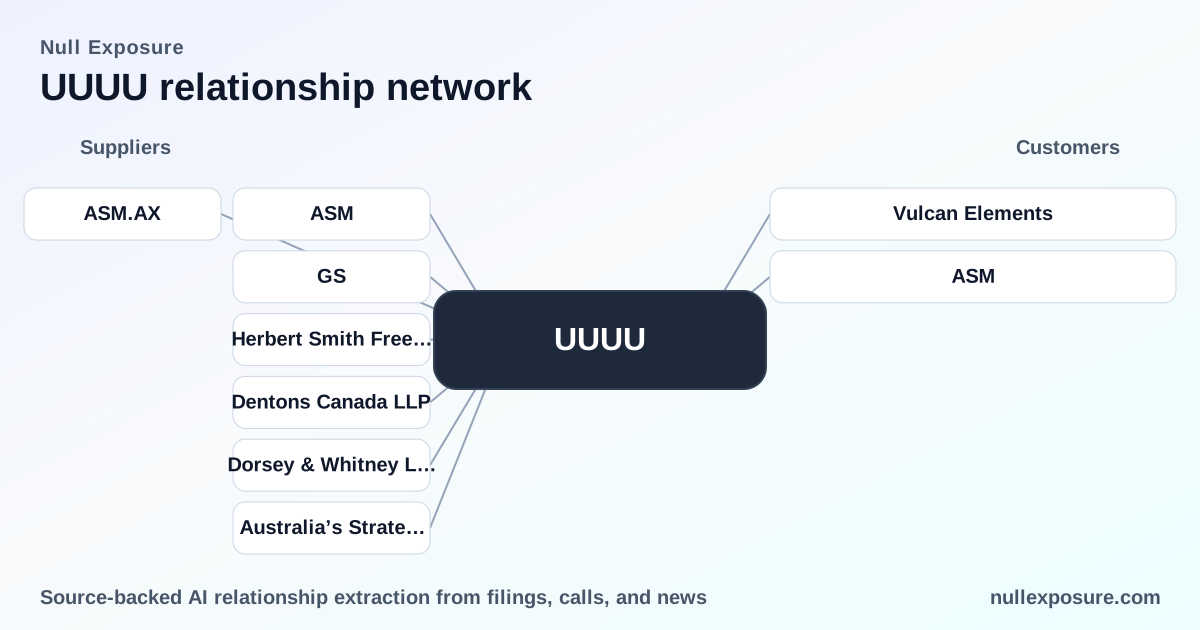
Australian Strategic Materials — Colorado Politics (Jan 21, 2026)
Energy Fuels agreed to acquire ASM including the Dubbo Rare Earth Project, which is intended to supplement development pipelines in Australia, Madagascar and Brazil and provide feed materials for White Mesa expansions. Source: Colorado Politics report on the transaction (Jan 21, 2026).
Goldman Sachs & Co. LLC — Energy Fuels press release on acquisition (Jan 20, 2026)
Goldman Sachs is acting as Energy Fuels’ financial adviser on the ASM transaction, providing strategic and execution support for the cross‑border acquisition. Source: Energy Fuels investor press release (Jan 20, 2026).
Herbert Smith Freehills Kramer — Energy Fuels press release (Jan 20, 2026)
Herbert Smith Freehills Kramer is engaged as the Australian legal adviser on the ASM acquisition, handling local regulatory and transactional legal work. Source: Energy Fuels investor press release (Jan 20, 2026).
Goldman Sachs & Co. LLC — 2025 results and 2026 guidance (Feb 26, 2026)
Goldman Sachs led the underwriting for an upsized offering of 0.75% Convertible Senior Notes due 2031 totaling $700 million (including full exercise of the initial purchasers’ option), completed October 3, 2025. Source: Energy Fuels FY2025 results and guidance release (Feb 26, 2026).
Dentons Canada LLP — Energy Fuels press release (Jan 20, 2026)
Dentons Canada LLP serves as the Canadian and Korean legal adviser on the ASM acquisition, aligning cross‑jurisdictional legal considerations for the deal and for ASM’s Korean metalisation operations. Source: Energy Fuels investor press release (Jan 20, 2026).
Dorsey & Whitney LLP — Energy Fuels press release (Jan 20, 2026)
Dorsey & Whitney LLP is retained as U.S. legal counsel for the acquisition, advising on U.S. regulatory, securities and transactional matters tied to the cross‑border combination. Source: Energy Fuels investor press release (Jan 20, 2026).
Australia’s Strategic Materials — TS2.tech coverage (Mar 2026)
Independent coverage reiterated that the deal (≈$300.9m) merges White Mesa Mill oxide output with ASM’s metalisation plant in Korea and a planned U.S. metals facility, framing the transaction as a push into mine‑to‑metal supply chains. Source: TS2.tech market commentary (Mar 2026).
Australian Strategic Materials (ASM.AX) — The Globe and Mail press release (Mar 2026)
The Globe and Mail relayed company commentary that ASM’s Dubbo project and technology reduce execution risk for planned U.S. metals and alloys assets and strengthen feedstock and vertical integration plans. Source: The Globe and Mail press release coverage (Mar 2026).
(If you want a consolidated supplier risk matrix or partner‑by‑facility map, visit https://nullexposure.com/ for custom reports.)
Company‑level constraints that shape contracting and operations
Company disclosures and transaction materials describe several operating constraints that inform supplier risk and contracting posture. First, Energy Fuels uses framework offtake arrangements—for example, an offtake commitment tied to the Donald Project that purchases production subject to project FID and commissioning, and includes a price floor that limits obligations below uneconomic thresholds. Second, the firm sources REE feed from U.S. third‑party miners in Florida and Georgia, signaling regional supply anchoring in North America while continuing to expand international feed via ASM. Third, the company operates both as buyer (ore purchase agreements) and seller (toll milling and sale of processed product), which increases commercial flexibility but also creates counterparty exposure across both upstream and downstream flows. Finally, Energy Fuels engages independent third‑party advisers for non‑operational services—recently commissioning external cybersecurity and governance assessments—indicating maturing enterprise controls as the company scales. These constraints are cited in company disclosures and investor materials for FY2025–FY2026.
Risk‑reward synthesis for supplier and operator investors
- Upside: Vertical integration into metals and alloys can materially expand margins versus raw oxide sales and reduce reliance on Chinese processing pathways; institutional underwriting and advisory support validate execution capacity.
- Key risks: Execution complexity from cross‑jurisdictional integration, funding dilution from convertible securities, and counterparty reliance inherent in framework offtakes and third‑party ore sourcing. Concentration around White Mesa as a processing hub and the speed of ASM integration are primary operational risk vectors.
- Operational posture: Energy Fuels is shifting from a pure‑play miner to a contracted processor and integrated supplier, balancing buy/sell roles and formal framework agreements to align feedstock and offtake economics.
For a deeper supplier‑level exposure assessment or bespoke diligence on UUUU counterparties, consult the project hub at https://nullexposure.com/.
Conclusion: Energy Fuels’ supplier network and advisory stack are consistent with an aggressive, vertically integrated growth strategy funded by capital markets and executed through multiple legal and financial partners. Investors should track integration milestones at White Mesa and ASM, the convertible note conversion dynamics, and the company’s ability to lock feedstock under economic offtake terms before re‑rating operational forecasts. More detailed partner maps and contract signals are available at https://nullexposure.com/.