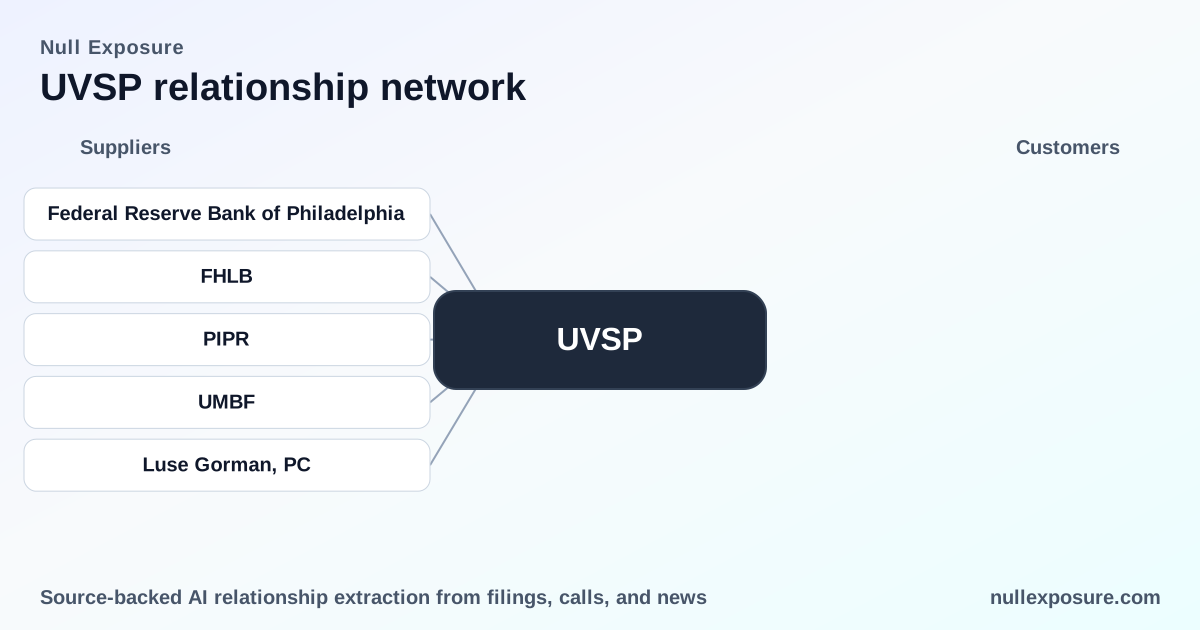
Univest (UVSP) — Supplier relationships that underpin liquidity and capital moves
Univest Financial Corporation operates as a regional bank holding company that monetizes through traditional banking spreads (loans funded by deposits and wholesale borrowings) plus fee and capital markets activity. Liquidity access and episodic capital-market engagement are the two supplier-driven levers that shape Univest’s balance-sheet flexibility. For investors evaluating counterparty risk and operational dependencies, the supplier roster combines large, institutional funding partners with transactional capital-markets and legal advisors.
Explore more supplier intelligence at https://nullexposure.com/.
Funding plumbing first: what the bank’s counterparties tell you about liquidity posture
Univest explicitly uses both the Federal Home Loan Bank system and the Federal Reserve to manage short-term and term funding needs. According to the 2024 Form 10‑K, the Bank maintains investment securities at the Federal Reserve Bank of Philadelphia to provide access to the Discount Window Lending program, and the company holds a credit facility with the FHLB with maximum borrowing capacity of approximately $3.3 billion at December 31, 2024. These relationships are not advisory; they are operationally critical shortcuts to liquidity that a regional bank relies upon during stress or planned funding management.
- Contracting posture: The company uses a mix of short‑term and term borrowings—both overnight and advances with the FHLB—so funding contracts are a blend of short- and long-term arrangements that give Univest the ability to flex funding duration when markets move (10‑K, FY2024).
- Counterparty type and criticality: The Federal Reserve and FHLB positions categorize core funding counterparties as government-sponsored and central bank-linked, elevating resilience and reducing counterparty-credit uncertainty versus reliance on unsecured wholesale markets.
- Maturity and capacity: The disclosed FHLB capacity of roughly $3.3 billion signals material backstop capacity relative to a regional bank balance sheet, while Discount Window access provides contingent liquidity that is fast and bilateral (10‑K, FY2024).
Consider this central funding profile when valuing Univest’s liquidity premium and stress-case protections. For a concise view of supplier implications and reporting, visit https://nullexposure.com/.
Capital markets suppliers: episodic but material for capital structure
Univest engaged external placement, exchange, and legal agents for a recent capital transaction — these suppliers are transaction-focused and influence cost of capital and execution risk.
- Piper Sandler & Co. served as sole placement agent for a private offering of subordinated notes in a March 2026 news release covering the closing of a $50 million placement; this is a one-off capital markets engagement that directly affects Tier 2 capital and funding costs (news reports, March 2026).
- UMB Bank acted as the exchange agent for an extended exchange offer, a transactional operational role that governs tender mechanics and settlement logistics in a capital restructuring event (TradingView report, March 2026).
- Luse Gorman, PC provided legal advice to the Corporation in connection with the private placement, supporting regulatory and securities documentation for the issuance (news reports, March 2026).
These supplier engagements are transactional but high-impact because placement agents, exchange agents, and counsel determine execution quality, pricing, and regulatory compliance for capital moves.
Relationship-by-relationship quick reference
- Federal Reserve Bank of Philadelphia — Univest holds investment securities at the Federal Reserve Bank of Philadelphia to provide access to the Discount Window Lending program, giving the Bank a direct contingent liquidity channel reported in the 2024 Form 10‑K (FY2024 10‑K).
- FHLB — The Bank maintains a credit facility with the Federal Home Loan Bank that had a maximum borrowing capacity of approximately $3.3 billion at December 31, 2024, and it uses the FHLB for overnight borrowings and term advances (FY2024 10‑K).
- Piper Sandler & Co. — Piper Sandler served as sole placement agent for Univest’s $50 million private placement of subordinated notes, a capital markets execution disclosed in multiple March 2026 news releases (StockTitan; Quiver Quant, March 2026).
- UMB Bank — UMB Bank acted as the exchange agent for Univest’s extended exchange offer, handling the mechanics and settlement for that tendering process according to a March 2026 trading news item (TradingView, March 2026).
- Luse Gorman, PC — Luse Gorman provided legal advisory services to the Corporation in connection with the private placement and related filings, as reported in March 2026 press coverage (StockTitan; Quiver Quant, March 2026).
How these suppliers change the risk and execution profile
The supplier mix reveals a deliberate trade-off: reliance on government-linked, high-capacity liquidity facilities reduces market funding risk but creates operational dependency on access terms, while capital markets and legal suppliers compress execution risk for episodic capital raises.
- Concentration: Funding is concentrated in institutional liquidity providers (FHLB and Federal Reserve), which improves credit reliability but concentrates dependency on these facilities’ eligibility and collateral requirements.
- Maturity spectrum: Univest uses both overnight short-term borrowings and term advances, giving treasury flexibility to manage interest-rate sensitivity and funding duration.
- Execution risk: The use of a single placement agent (Piper Sandler) and a designated exchange agent (UMB Bank) for a material subordinated-note placement and exchange indicates managed execution with limited vendor redundancy, which speeds transactions but concentrates counterparty and operational risk during capital events.
- Operational criticality: Legal counsel was retained for the issuance and structuring, reflecting standard but necessary compliance controls that are critical to completing capital transactions on schedule and under regulatory constraints.
Investor implications and recommended next steps
For investors, the supplier set signals a funding model built on institutional liquidity plus transactional capital markets support. That creates a profile with lower unsecured wholesale exposure but some concentration and single‑source execution risk during capital events.
- Monitor FHLB collateral capacity and Discount Window eligibility statements in future 10‑Ks and 10‑Qs; those disclosures will drive implied resilience under stress.
- Watch execution cadence and advisor selection for future capital raises: repeated reliance on a single placement agent accelerates issuance but raises vendor-concentration questions for larger or more frequent raises.
- Assess capital costs on new subordinated issuance and its effect on book value and return metrics; placement mechanics and legal confirmations influence pricing and timing.
If you want continuous monitoring of supplier anchoring and counterparty exposure for regional financial institutions, visit https://nullexposure.com/ for more intelligence.
Bottom line
Univest’s supplier roster is purposeful: institutional liquidity providers provide scalable funding capacity, and capital-market advisors enable managed capital transactions. Investors should value the balance between contingent liquidity protections and the operational concentration inherent in transactional suppliers when modeling downside scenarios and capital flexibility. For deeper supplier-by-supplier tracking and risk scoring, start on the NullExposure homepage: https://nullexposure.com/.