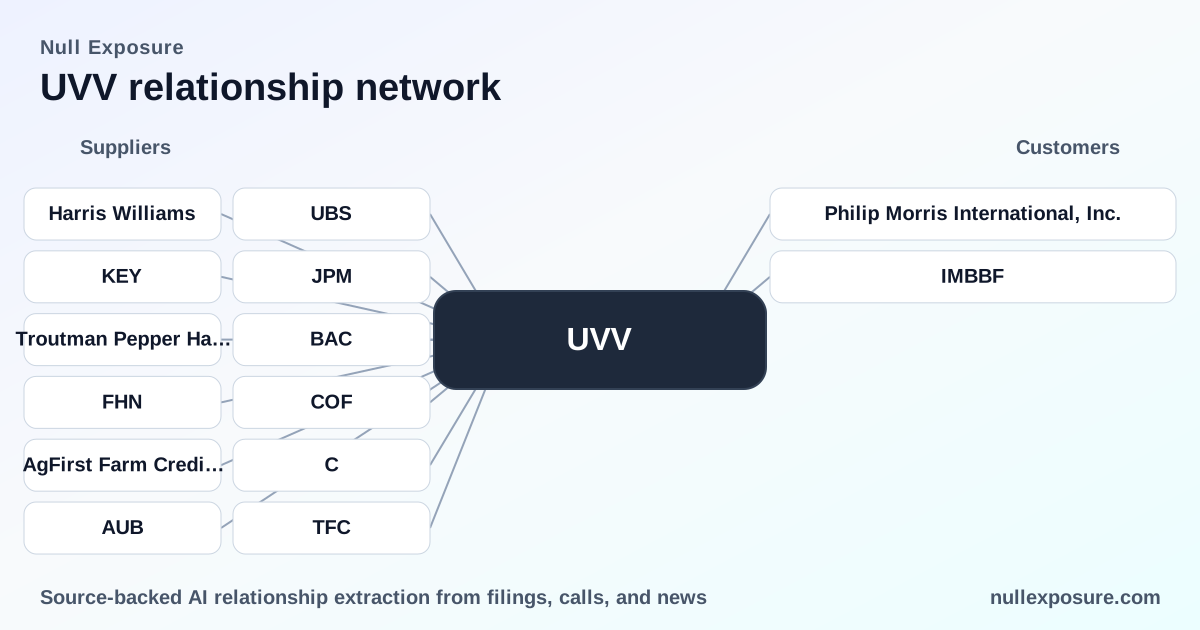
Universal Corporation (UVV): Supplier relationships, financing partners, and what they mean for investors
Universal Corporation processes and supplies leaf tobacco and plant ingredients globally, monetizing through commodity procurement from growers, downstream processing and sales to manufacturers, and ancillary agronomy services and supplier advances that lock in raw-material flows. The company funds working capital and strategic M&A with syndicated and unsecured credit facilities arranged with major banks and uses advisory relationships when acquiring complementary ingredient businesses. For investors and operators, the key thesis is simple: Universal’s balance of short-term supplier contracting plus diversified regional sourcing creates both operational resilience and working-capital intensity — financed by a conventional bank syndicate rather than asset-backed or captive financing.
Explore more on supplier risk and counterparty mapping at https://nullexposure.com/.
Why the December 2025 credit package matters to supplier strategy
Universal closed a new unsecured credit agreement on December 9, 2025 that formalizes the company’s banking counterparty set and liquidity posture. That facility is unsecured and syndicated among large commercial banks, which signals reliance on relationship lending and capital-market access rather than collateralized financing tied to inventory or receivables. According to the company’s 8‑K (filed and republished via StockTitan), JPMorgan Chase Bank, N.A. served as Administrative Agent while a mix of national and regional banks acted as co-syndication and co-documentation agents.
The syndicate and advisory roster — who showed up
-
JPMorgan Chase Bank, N.A.: Served as Administrative Agent for the new unsecured credit agreement and was identified as a joint bookrunner and joint lead arranger in coverage of the refinancing. According to Universal’s 8‑K and a CityBiz report on the refinancing, JPMorgan led the facility. (Source: 8‑K as republished on StockTitan; CityBiz article, FY2025/FY2026 coverage.)
-
Truist Bank / Truist Securities, Inc.: Named as a Co‑Syndication Agent in the 8‑K and also cited among joint bookrunners and lead arrangers in market coverage, indicating a lead role in distribution of the facility. (Source: Universal 8‑K / CityBiz, FY2025.)
-
AgFirst Farm Credit Bank: Listed as a Co‑Syndication Agent and identified alongside JPMorgan and Truist as a joint bookrunner/lead arranger in the refinancing announcement. (Source: CityBiz, FY2025; 8‑K republished on StockTitan.)
-
UBS Switzerland AG: Included among the co‑documentation agents on the unsecured credit agreement filed December 9, 2025 and republished in the 8‑K. (Source: Universal 8‑K as republished on StockTitan, FY2025.)
-
Bank of America, N.A.: Listed as a Co‑Documentation Agent on the December 2025 credit agreement in the 8‑K filing. (Source: Universal 8‑K on StockTitan, FY2025.)
-
Citibank, N.A.: Identified as a Co‑Documentation Agent on the new unsecured credit agreement per the 8‑K. (Source: StockTitan republishing of Universal’s 8‑K, FY2025.)
-
Capital One, N.A.: Named among the co‑documentation agents on the credit agreement in the company filing. (Source: Universal 8‑K as republished on StockTitan, FY2025.)
-
First Horizon Bank: Included as a Co‑Documentation Agent on the unsecured facility according to the 8‑K filing. (Source: Universal 8‑K on StockTitan, FY2025.)
-
KeyBank National Association: Listed as a Co‑Documentation Agent in the 8‑K describing the syndicated credit agreement. (Source: StockTitan republishing of the 8‑K, FY2025.)
-
Atlantic Union Bank: Named as a Co‑Documentation Agent on the December 2025 credit agreement filed in the 8‑K. (Source: Universal 8‑K republished on StockTitan, FY2025.)
-
Harris Williams: Acted as exclusive financial advisor to Universal on the acquisition of Silva International, a specialty dehydrated-ingredient business closed in FY2020, demonstrating Universal’s use of boutique M&A advisory for strategic bolt-ons. (Source: PR Newswire release announcing the Silva acquisition, FY2020.)
-
Troutman Pepper Hamilton Sanders LLP: Served as legal counsel on the Silva International transaction, highlighting reliance on established corporate counsel for cross-border ingredient acquisitions. (Source: PR Newswire release, FY2020.)
Supplier-side operating model: constraints and practical consequences
Universal’s supplier footprint and contracting approach create several company-level characteristics that investors and procurement managers need to factor into counterparty analysis:
-
Short-term contracting posture: Contracts to purchase tobacco generally cover a single growing season. That creates recurring purchasing cycles, exposure to seasonal price volatility, and continual working-capital draw in the form of advances to growers. (Company-level signal from public disclosures.)
-
Geographic diversification across APAC, LATAM, and NA: Sourcing remains concentrated across Africa, Asia, North America, and South America, which reduces single-region supply risk but preserves geopolitical and climate exposure across multiple agricultural markets. (Company-level signal.)
-
Dual role as buyer and service provider: Universal is both a major purchaser/processor and an agronomy service provider that advances seeds, fertilizer, and other inputs to growers — a model that locks supply but creates supplier-credit exposure through advances and allowance accounts. (Company-level signal.)
-
Mature and active supplier relationships: The company’s acquisitions and supplier-account disclosures indicate longstanding, operationally embedded supply channels in key sourcing countries; these are not short-lived transactional ties. (Company-level signal.)
-
Segment mix: core commodity plus services: Revenue flows come from processed tobacco and plant ingredients as well as value-added services (agronomy, input financing), increasing margins opportunistically but also operational complexity. (Company-level signal.)
These characteristics mean investors should treat Universal as a working-capital intensive processor with structurally recurring procurement cycles, financed by relationship banks rather than collateralized commercial-paper setups.
Explore counterparty and supplier risk analytics relevant to Universal at https://nullexposure.com/.
Financial and risk implications for investors and operators
From a financial perspective, the unsecured syndicated facility and the high proportion of institutional ownership (about 86% per company data) reflect credit access and governance discipline: Universal carries an EV/EBITDA around 8.3 and a trailing P/E near 12, suggesting market valuation consistent with mid-cycle commodity-processing peers. Key operational risk vectors remain: seasonal price swings, advance-credit exposure to growers, and region-specific agronomic shocks. The bank syndicate’s presence provides operational liquidity but also ties covenant and refinancing risk to wholesale credit markets rather than asset-backed leverage.
For sourcing teams and credit officers, the takeaways are:
- Monitor seasonal advance balances and allowance movements as early warning indicators of supplier stress.
- Treat agronomy services as both retention tools and a source of counterparty credit exposure.
- Maintain multi-regional sourcing options to hedge climate and political risk.
Closing read and actions for investors
Universal operates a classic commodity-processing franchise with embedded supplier services that both stabilize supply and create credit exposure. The December 2025 unsecured credit agreement confirms that the company finances these cycles through relationship lending from a diversified bank syndicate rather than collateralized financing. For active investors and procurement managers, the immediate actions are to track supplier-advance trends, regional crop conditions, and covenant language in the company’s credit filings.
For a deeper review of counterparty mapping and supplier significance for Universal, visit https://nullexposure.com/ for tailored supplier-intelligence and risk scoring.