UY Scuti Acquisition Corp. (UYSC): supplier map and what it signals for investors
UY Scuti Acquisition Corp. is a technology-focused SPAC that monetizes primarily through its sponsor-backed structure: raising capital via an IPO, holding proceeds in a U.S.-based trust, and capturing sponsor economics (monthly administrative fees, potential extension fees and upside on a completed business combination). Revenue drivers are non-operational today — underwriting and formation costs are sunk, while the sponsor and trustee mechanics govern liquidity and timing of a combination. For investors and operators analyzing supplier risk, the critical questions are counterparty concentration (sponsor and trustee), short-term contracting posture, and the cash waterfall around trust-account protections and extension economics.
Learn how supplier relationships influence SPAC outcomes and risk weighting at https://nullexposure.com/.
The supplier picture in plain English
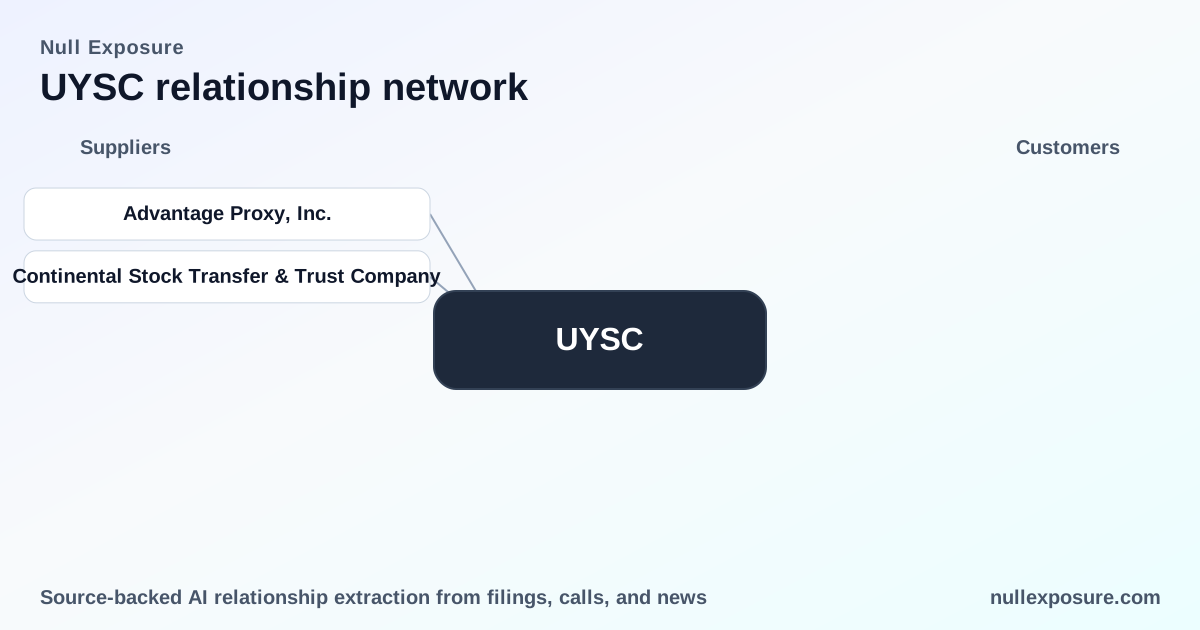
UYSC’s disclosed supplier footprint is compact and functionally specific: proxy solicitation, trustee services, sponsor administrative services, accounting and short-term office arrangements. Two external providers show up in SEC filings as active third parties — a proxy solicitor and the trust company — and both are operationally critical to execution and governance around a business combination. The remainder of the vendor exposures are low-dollar ongoing services and sponsor-affiliate arrangements that concentrate control and operational dependency.
Who does what: the relationships you must track
Advantage Proxy, Inc.
UYSC engaged Advantage Proxy, Inc. to solicit proxies for an Extraordinary General Meeting, and investors can revoke proxies by contacting Advantage Proxy directly; the role is the operational conduit for shareholder votes that approve trust amendments and extensions. (Source: UYSC definitive proxy statement, FY2026 — https://www.stocktitan.net/sec-filings/UYSC/def-14a-uy-scuti-acquisition-corp-definitive-proxy-statement-20b515b61ccf.html)
Continental Stock Transfer & Trust Company
Continental Stock Transfer & Trust Company serves as the trustee under UYSC’s Investment Management Trust Agreement and is the counterparty in a proposed amendment to allow time extensions for consummating a business combination, including specified sponsor deposit mechanics tied to each extension period. (Source: UYSC definitive proxy statement, FY2026 — https://www.stocktitan.net/sec-filings/UYSC/def-14a-uy-scuti-acquisition-corp-definitive-proxy-statement-20b515b61ccf.html)
Operational constraints that frame supplier risk
The filings reveal several company-level signals that shape supplier strategy and exposure:
-
Short-term contracting posture. UYSC uses month-to-month office leases and limited-duration promissory notes from the sponsor. This reduces fixed-cost burden but raises operational fragility if sponsor support falters. Evidence includes a month-to-month lease at 39 E Broadway, Suite 603, New York, and promissory notes that are interest-free and repayable only upon consummation of a business combination.
-
Trust-account concentration and U.S. domicile. The IPO and private placement proceeds — $57.5 million — are held in a U.S.-based trust account, and Continental is the trustee. Control of the trust and the mechanics for extensions are single points of failure for transaction timing and investor protections.
-
Sponsor-affiliate service dependence. UYSC pays its sponsor (UY Scuti Investments Limited) $10,000 per month for office, administrative and support services under an Administrative Services Agreement; that same sponsor is contractually responsible to top up the trust under certain circumstances. Because the administrative provider is also the sponsor, operational and governance roles are concentrated within the same group. (Source: UYSC filings, FY2026 — proxy statement linked above.)
-
Spend profile that mixes large formation costs with low ongoing vendor bills. Transaction costs for the IPO totaled approximately $3.02 million (underwriting fees and related costs), while recurring vendor spends are small: independent audit fees (~$82,500 for the period) and minor monthly expenses (cost per month ≈ $200 cited for certain services). At the same time, extension economics require sponsor deposits of $575,000 per three-month extension (up to $1,150,000 aggregate), which creates intermediate-sized contingent cash needs if the SPAC requires more time to close a deal.
-
Stage and role orientation. UYSC is in the search/active stage: it has completed an IPO and is actively soliciting proxies and negotiating trust amendments. The company’s contractual commitments are predominantly service-provider oriented rather than long-term strategic supplier contracts.
What these constraints mean for investors and operators
-
Concentration risk is material. The trustee and the sponsor/affiliate are the two levers that determine whether the SPAC keeps time and liquidity — both have outsized governance and cash roles. Continental’s agreement on trust amendment timelines and the sponsor’s obligation to deposit extension fees create binary outcomes for the SPAC’s ability to continue its search beyond initial deadlines.
-
Short-term contracts reduce fixed-cost leverage but increase execution risk. Month-to-month leases and promissory notes limit fixed obligations, but they leave the company exposed if the sponsor stops funding or if counterparty relationships change quickly.
-
Cash buffer and extension mechanics are the real financial levers. The trust account balance, the sponsor’s willingness/ability to deposit extension fees, and the promissory note principal outstanding ($337,584 as of March 31, 2025) are the immediate numeric items to monitor. The IPO transaction costs are a sunk headline but do not change the day-to-day supplier exposures. (Source: UYSC filings, FY2026 — proxy statement linked above.)
Explore a supplier-centric view of SPAC counterparties and maintain a running watchlist at https://nullexposure.com/.
Practical risk-management takeaways
- Operational diligence should prioritize trustee agreements and proxy solicitation arrangements: trustee terms and proxy timelines directly control the SPAC’s optionality.
- For insurers and underwriters, the sponsor-affiliate overlap is a governance flag: service agreements with the sponsor and indemnities tied to offerings create potential claims pathways into the trust account.
- Maintain covenant and liquidity scenario models around the $575k extension tranche and the total $1.15M cap; model both sponsor willingness to fund and trustee acceptance mechanics.
Bottom line: what to watch next
For investors and operators evaluating UYSC supplier relationships, focus on the trustee (Continental) and proxy solicitor (Advantage Proxy) as governance levers, monitor sponsor-affiliate funding capacity and extension deposits, and treat short-term vendor contracts as stability levers rather than fixed-cost commitments. The combination of a concentrated supplier set and explicit extension economics makes UYSC’s near-term outcome highly dependent on a small set of counterparties.
If you want a tailored supplier-risk briefing or a monitoring signal for SPAC counterparties, visit https://nullexposure.com/ for a structured view and alerts.