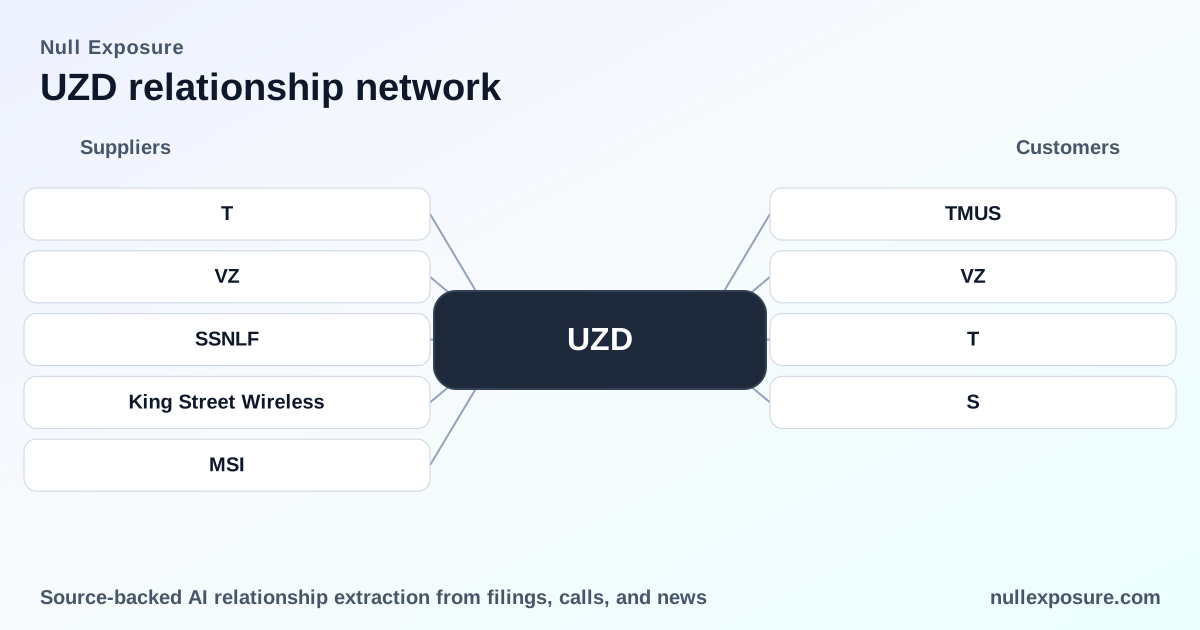
UZD supplier profile: who powers United States Cellular’s network and retail engine
United States Cellular Corporation (ticker UZD) operates as a regional wireless carrier that monetizes through subscription services, device sales, and network access agreements; its economics depend on a mix of long-term financing, third‑party software and managed services, and OEM device supply. Investors should view UZD as a capital‑intensive operator whose revenue stability is tied to durable customer relationships and supplier arrangements that deliver both network coverage and handset availability. For a concise supplier-risk readout and ongoing monitoring, visit https://nullexposure.com/.
Why supplier relationships matter for valuation and operational risk
UZD’s supplier set combines network partners, handset OEMs, and IT/service providers—each group affects capital intensity, customer churn risk, and margin pressure in different ways. Network partnerships influence coverage economics and spectrum utilization; handset supply controls retail margins and customer acquisition cadence; and software/managed services drive operating leverage and service quality. Together these relationships shape both near‑term cash flow and the long‑term cost of serving customers.
Visit https://nullexposure.com/ for supplier tracking and supplier-driven risk signals.
What the public citations show about UZD’s active partners
Below I cover every relationship surfaced in the public results and provide a concise, plain‑English take on what each partner contributes to UZD’s business.
AT&T (T) — network agreements expand coverage footprint
According to an industry summary of U.S. Cellular’s arrangements, UZD has agreements with AT&T that are referenced in connection with spectrum and network collaboration in FY2019; these arrangements support regional coverage strategies and spectrum sharing. (Source: Android Central, FY2019)
Verizon (VZ) — complementary roaming and spectrum coordination
The same Android Central report lists Verizon alongside AT&T as a named partner in the FY2019 period, indicating UZD uses commercial arrangements with major national carriers to extend capabilities beyond its owned network. (Source: Android Central, FY2019)
King Street Wireless — 700 MHz LTE deployment partner across 27 states
UScellular partners with King Street Wireless specifically for deployment of the 700 MHz LTE band across 27 states, a relationship that drives spectrum rollout and rural coverage economics rather than consumer retail branding. (Source: Android Central, FY2019)
Samsung (SSNLF) — handset supply and promotional inventory
A PR Newswire release (FY2014) documents U.S. Cellular promotional programs offering Samsung Galaxy devices at promotional pricing, confirming Samsung’s role as a primary device supplier and retail incentive partner. (Source: PR Newswire, FY2014)
Motorola (MSI) — device OEM and retail promotions
The same PR Newswire release lists Motorola devices (for example, the Moto X) in limited‑time promotional pricing, indicating Motorola is part of UZD’s OEM procurement and promotional mix. (Source: PR Newswire, FY2014)
How UZD contracts and organizes its supplier relationships
Public filings and referenced exhibits reveal a clear organizing principle: UZD relies on a mix of long‑term financial commitments, licensed software, and outsourced managed services to operate at scale. These characteristics are company‑level signals drawn from the filing excerpts.
- Long‑term contractual posture: A Ninth Supplemental Indenture incorporated by reference to a Form 8‑A (dated August 12, 2020) ties UScellular to long‑dated senior notes; this signals durable financing commitments and a need for predictable cash generation to service long‑term obligations.
- Software licensing and maintenance as a core input: An Amended and Restated Software License and Maintenance Agreement effective October 1, 2019 (incorporated to a 10‑Q) shows UZD has formal licensing arrangements with enterprise software vendors, implying recurring licence and maintenance costs that are integral to operations.
- Managed services and third‑party operations: A 2019 Managed Services Statement of Work (effective October 1, 2019) indicates UZD outsources elements of IT and operational support—this creates operational leverage but also vendor dependency for customer‑facing systems.
- Device manufacturer and distributor sourcing: Filings explicitly state that UZD purchases devices and accessories from multiple OEMs and distributors, establishing a multi‑vendor procurement posture for retail inventory.
These constraints translate into investor-relevant characteristics: contractual maturity is long; vendor relationships are operationally critical; and the supplier base is diversified across software, services, and hardware but still central to service delivery.
Investment implications and risk map
- Capital structure dependency: Long‑dated senior notes increase the importance of predictable free cash flow to avoid refinancing risk. The indenture reference is a direct signal of long‑term debt obligations.
- Operational concentration risk in services and software: Outsourced managed services and licensed software are critical for billing, CRM, and network OSS/BSS; any vendor disruption would have immediate customer experience implications.
- Supply cycle effects on growth and churn: Device promotions with Samsung and Motorola affect subscriber acquisition and upgrade economics—inventory timing and OEM pricing directly influence ARPU and churn.
- Network partnership criticality: Agreements with national carriers and spectrum partners (AT&T, Verizon, King Street Wireless) are strategic to coverage and roaming economics; these relationships materially affect competitive positioning in rural and fringe urban markets.
Practical next steps for investors and operators
- For investors focused on operational risk, monitor covenant coverage and managed‑service SLAs as leading indicators of execution risk.
- For operators benchmarking competitiveness, track handset promotional cadence and spectrum deployment milestones against competitors to anticipate ARPU and churn shifts.
- For due diligence on supplier risk, obtain the specific contract exhibits referenced in filings (the 8‑A and 10‑Q exhibits cited in the company documents) and validate renewal and termination terms.
Explore a supplier-risk dashboard and ongoing supplier monitoring at https://nullexposure.com/.
Bottom line
United States Cellular runs a supplier model that balances long‑term financing, outsourced software and managed services, and multi‑OEM device sourcing. That structure supports regional coverage and retail operations but concentrates operational risk in several external suppliers and long‑dated financing commitments. Investors should weight supplier SLA strength, device procurement cycles, and spectrum/roaming arrangements into both valuation and scenario analysis.
For continuous updates on supplier relationships, contract signals, and operational constraints, return to https://nullexposure.com/—the quickest way to convert supplier intelligence into investment action.