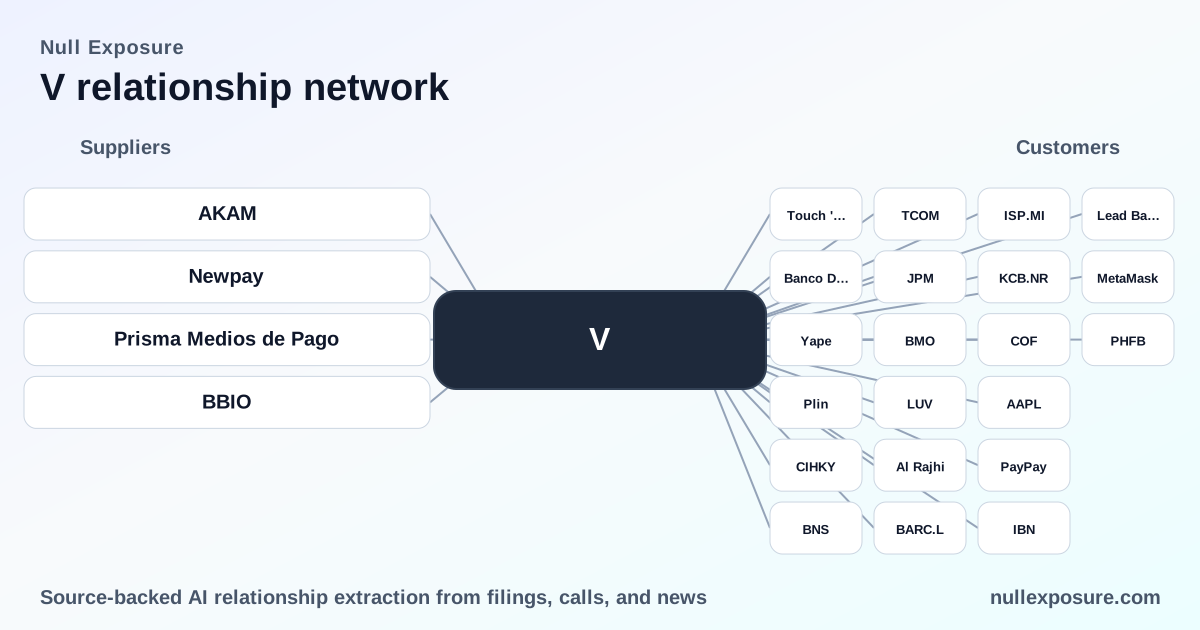
Visa's Supplier Ecosystem: Strategic Partners, Risks, and What Investors Should Know
Visa operates a global payments network that monetizes through transaction and processing fees, value-added services to issuers and acquirers, and strategic acquisitions that deepen local payment flows. Its economics depend on scale, trust, and uninterrupted transaction processing; third-party suppliers deliver critical capabilities—security, local market access, and emerging rails like stablecoins—that directly affect revenue growth and operational risk. For a concise supplier map and continuous monitoring of relationships like these, visit https://nullexposure.com/ for investor-grade supplier intelligence.
How Visa contracts and runs its supplier stack — what matters to returns
Visa’s commercial model centralizes network effects and delegates specialized capabilities to third parties. This creates a contracting posture that emphasizes active oversight, cybersecurity controls, and integration with global payment rails. Company disclosures explicitly describe governance applied to service providers and proactive vendor engagement when vulnerabilities arise, signaling a mature vendor risk program focused on resilience and regulatory compliance.
- Contracting posture: Visa enforces vendor oversight through formal governance and risk assessment, consistent with enterprise-scale financial-services procurement.
- Concentration and criticality: While Visa’s franchise spans millions of merchants and cardholders, key suppliers that provide security, local market access, or new rails (for example, stablecoin custody and tokenization partners) are highly critical to uninterrupted service and growth initiatives.
- Maturity: Visa’s language around vendor engagement and cybersecurity indicates institutionalized third-party management rather than ad-hoc vendor relationships.
These company-level signals reduce but do not eliminate supplier risk; investors should treat third-party integrations as both growth levers and potential operational vulnerabilities. For a deeper supplier risk view tailored to institutional portfolios, see https://nullexposure.com/.
What the latest supplier headlines tell investors
Akamai Technologies — upgrading identity and security
Visa partnered with Akamai to enhance identity verification, user recognition, and e‑commerce security, reinforcing Visa’s investment in web‑scale defenses that protect transaction integrity. According to a National Today write-up referencing the partnership (reported Feb 24, 2026), the collaboration targets improved fraud prevention and user verification at the edge — https://nationaltoday.com/us/ma/cambridge/news/2026/02/24/akamai-earnings-expected-to-rise-as-analysts-revise-forecasts/.
Key takeaway: Strengthening edge security with an established CDN/security provider reduces transaction fraud exposure and supports seamless scale.
Newpay — local-market payments capability in Argentina
Visa completed the acquisition of Newpay in Argentina to expand its footprint in the local payments ecosystem and capture more on‑net volume and issuing relationships. A March 1, 2026 report by Sahm Capital notes Visa’s completion of the Newpay transaction as part of a broader regional expansion — https://www.sahmcapital.com/news/content/visa-deepens-global-payment-ties-across-argentina-japan-and-india-2026-03-01.
Key takeaway: Local acquisitions like Newpay accelerate issuer and merchant onboarding and lift total addressable volume in high-potential corridors.
Prisma Medios de Pago — consolidating payments infrastructure in Argentina
Visa completed the acquisition of Prisma Medios de Pago, further embedding itself into Argentina’s payments infrastructure and settlement flows. Sahm Capital covered the transaction in the same March 1, 2026 note that announced both the Prisma and Newpay deals — https://www.sahmcapital.com/news/content/visa-deepens-global-payment-ties-across-argentina-japan-and-india-2026-03-01.
Key takeaway: Controlling a national payments processor increases Visa’s routing optionality and capture of domestic interchange opportunities.
Bridge — extending stablecoin-backed card rails globally
Visa announced a global partnership with Bridge to expand stablecoin-backed cards across more than 100 countries, testing crypto-native rails for everyday payments. Sahm Capital described Visa’s collaboration with Bridge in a March 3, 2026 commentary on stablecoin initiatives — https://www.sahmcapital.com/news/content/visas-stablecoin-push-with-bridge-tests-future-of-everyday-payments-2026-03-03.
Key takeaway: Pilot programs with stablecoin partners open a potential new revenue stream and product differentiation, while attracting regulatory scrutiny and integration complexity.
For a consolidated supplier monitoring and alert feed that tracks moves like these in near real time, check https://nullexposure.com/.
What investors should weigh: strategic upside and concentrated risks
Visa’s supplier activity reflects two simultaneous themes: growth through horizontal expansion and technological hardening. Acquisitions in Argentina deliver immediate local scale and higher on‑net volume; partnerships with Akamai and Bridge address security and future rails. Those moves support sustained margin expansion if integration succeeds.
Risk vectors are clear and material:
- Integration risk: Acquisitions and novel payments rails require operational integration into clearing, reconciliation, and compliance flows; execution slippage can create revenue drag.
- Regulatory risk: Stablecoin initiatives are exposed to evolving cross‑border regulation; regulatory action could slow rollouts or impose costly compliance measures.
- Cybersecurity/supply‑chain risk: Visa’s dependence on third-party security providers and infrastructure vendors elevates systemic operational risk if oversight or incident response fails.
Visa’s documented active engagement with vendors and explicit cybersecurity oversight is a meaningful mitigant, but investors must discount for execution and regulatory variability. Monitor partner announcements, integration milestones, and regulatory filings for clearer lead indicators of upside or stress.
Short checklist for operators and portfolio managers
- Track integration milestones post-acquisition (customer migration, processing volumes, margin impact).
- Monitor regulatory developments in jurisdictions where stablecoin pilots expand.
- Review Visa’s vendor oversight disclosures and incident reporting cadence to assess operational resilience.
For an investor-facing supplier risk dashboard and regular alerts on these exact relationships, visit https://nullexposure.com/.
Bottom line
Visa is using targeted acquisitions and specialized partnerships to protect its core network and pursue new rails. These supplier relationships are strategic: they bolster security, expand local market share, and enable product innovation, while exposing Visa to integration, regulatory, and supplier‑chain cyber risk. Investors should prioritize monitoring of execution milestones and regulatory touchpoints to translate these supplier moves into risk‑adjusted valuation decisions.
For ongoing coverage that maps supplier linkages to financial impact, see https://nullexposure.com/.