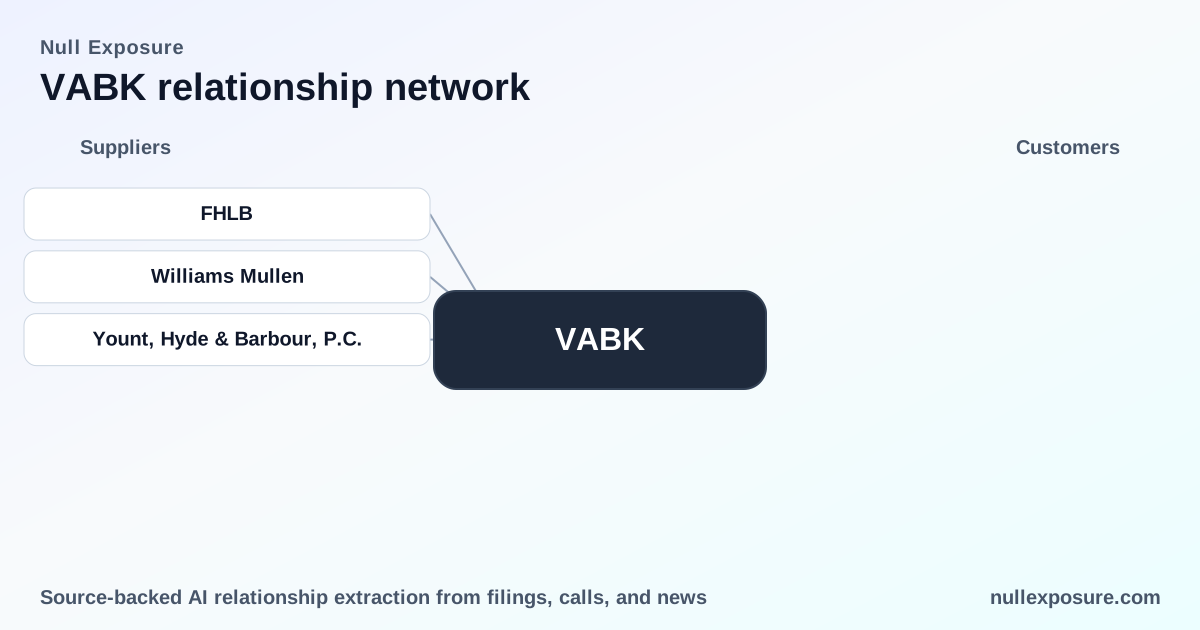
Virginia National Bankshares (VABK): supplier relationships as a lens on liquidity and legal posture
Virginia National Bankshares Corporation is the holding company for Virginia National Bank, a regional commercial bank that monetizes through traditional banking spread and fee income by serving commercial and consumer customers in Virginia. The company’s balance-sheet management — notably its use of short- and medium-term borrowings and lease commitments — drives funding flexibility and operating leverage that investors should watch closely. For a quick way to track supplier and counterparty exposure across VABK’s public disclosures, visit https://nullexposure.com/.
What the supplier signals reveal about how the company runs its business
Virginia National operates as a regional bank with intentional liquidity management and modest off-balance contractual commitments. Two themes emerge from the supplier-level evidence:
- Funding optionality and active liability management. The bank reduced advances from the Federal Home Loan Bank (FHLB) materially over recent periods, showing an effort to lower interest-bearing borrowings and reliance on wholesale funding. This is a funding choice that affects net interest margin and balance-sheet duration risk. (See the relationship summaries below for source details.)
- Standard corporate legal and facilities outsourcing. Filings show external law firms providing opinions and consents for securities filings and the company holding operating leases on offices with durations spanning 1–20 years, representing ongoing fixed-cost commitments that are operationally relevant to branch and back-office footprint.
If you track concentration and counterparty risk in community banks, these supplier entries give direct windows into the company’s contracting posture (leases and counsel), funding counterparty concentration (FHLB), and the maturity profile of commitments (multi-year leases). Explore an aggregated supplier view at https://nullexposure.com/ to contextualize these relationships across peers.
The relationships, one by one
FHLB — reported in a 10‑K overview (FY2025)
Virginia National disclosed it reduced FHLB advances from $66.5 million to $20.0 million, reflecting active management of borrowing levels as of the FY2025 filing. This indicates the bank used the FHLB line for liquidity and then pared it down as balance-sheet conditions allowed. Source: TradingView summary of the company’s SEC 10‑K (first seen March 2026).
FHLB — cited in the FY2026 full-year results press release (Finviz)
The company reiterated $20.0 million outstanding FHLB borrowings as of December 31, 2025, a $10.0 million decrease from September 30, 2025, signaling sequential deleveraging of FHLB exposure during FY2026. Source: Finviz coverage of the FY2025/FY2026 full-year results press release (reported March 2026).
FHLB — same FY2026 disclosure in the company press release (PR Newswire)
The PR Newswire distribution of the company’s full-year results also documented $20.0 million of outstanding FHLB advances at year-end 2025, down $10.0 million quarter-over-quarter, confirming the messaging used in investor communications. Source: PR Newswire release announcing 2025 full-year results and the quarterly dividend (March 2026).
Williams Mullen — counsel opinion listed in S‑8 exhibits (FY2025)
An exhibit to a securities registration (S‑8) includes an opinion from Williams Mullen, indicating that Virginia National retained external outside counsel to provide statutory or securities opinions associated with employee benefit plan registrations or equity plan filings. Source: StockTitan transcription of the S‑8 filing exhibits (reported March 2026).
Yount, Hyde & Barbour, P.C. — consent included with filing exhibits (FY2025)
The S‑8 exhibits also list a consent from Yount, Hyde & Barbour, P.C., consistent with the use of local audit or legal advisors to support registration and compliance matters tied to employee benefit plans. Source: StockTitan transcript of the S‑8 filing exhibits (reported March 2026).
What these relationships mean for investors — a focused analysis
- Liquidity and funding risk: The FHLB is a meaningful overnight-to-medium-term counterparty for many community banks. VABK’s reduction of FHLB advances from $66.5M to $20M shows the bank is lowering reliance on that facility; this reduces wholesale funding concentration but also signals management’s confidence in internal liquidity or deposit growth. Investors should monitor FHLB outstanding levels alongside deposit trends and loan growth to assess stability of funding. (See TradingView and the company’s press communications in March 2026.)
- Contracting posture and fixed-cost commitments: The company’s adoption of operating leases with terms ranging 1–20 years is a corporate-level signal of branch and office footprint commitments that lock in fixed costs and affect flexibility in a stressed environment. This lease information was presented as part of contract evidence in company disclosures and is consistent with a service-provider relationship classification. (Constraint excerpt from FY2025 filings.)
- Legal and compliance normalcy: External counsel and audit consents for securities filings are routine for community banks executing equity plan registrations; these are standard supplier relationships rather than strategic dependencies. The S‑8 exhibits listing Williams Mullen and Yount, Hyde & Barbour reflect compliance and disclosure work tied to employee plans (S‑8 filings, FY2025).
Practical checklist for investors evaluating VABK supplier exposure
- Watch the quarterly movement in FHLB advances alongside deposit betas and loan-to-deposit trends; changes will indicate whether funding is shifting toward core deposits or wholesale sources.
- Account for lease maturities when modeling branch rationalization or cost structure normalization; multi-year leases constrain short-term flexibility.
- Treat law‑firm and auditor consents as transactional but review them for any unusual legal language that could imply contingent liabilities.
For a consolidated view of supplier relationships across Virginia National and peer banks, visit https://nullexposure.com/ — the homepage provides direct links to relationship overviews and disclosure extracts.
Bottom line and next steps
Virginia National’s public supplier footprint is straightforward: FHLB advances are the primary funding counterparty shown, and external counsel and audit consents are standard for securities filings. The operational profile is that of a regional bank actively managing borrowing levels while maintaining a leased branch and office network supported by outside legal advisors. Investors valuing clarity in funding and predictable cost structure will find these signals informative when modeling margin sensitivity and liquidity buffers.
If you need a consolidated vendor and counterparty risk map for VABK or peer comparatives, start here: https://nullexposure.com/.