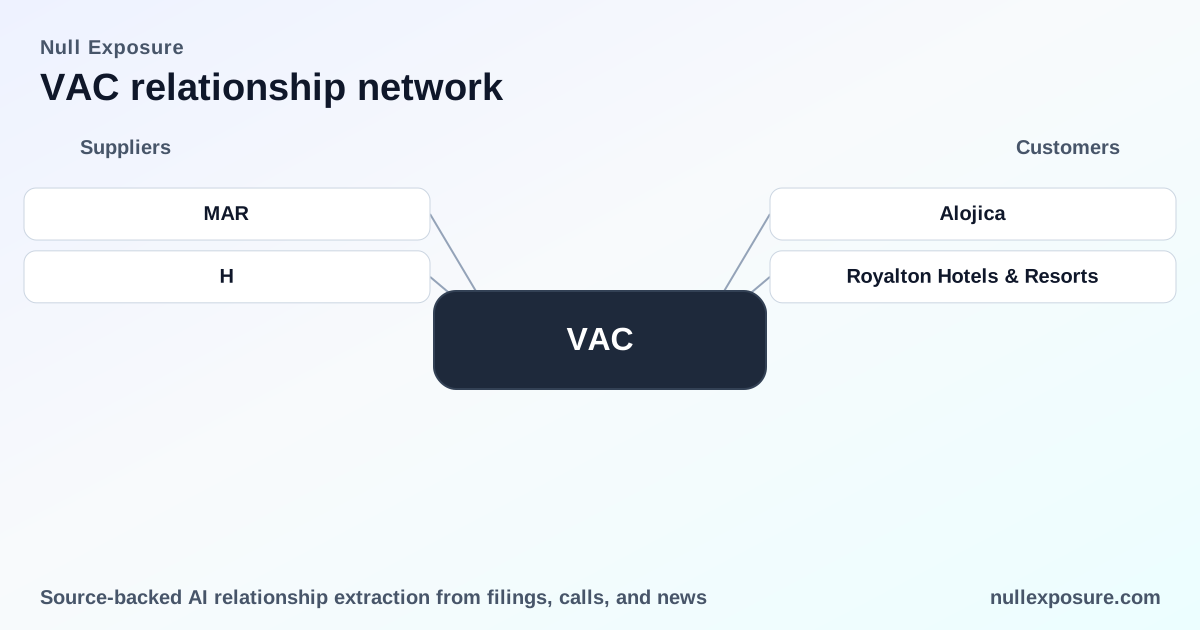
Marriott Vacations Worldwide (VAC): Strategic Supplier Relationships that Underpin the Vacation-ownership Franchise
Marriott Vacations Worldwide develops, markets, sells and manages vacation ownership products and related residential services and monetizes through upfront sales of ownership interests, recurring management and maintenance fees, and brand-enabled resale and exchange channels. Critical to that model are long-term, exclusive licensing relationships that allow VAC to sell under globally recognized hospitality brands, which directly drive sell-through, price realization and distribution reach.
For a deeper look at how those supplier relationships shape credit and operational risk, see NullExposure for supplier intelligence: https://nullexposure.com/
Why Marriott and Hyatt are not just partners — they are platform enablers
VAC operates as a licensed operator of marquee hospitality brands. Company disclosures and contemporaneous press both confirm exclusive, long-term license agreements with Marriott International and Hyatt that grant VAC the rights to use flagship marks like Marriott, Sheraton, Westin and select Hyatt brands in its vacation ownership business. Those agreements are multi-decade in tenor (licenses cited to 2093–2095, subject to renewal), which converts brand access into a durable competitive advantage and a highly predictable distribution channel for VAC’s product inventory.
This licensing posture produces several embedded operating-model characteristics investors need to price:
- Contracting posture: long-term, exclusive licenses. The company functions more as a licensee than an independent franchisor for its signature offerings, which reduces brand development costs but increases dependency on third-party IP.
- Concentration and criticality: high. Two hospitality giants provide the brand equity VAC uses to market and sell units; company filings flag that termination would materially harm operations and results.
- Maturity and runway: extended. With contractual expiries into the 2090s, the relationships are effectively permanent for portfolio and valuation horizons, subject to compliance with contract terms.
- Counterparty leverage: asymmetric. Licensors retain termination rights for breaches; VAC is exposed to reputational and operational risk if contractual obligations are not met.
If you want an operational map of how supplier risk feeds into valuation and covenant stress tests, review company-level supplier profiles at NullExposure: https://nullexposure.com/
Relationship rundown: Marriott International (MAR)
VAC holds a long-term license with Marriott International that grants exclusive rights to use Marriott, Sheraton and Westin marks for its vacation ownership business and additional rights for Grand Residences by Marriott in residential real estate; the license is disclosed to expire in 2095, subject to renewal. According to a StockTitan news release referencing VAC’s FY2026 disclosures, VAC describes its relationship with Marriott as exclusive and long-term, and material to marketing and sales strategy (StockTitan, March 2026).
Relationship rundown: Hyatt Hotels Corporation (H)
VAC maintains a long-term, exclusive license with Hyatt that authorizes VAC to use Hyatt marks in connection with its Hyatt Vacation Ownership business; that license is disclosed to expire in 2093, subject to renewal. A Travel & Tour World piece summarizing recent leadership commentary reiterated VAC’s long-standing partnership with Hyatt as augmenting the company’s product offering and distribution (Travel & Tour World, March 2026).
Company-level constraints and contractual signals investors should model
Beyond the headline brand licenses, the company filing excerpts reveal concrete contractual and capital commitments that affect cash flow timing and counterparty exposure. These are company-level signals that shape operating leverage:
- Licensing and exclusivity are explicit and long-dated. Filings indicate license expirations in the 2090s and exclusive rights for the term of the agreement, which fixes VAC’s go-to-market around external brand access.
- Materiality is explicit. The filing text states that termination of licenses with Marriott or Hyatt would materially impair VAC’s ability to market and sell products — a direct disclosure of existential supplier risk.
- Capital commitments are meaningful. VAC discloses a $122 million commitment related to the purchase of property and 168 vacation ownership units in Nashville (payments staged across 2026–2027), and remaining commitments of $80 million for unit purchases in Thailand across two transactions. These purchase obligations represent near-term cash funding requirements tied to development pipelines.
- IT and cloud commitments are non-trivial. Aggregate contractual commitments for IT hardware and software, including cloud arrangements, total $82 million with scheduled payments through 2028, indicating ongoing operating-expense and capitalized-software commitments that will draw liquidity.
These disclosures combine to create a profile of long-term brand dependence with measurable near-term cash commitments, which should be included in scenario analyses for free cash flow and covenant pressure.
If you are modeling supplier default or brand-termination scenarios, NullExposure’s supplier risk pages provide comparative case studies and stress frameworks: https://nullexposure.com/
Commercial and financial implications — what investors should price in now
- Revenue resilience vs. concentration risk. Brand affiliation protects pricing and demand, which supports revenue per unit and resale dynamics; however, the concentration in two licensors creates single-event tail risk that is explicitly described as material.
- Operational leverage through long-term rights. Multi-decade licenses lower variability of branding costs and support multi-year sales pipelines, increasing asset-backed financing feasibility for inventory and development.
- Liquidity and timing pressure from development commitments. The $122M Nashville and $80M Thailand commitments, plus $82M IT obligations, place defined cash outflows into 2026–2028 — these are predictable, contract-level drains investors must reconcile with projected operating cash flow given recent negative EPS and mixed margins.
- Counterparty termination exposure. Licensors retain termination remedies for breaches; governance, quality-control and compliance processes are therefore value‑critical operational levers.
Bottom line and investor action points
Marriott Vacations Worldwide’s business is structurally dependent on long-term, exclusive licensing relationships with Marriott and Hyatt that materially underpin its go-to-market and pricing power, while company-level capital commitments create a defined near-term liquidity profile. Investors should treat these supplier contracts as both strategic assets and concentrated counterparty risk when valuing enterprise cash flows and setting covenant buffers.
For a vendor-level view that maps these contractual exposures into credit and operational scenarios, visit NullExposure to explore supplier intelligence and scenario tools: https://nullexposure.com/
If you need tailored analysis or a supplier-risk briefing for portfolio stress-testing, NullExposure’s research services translate these contract signals into modeled outcomes and decision-ready recommendations: https://nullexposure.com/