Voyager Acquisition Corp (VACH): supplier relationships and operational constraints investors should price in
Voyager Acquisition Corp is a purpose-built acquisition vehicle (a SPAC) that monetizes by completing a business combination and through pre-combination sponsor arrangements — short-term sponsor loans, recurring payments to sponsor-affiliated service providers, and the residual economics that flow after a merger closes. The firm’s market capitalization sits near $333.6 million, and its pre-combination financial footprint shows modest operating spend concentrated on sponsor-related services. For investors and counterparties evaluating supplier relationships, the relevant facts are simple: this is a transaction-driven company with short-term contracts, recurring subscription payments to affiliates, and concentrated supplier exposure tied to the SPAC lifecycle. Visit Null Exposure for ongoing coverage and supplier intelligence: https://nullexposure.com/
How Voyager’s operating model translates into supplier economics
Voyager’s operating model is the classic SPAC playbook: raise capital into trust, operate with a lean corporate structure while sourcing a target, and realize value through a completed business combination. Before that closing (or liquidation), operational spend is limited, predictable, and frequently routed to sponsor or sponsor-affiliated vendors.
- Contracting posture — short-term and transaction-tied. The company has accepted short-term sponsor loans and service contracts that terminate on the earlier of a business combination or liquidation, indicating temporary contractual commitments that are durable only until the transaction outcome. According to company filings, the sponsor agreed to loan up to $300,000 on January 11, 2024, with repayment due at the earlier of December 31, 2024 or closing of the offering.
- Subscription-style vendor relationships. Voyager pays recurring monthly fees for office space, administration and consulting — typical fixed, subscription-like arrangements with sponsor affiliates that continue until deal close. The offering documents state the company will pay up to $10,000 per month for office/admin services and $15,000 per month for consulting services from sponsor affiliates.
- Concentration and criticality skew toward the sponsor. Pre-combination, the sponsor functions both as capital provider and primary service provider, increasing counterparty concentration and operational dependence on a small set of affiliated vendors.
- Maturity and spend scale remain modest. Reported spend for the year ended December 31, 2024 totals in the low six-figures, consistent with a SPAC in the pre-close phase.
All supplier and advisory relationships disclosed in the coverage
Below I cover every relationship surfaced in the available results.
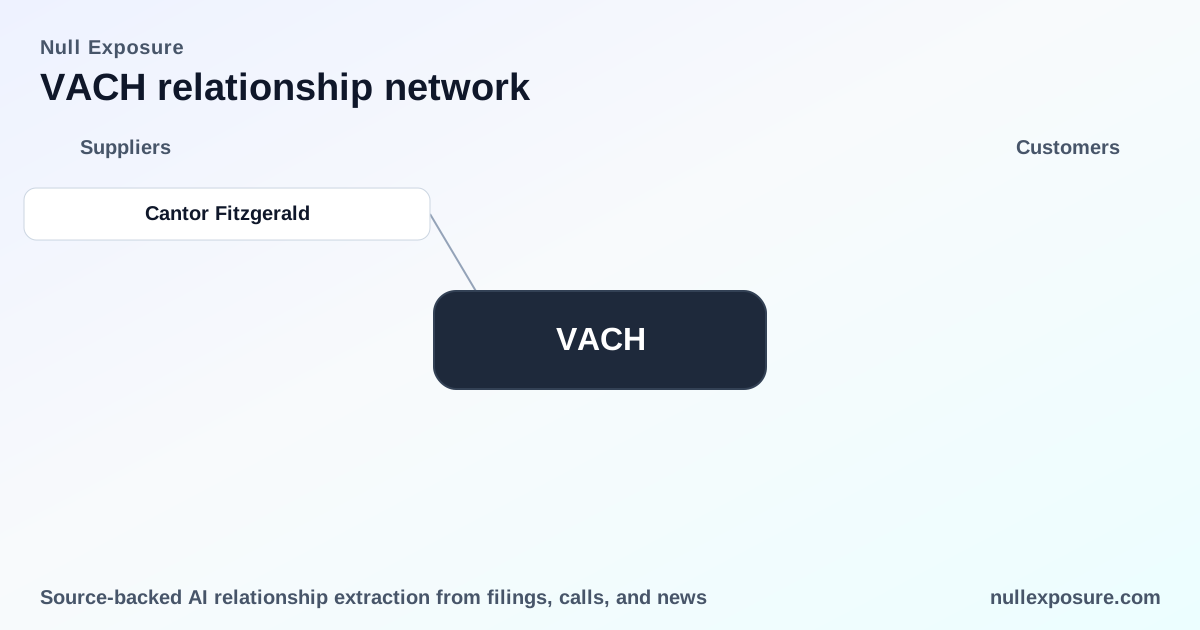
Cantor Fitzgerald — capital markets advisory for the VERAXA combination
Cantor Fitzgerald is providing capital markets advisory services to Voyager in connection with Voyager’s proposed business combination with VERAXA. This engagement is transactional and focused on the planned combination. A news item on StockTitan reported this advisory role on March 10, 2026. (Source: StockTitan news report, March 10, 2026.)
What the contract and spend constraints tell investors about counterparty risk
The disclosed constraints paint a consistent corporate signal: Voyager’s supplier relationships are short-lived, concentrated, and primarily service-oriented, not long-term strategic sourcing arrangements.
- Short-term tenor. The sponsor loan terms and the stated end-dates (earlier of combination or liquidation, and explicit repayment windows) create a contracting posture where counterparties can expect limited duration exposure.
- Recurring subscription payments to affiliates. The company’s payment of $10,000 per month for office/admin and $15,000 per month for consulting indicates a steady monthly cash outflow to related parties — predictable but concentrated.
- Service-provider role dominated by affiliates. Filings note that the sponsor and sponsor-affiliated entities have provided and continue to provide administrative, consulting, and formation cost coverage; between inception and December 31, 2024 the sponsor paid $228,274 on behalf of the company, underscoring affiliate-provided services as the backbone of current operations.
- Active but pre-transaction stage. Multiple agreements remain active until the business combination closes or the entity liquidates; therefore supplier contracts retain full force in the transaction run-up.
- Spend scale: low-to-moderate. Reported spend levels are consistent with early-stage SPAC operations — $165,536 incurred for the year ended December 31, 2024, with an additional $45,800 accrued and unpaid as of that date — placing the company’s vendor spend in a sub-$1M band.
These signals together create a supplier-risk profile where counterparties should treat engagements as transaction-dependent and concentrated, with limited long-term revenue visibility beyond completion of the business combination.
Financial footprint and what that implies for supplier negotiating posture
Voyager’s disclosed pre-combination cash flows and sponsor support create predictable short-term liquidity but limited independent operating revenue (Revenue TTM = 0). For suppliers and investors evaluating exposure:
- Payments are predictable but tied to corporate outcomes. Monthly fees are fixed and will cease upon consummation of a business combination or liquidation, so revenue from these contracts is temporally bounded.
- Sponsor backstop reduces near-term credit risk but increases related-party concentration. The sponsor advanced formation and deferred offering costs ($228,274 through Dec 31, 2024), reducing immediate counterparty credit pressure while concentrating counterparty exposure.
- Spend bands suggest that most supplier relationships are service-level, administrative, and consulting in nature, not material procurement or capex commitments.
For more detailed supplier risk profiles and relationship mapping for SPACs and other sponsors, check our platform: https://nullexposure.com/
Investment implications and actionable takeaways
- Counterparty concentration is the principal supplier risk. Sponsor-affiliated vendors supply most services and cover material pre-combination costs; if the sponsor changes posture, service continuity is vulnerable.
- Contracts are short-term and predictable. That structure reduces long-tail liability but limits revenue scalability for suppliers unless they convert to post-combination counterparties.
- Spend is modest and transparent. Low six-figure annualized expense levels indicate limited operational complexity and manageable vendor exposure before transaction close.
- Transactional dependencies create event risk. The completion or failure of the VERAXA combination will materially alter supplier revenue flows and contractual status.
If you are evaluating relationships with VACH as a potential supplier or investor, focus on contract termination triggers, payment seniority relative to trust assets, and the sponsor’s willingness to convert short-term engagements into post-combination, independent contracts. For ongoing monitoring and supplier intelligence, visit: https://nullexposure.com/
Bottom line
Voyager Acquisition is a classic SPAC supplier ecosystem: short-duration, sponsor-centric, subscription-style service relationships with modest pre-combination spend. Cantor Fitzgerald’s advisory role for the VERAXA transaction is an isolated, transaction-led engagement and does not change the underlying supplier risk profile. Investors and operators should underwrite counterparties to VACH as transaction-dependent and concentrated, and price contracts accordingly. For continued coverage and supplier risk tools tied to SPACs and acquisition vehicles, go to https://nullexposure.com/