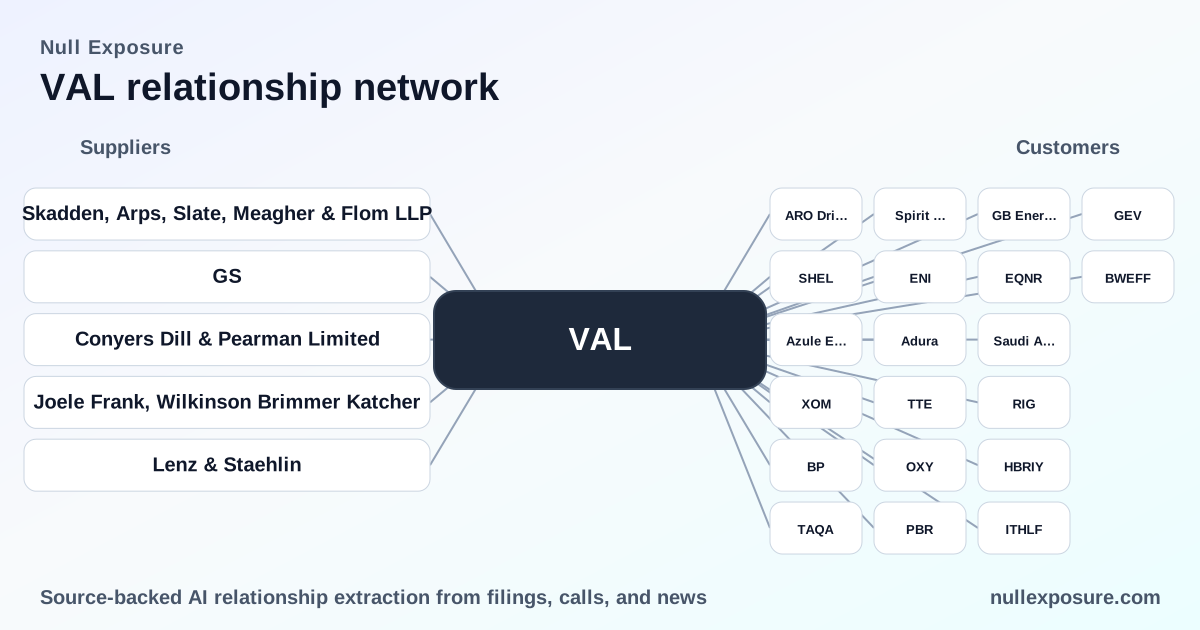
Valaris Ltd (VAL): advisor network, supplier posture, and what buyers should price into the deal
Valaris operates as a capital-intensive offshore contract driller, monetizing a fleet of rigs through dayrates, utilization management and contractual uptime commitments with major oil-and-gas producers. Cash flow is driven by long-term rig contracts and spot-market dayrates; balance-sheet discipline and asset-light contracting for non-core services shape supplier relationships. Recent FY2026 disclosures around the Transocean transaction put several law firms, banks and communications advisers squarely on Valaris’s counterparty ledger — a useful lens for investors and operators assessing transactional risk and supplier concentration. For a quick portfolio-level check on counterparties, visit https://nullexposure.com/.
Why the adviser list matters for investors: deal context and supplier economics
Valaris’s core economics are straightforward: rigs generate operating cash as long as dayrates exceed variable and fixed operating costs; the company’s valuation is sensitive to utilization and the timing of large corporate events. An M&A process compresses counterparty risk into a short window where legal, financial and communications suppliers become critical. The counterparties named in FY2026 disclosures signal an active sell-side process and higher short-term dependency on external advisors to execute the transaction and transition governance.
Operationally, Valaris shows typical energy-sector supplier traits: high contractual concentration (few large customers), elevated criticality of specialized service providers (legal, finance, communications) and mature, capital-heavy asset profiles where supplier performance directly impacts uptime and revenue. These characteristics justify a pragmatic contracting posture: rigorous SLAs for critical vendors, selective outsourcing for back-office services, and careful shift of liability in vendor terms.
Visit https://nullexposure.com/ for a concise vendor-risk snapshot and to explore deeper counterparty mapping.
The advisors and service providers named in FY2026 — who’s on the roster
Below are each of the counterparties reported in connection with Valaris’s FY2026 activities, described in plain English with source context.
Goldman Sachs & Co. LLC
Goldman Sachs is acting as a financial advisor to Valaris in the FY2026 transaction process, providing valuation, deal structuring and sale execution support. According to ConnectMoney’s coverage of the Transocean acquisition announcement (Mar 2026), Goldman was listed among Valaris’s financial advisers (https://www.connectmoney.com/stories/transocean-to-acquire-valaris-for-5-8b-creating-offshore-drilling-leader/).
Skadden, Arps, Slate, Meagher & Flom LLP
Skadden is serving as legal counsel to Valaris on the transaction, handling deal documentation and regulatory filings characteristic of cross-border M&A in the offshore sector. Euro-Petrole’s March 2026 article on the Transocean deal lists Skadden among Valaris’s legal advisers (https://www.euro-petrole.com/transocean-to-acquire-valaris-n-i-29662).
Conyers Dill & Pearman Limited
Conyers Dill & Pearman is engaged as part of Valaris’s legal advisory team, likely providing Bermuda-corporate and regulatory advice given Valaris’s Bermuda headquarters. Euro-Petrole (Mar 2026) includes Conyers Dill & Pearman in the adviser roll for the transaction (https://www.euro-petrole.com/transocean-to-acquire-valaris-n-i-29662).
Lenz & Staehlin
Lenz & Staehlin is listed among legal advisors to Valaris in FY2026 reporting, contributing cross-border or specialist transactional counsel. Both Euro-Petrole and ConnectMoney cite Lenz & Staehlin in the adviser list for the deal (https://www.euro-petrole.com/transocean-to-acquire-valaris-n-i-29662; https://www.connectmoney.com/stories/transocean-to-acquire-valaris-for-5-8b-creating-offshore-drilling-leader/).
Joele Frank, Wilkinson Brimmer Katcher
Joele Frank is serving as Valaris’s strategic communications adviser for the FY2026 transaction, running external messaging and investor relations through the sale process. Euro-Petrole and ConnectMoney both identify Joele Frank in the disclosure around the Transocean acquisition (https://www.euro-petrole.com/transocean-to-acquire-valaris-n-i-29662; https://www.connectmoney.com/stories/transocean-to-acquire-valaris-for-5-8b-creating-offshore-drilling-leader/).
All five counterparties are documented in FY2026 news coverage of the Transocean acquisition process. Their presence confirms a standard sell-side configuration: a lead bank, international and local law firms, and a communications firm — each carrying outsized importance during transaction execution.
What the constraints say about Valaris’s supplier posture
Two company-level signals derived from the available constraint excerpts are material for supplier-risk assumptions:
-
Evidence around smaller vendors’ liability caps — “liability is usually limited to the value, or double the value, of the contract for the purchase of such equipment or services” — signals a contracting posture that limits downside to small suppliers and pushes larger exposure to counterparties able to accept broader indemnities. This is a company-level policy signal, not tied to any named adviser.
-
A separate excerpt notes outsourcing of “accounting, payroll, human resources, supply chain and IT functions to a third‑party service provider,” which indicates Valaris uses service providers for non-core operations, concentrating operational risk externally while keeping core rig operations in-house.
Taken together, these constraints imply a hybrid operating model: high criticality and concentration for core drilling suppliers, coupled with selective outsourcing for administrative functions and conservative liability allocation for smaller vendors.
Investment implications and operational risk takeaways
- Short-term counterparty concentration is elevated: advisers listed in FY2026 are mission-critical to closing and communications; any disruption would have immediate transactional impact.
- Contracting posture protects the balance sheet: liability caps for smaller vendors reduce contingent exposure but shift operational risk toward larger service providers and in-house capabilities.
- Maturity and capital intensity lower supplier flexibility: large rig operators require specialized vendors; switching costs are high and supplier performance materially affects revenue.
For active investors evaluating exposure, model scenarios that stress execution risk around the deal close and re-contracting of major rig agreements post-transaction. For operators and procurement teams, prioritize rigorous SLA enforcement with critical suppliers and ensure continuity planning for outsourced back-office services.
For a deeper, structured counterparty assessment and to map exposure across suppliers, see https://nullexposure.com/.
Final recommendation
Valaris’s FY2026 adviser roster is consistent with a standard sale process and highlights the company’s reliance on a small set of critical external partners during material corporate events. Investors should price execution risk into short-term valuation and monitor post-close re-contracting of major customers and suppliers. Operators should treat the liability-cap signal as a cue to negotiate stronger protections for high-value service agreements.
To review Valaris’s counterparty map or to run bespoke supplier-impact scenarios, visit https://nullexposure.com/ and request a tailored report.