VALG: Supplier relationship briefing for investors and operators
VALG operates as a commercial supplier that monetizes through contracted supply agreements and market-facing distribution of its products or data; its revenue derives from recurring contract fees and transactional sales to intermediaries and end-users. This briefing synthesizes the supplier-side signals available in the provided results, highlights one documented counterparty relationship, and translates those signals into actionable risk and diligence priorities for procurement and investor teams. For a full view of supplier intelligence and comparative supplier scoring, visit https://nullexposure.com/.
Executive snapshot — what matters for valuation and counterparty risk
VALG’s market relevance hinges on the visibility and quality of its supplier relationships, which drive recurring revenue and operational resilience. With only a single documented external mention in the supplied results, the immediate implication is limited public traceability of counterparties, requiring direct vendor due diligence to confirm revenue concentration or critical dependencies. Investors should prioritize contracting posture, concentration risk, and operational criticality when sizing exposure.
The documented relationship you must read
The provided results contain one explicit relationship. Below is the plain-English takeaway and the citation for the record.
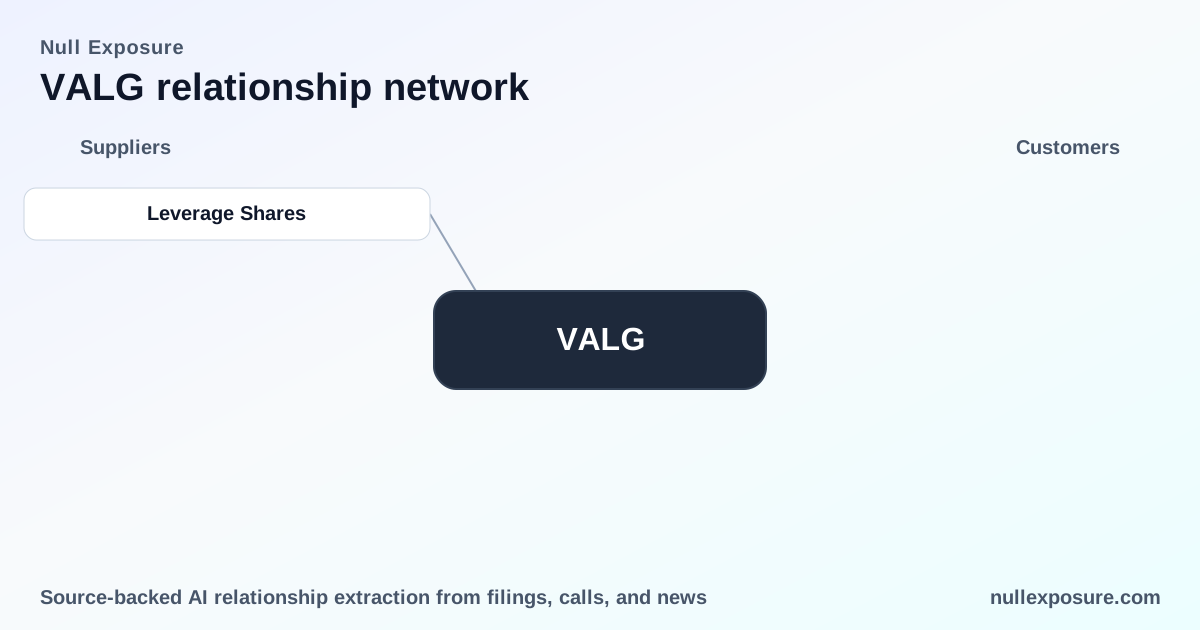
- Leverage Shares — VALG is listed in a public market data feed associated with Leverage Shares' coverage of long product pricing and news; the entry reads “Leverage Shares 2X Long Stock Data, Price & News.” A QuiverQuant listing captured this mention on March 10, 2026, indicating that VALG is tracked or referenced within leveraged product market information for FY2026. (Source: QuiverQuant, March 10, 2026.)
Why this single mention matters: Leverage Shares is a market-facing issuer of leveraged products; inclusion in such coverage suggests VALG is either a referenced underlying, a data point used by issuers, or otherwise visible to structured-product market participants. That visibility can translate into episodic market attention and potential short-term impacts on liquidity or trading flows.
Constraints — what the absence of recorded constraints signals
The supplied results include no explicit constraints tied to VALG’s supplier profile. This absence is itself a signal: limited public disclosure of contractual limitations, SLAs, or regulatory encumbrances. For investors and operators, that implies two practical takeaways:
- Transparency risk: The company-level dataset contains no documented contracting constraints, which increases reliance on direct contract review and on-site operational verification.
- Diligence priority: When constraints are not publicly enumerated, prioritize obtaining redacted contracts, supplier scorecards, and third-party attestations during diligences.
These company-level observations should be treated as material to counterparty assessment until formal constraints are produced.
What the operating model likely looks like (company-level signals)
Without granular constraints, one must infer operating characteristics from the relationship footprint and standard supplier practices. Frame your diligence around these key dimensions:
- Contracting posture — expect standard commercial supplier agreements with periodic renewal cadence; absence of public constraints suggests negotiation leverage likely lies with counterparties that demand transparency.
- Concentration risk — a single public mention indicates potential concentration of visibility; confirm whether a small set of customers or market intermediaries account for most revenue.
- Criticality — visibility in leveraged-product coverage elevates systemic sensitivity; where products become inputs to financial instruments, outages or data errors can create outsized impacts.
- Maturity — limited public relationship data suggests either early-stage market penetration or a private/commercially discreet posture; treat maturity as unknown and verify through financials and reference checks.
These are high-priority lenses for procurement teams and credit analysts when building exposure models and stress scenarios.
Operational and commercial implications for investors
VALG’s supplier footprint, as captured, poses several actionable implications for capital allocators and operators:
- Concentration monitoring: Confirm the top-five customers and their contract durations; a small number of intermediaries referencing VALG in market products raises counterparty concentration risk.
- Operational SLAs and incident history: If VALG supports market data or product inputs, obtain uptime guarantees and incident logs; data integrity and availability are critical for counterparties like Leverage Shares that build traded products on external inputs.
- Contractual terms: Seek clauses addressing indemnities, change-of-control, and escape provisions; absence of public constraints suggests these terms could materially affect transferability and valuation.
- Market signaling: Public mentions in leveraged-product feeds can amplify reputational and liquidity impacts; incorporate monitoring of such mentions into investor dashboards.
For an expanded supplier risk framework and continuous monitoring tools, check https://nullexposure.com/.
Practical investor checklist — what to request now
- Get the top-10 revenue counterparties and percentage of revenue by counterparty.
- Request redacted master service agreements and SLA appendices.
- Ask for incident and outage history for the last 24 months, with remediation timelines.
- Confirm whether VALG’s products are used as inputs to traded or leveraged financial instruments.
- Conduct reference calls with named counterparties where possible.
These steps convert the limited public footprint into concrete risk sizing for portfolio decisions.
Final read — how to act on this intelligence
The single documented external mention of VALG in March 2026 is a starting point, not a conclusion. It signals market visibility in a channel that can amplify trading and reputational outcomes, but it does not quantify revenue exposure or contractual fragility. Investors should treat the current publicly available information as sparse and elevate primary diligence: secure contract copies, verify customer concentration, and validate operational SLAs before assigning significant exposure.
For tailored supplier diligence and comparative supplier scoring to support investment committees, visit https://nullexposure.com/ and request the VALG supplier packet.
Bold, direct scrutiny of supplier relationships converts uncertainty into measurable risk premia. Use the checklist above to move from visibility to verifiable exposure.