Value Line Inc (VALU): supplier relationships that matter for investors
Value Line operates a tightly focused business that produces and sells investment periodicals and related publications primarily in the United States, and it monetizes through subscription revenues, fund advisory/distribution arrangements and a modest dividend policy supported by stable cash flow. Revenue is concentrated in publishing and related services, with operational execution dependent on a small set of outsourced partners and trust relationships that handle investment-advisory and distribution functions. For a shortcut to the underlying supplier signals and their commercial implications, visit https://nullexposure.com/.
Why supplier relationships matter for a small-cap publisher
Publishers and information businesses like Value Line are asset-light: the product is content, but the customer experience, distribution pipeline and regulatory/financial plumbing are outsourced or run through affiliated investment structures. That architecture reduces fixed-cost exposure but raises supplier risk where distribution partners, fund-advisors and outsourced IT/fulfillment vendors carry operational criticality. Investors should treat these supplier ties as operational levers — they influence churn, margins and governance — not peripheral contracts.
All reported supplier relationships, in plain English
Below are the supplier relationships found in public signals for Value Line. Each relationship summary is one to two sentences with the most relevant citation.
-
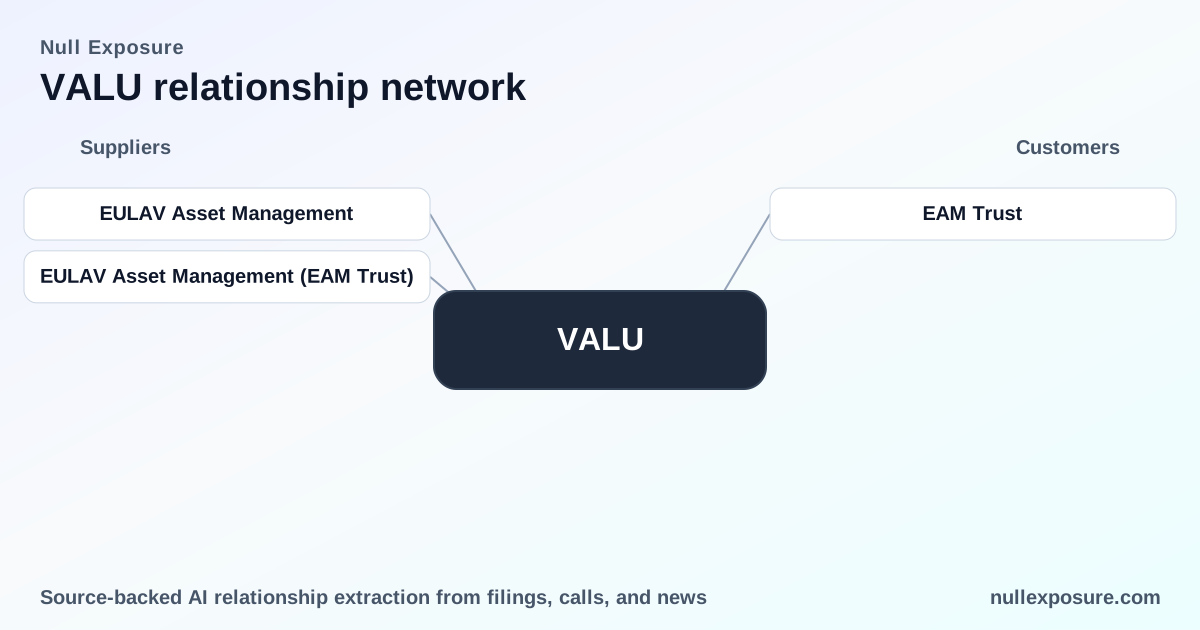
EULAV Asset Management (EAM Trust) — According to multiple press releases, EAM Trust is the Delaware statutory trust that acts as investment advisor to the Value Line Funds and handles related distribution, marketing and administrative services, creating an important fee and governance linkage between Value Line and its funds (noted in a GlobeNewswire distribution reported by The Manila Times, FY2025).
Source: GlobeNewswire release reported in The Manila Times (2025-10-18). -
EULAV Asset Management (EAM Trust) — A FinancialContent markets release in FY2026 reiterates that EAM Trust provides investment advisory and distribution functions for the Value Line Funds, confirming continuity of that advisory distribution relationship into the reported fiscal period.
Source: FinancialContent/markets release (2026-01-16). -
EULAV Asset Management — Quiver Quant and related reporting highlight Value Line’s dependence on non-voting revenue streams and profit interests tied to EULAV Asset Management, and on key management and sales personnel associated with that trust, which amplifies the economic and personnel linkage between Value Line and EAM (FY2025).
Source: QuiverQuant news piece (FY2025).
What the constraints and contracts reveal about the operating model
The public constraint excerpts provide a readable map of Value Line’s contracting posture and operational maturity:
-
Long-term real estate commitment: Value Line holds a lease for 24,726 sq ft at 551 Fifth Avenue that began December 1, 2016 and runs through November 29, 2027 — a multi-year, fixed-cost commitment that signals a stable corporate footprint in New York but also a near-term lease renewal exposure as 2027 approaches. (Lease language referenced explicitly in filings.)
-
Outsourced distribution and warehouse functions: Value Line ceased in-house print distribution through Value Line Distribution Center, Inc. (VLDC) on April 30, 2024, and outsourced those functions to third parties in the United States thereafter; distribution is therefore managed through external operators rather than internal logistics. This reduces capital intensity but increases dependence on third-party execution for subscriber fulfillment.
-
Third-party IT and service providers: The company relies on several external service providers to run its information systems, creating operational dependency for day-to-day publishing, subscription processing and digital delivery.
-
Geographic concentration: All outsourcing and fulfillment activity is reported as occurring in the United States, which simplifies regulatory exposure but concentrates regional risk.
-
Relationship stage and criticality: Contracts and disclosures classify these supplier relationships as active and operationally important; distribution and advisory relationships are functionally critical to revenue flow and customer delivery.
Collectively these constraints describe a company that is low on fixed operational staff but highly dependent on the stability and performance of external vendors and an affiliated trust (EAM Trust) for both distribution and fund advisory revenues.
Investment implications: what investors and operators should prioritize
The supplier picture drives a narrow set of investment and operational conclusions:
-
Concentration risk is material. Insiders hold a dominant equity stake (~91.8%), institutions hold ~5.7%, and the firm’s economics are linked to EAM Trust — that creates governance concentration and limited institutional oversight, which investors should factor into any valuation premium or discount.
-
Operational risk is outsourced but not eliminated. Outsourcing distribution and IT reduces fixed costs but transfers execution risk to vendors; due diligence on vendor performance, SLAs and contingency plans is essential for credit-sensitive investors or potential acquirers.
-
Lease maturity is a near-term event. The 2027 lease expiration at 551 Fifth Avenue is a discrete strategic inflection point — negotiate, downsize or renew — with implications for cash flow and cost structure.
-
EAM Trust is an economic lever. The relationship with EAM Trust carries revenue and personnel concentration; any changes in that trust’s management, advisory contract or distribution rights would have immediate earnings implications.
Actionable checklist for research teams:
- Confirm the status and economics of the EAM advisory agreement and any fee-sharing or profit-interest arrangements.
- Obtain vendor performance metrics for the third-party distributors and IT providers since April 2024.
- Model lease renewal scenarios for 2027 and test sensitivity to occupancy cost changes.
For detailed supplier signal analysis, check practical tools and deep-dive reports at https://nullexposure.com/ — relevant for underwriting and operational due diligence.
Risks to watch and how they affect valuation
- Operational continuity risk: Outsourced distribution and IT concentrate operational risk outside the corporate firewall; service disruption or vendor contract failure would hit revenues quickly.
- Governance and concentration risk: Extremely high insider ownership reduces the likelihood of activist pressure or governance-driven corrective actions, which affects liquidity and takeover propositions.
- Contract timing risk: The landlord and lease renewal dynamic in 2027 is a valuation hinge for occupational cost and optionality.
Each of these is a direct input into discounted cash flow and scenario models: model a vendor outage scenario, a 10–30% increase in occupancy cost after 2027 for sensitivity tests, and an advisory-fee shock from EAM Trust to stress test margins.
Bottom line and next steps for investors and operators
Value Line runs an asset-light publishing business with concentrated governance and outsized reliance on an affiliated asset-management trust and outsourced vendors. Those dynamics create predictable subscription cash flows but bring vendor and governance risk that should be explicitly modeled. For operational diligence and supplier-risk playbooks, visit https://nullexposure.com/ to access prioritized signals and supplier profiles. If you are underwriting Value Line exposure or negotiating vendor terms, focus first on the EAM advisory economics, vendor SLAs for distribution/IT, and the 2027 lease decision as the three highest-impact levers. For ongoing monitoring and supplier intelligence subscribe or learn more at https://nullexposure.com/.